
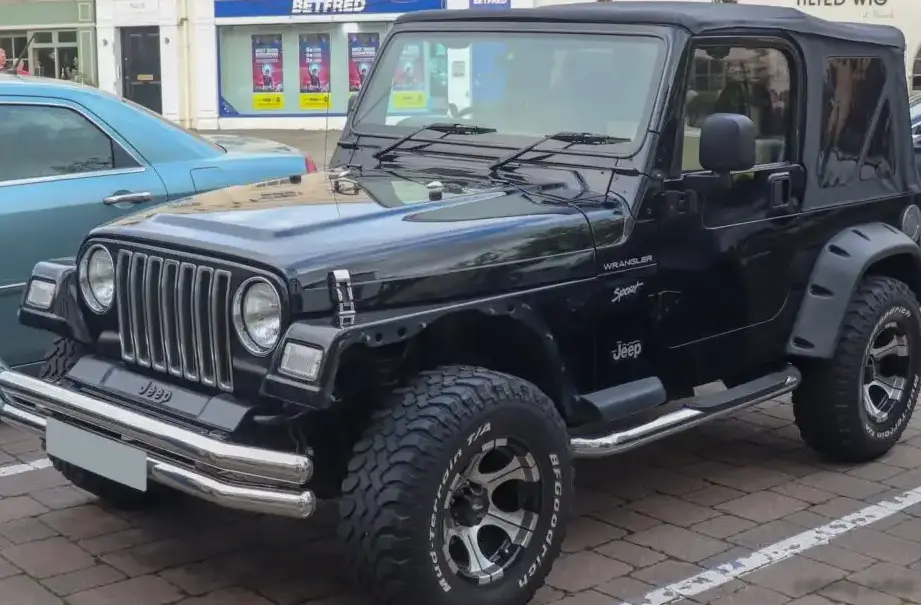
Technical Specifications
| Brand | Jeep |
| Model | Wrangler |
| Generation | Wrangler II (TJ) |
| Type (Engine) | Rubicon 4.0i (193 Hp) |
| Start of production | 2003 |
| End of production | 2006 |
| Powertrain Architecture | Internal Combustion engine |
| Body type | Off-road vehicle |
| Seats | 5 |
| Doors | 2 |
| Fuel consumption (urban) | 16.8 l/100 km (14 US mpg, 16.8 UK mpg) |
| Fuel consumption (extra urban) | 13.1 l/100 km (18 US mpg, 21.6 UK mpg) |
| Fuel Type | Petrol (Gasoline) |
| Acceleration 0 – 100 km/h | 9.4 sec |
| Acceleration 0 – 62 mph | 9.4 sec |
| Acceleration 0 – 60 mph | 8.9 sec |
| Maximum speed | 174 km/h (108.12 mph) |
| Weight-to-power ratio | 8.9 kg/Hp |
| Weight-to-torque ratio | 5.4 kg/Nm |
| Power | 193 Hp @ 4600 rpm |
| Torque | 319 Nm @ 3200 rpm (235.28 lb.-ft. @ 3200 rpm) |
| Engine layout | Front, Longitudinal |
| Engine Model/Code | ERH |
| Engine displacement | 3956 cm3 (241.41 cu. in.) |
| Number of cylinders | 6 |
| Engine configuration | Inline |
| Cylinder Bore | 98.4 mm (3.87 in.) |
| Piston Stroke | 86.7 mm (3.41 in.) |
| Compression ratio | 8.8:1 |
| Number of valves per cylinder | 2 |
| Fuel injection system | Multi-port manifold injection |
| Engine aspiration | Naturally aspirated engine |
| Engine oil capacity | 5.7 l (6.02 US qt | 5.02 UK qt) |
| Coolant capacity | 9.9 l (10.46 US qt | 8.71 UK qt) |
| Kerb Weight | 1725 kg (3802.97 lbs.) |
| Max. weight | 2064 kg (4550.34 lbs.) |
| Max load | 339 kg (747.37 lbs.) |
| Trunk (boot) space – minimum | 252 l (8.9 cu. ft.) |
| Trunk (boot) space – maximum | 1303 l (46.02 cu. ft.) |
| Fuel tank capacity | 72 l (19.02 US gal | 15.84 UK gal) |
| Length | 3947 mm (155.39 in.) |
| Width | 1693 mm (66.65 in.) |
| Height | 1764 mm (69.45 in.) |
| Wheelbase | 2373 mm (93.43 in.) |
| Front track | 1474 mm (58.03 in.) |
| Rear track | 1473 mm (57.99 in.) |
| Drive wheel | All wheel drive (4×4) |
| Number of gears | 5 |
| Gearbox type | Manual transmission |
| Front suspension | Coil spring |
| Rear suspension | Coil spring |
| Front brakes | Ventilated discs |
| Rear brakes | Drum |
| Power steering | Hydraulic Steering |
| Tires size | LT 245/75 R16 |
The Jeep Wrangler TJ Rubicon 4.0i, introduced in 2003, represented a significant evolution in the Wrangler lineage, cementing its reputation as an exceptionally capable off-road vehicle. Part of the second-generation (TJ) Wrangler platform, produced from 1997 to 2006, the Rubicon trim was specifically engineered for serious trail use, building upon the already robust Wrangler foundation. The “4.0i” designation refers to the 4.0-liter inline-six engine. This variant occupied the premium position within the TJ range, offering enhanced off-road hardware and features compared to the base Sport and Sahara models. It was positioned as the ultimate factory-built off-road Wrangler, appealing to enthusiasts seeking uncompromising capability.
Powertrain & Engine Architecture
The Rubicon 4.0i’s powertrain centers around the 4.0-liter (3956 cc) inline-six cylinder engine, internally known as the ERH code. This engine, a direct descendant of the AMC 199 engine, is renowned for its durability and relatively straightforward design. It features a cast iron block and cylinder head, and employs a single overhead camshaft (SOHC) operating two valves per cylinder. Fuel delivery is managed by a multi-port fuel injection system, ensuring precise fuel metering for optimal performance and emissions control. The engine generates 193 horsepower at 4600 rpm and 235 lb-ft of torque at 3200 rpm. The torque curve is notably flat, delivering strong low-end grunt crucial for navigating challenging off-road obstacles. While a robust 5-speed manual transmission was standard, a 4-speed automatic transmission was also offered. The automatic, while providing convenience, resulted in a slight decrease in fuel economy and responsiveness compared to the manual counterpart.
Driving Characteristics
The Rubicon 4.0i, even when equipped with the automatic transmission, delivered a surprisingly competent driving experience both on and off the pavement. The 4.0-liter engine, while not boasting exceptional power, provided sufficient power for highway cruising and tackling moderate trails. The automatic transmission, though lacking the engagement of the manual, offered smooth shifts and simplified navigation of technical terrain for some drivers. The Rubicon’s true strength lay in its advanced 4×4 system. Front and rear locking differentials, activated by dedicated switches, maximized traction in demanding conditions. The disconnecting front sway bar increased axle articulation, allowing the Rubicon to maintain ground contact even on extremely uneven surfaces. Compared to the standard Wrangler, the Rubicon felt more stable and confident, particularly when traversing rocky or muddy landscapes. The manual transmission version offered a more direct connection to the engine and superior control in technical situations.
Equipment & Trim Levels
The Rubicon trim came standard with a comprehensive suite of features designed to enhance its off-road prowess and driver comfort. These included heavy-duty Dana 44 axles, a self-locking rear differential, a disconnecting front sway bar, robust rock rails, and unique Rubicon-specific wheels and tires. Interior appointments included cloth upholstery, air conditioning, and a basic sound system. Optional extras encompassed a premium sound system, leather upholstery, and a limited-slip front differential. The interior, while functional, was relatively spartan compared to some contemporary SUVs, reflecting the Rubicon’s primary focus on off-road performance. The dashboard layout was straightforward and user-friendly, with clearly marked controls for the 4×4 system and other essential functions.
Chassis & Braking
The Wrangler TJ Rubicon utilized a traditional body-on-frame construction, providing a robust and durable platform ideally suited for off-road excursions. The suspension system consisted of coil springs at all four corners, offering a comfortable ride and ample articulation. The Rubicon featured heavier-duty shocks and springs compared to other Wrangler models. The braking system incorporated ventilated discs at the front and drum brakes at the rear. While adequate for most driving scenarios, the rear drum brakes were a common point of critique, as they offered less stopping power and were more susceptible to fading under strenuous use. The Rubicon’s tires, typically LT245/75R16, were specifically selected for their off-road traction and durability.
Market Reception & Comparison
The Jeep Wrangler TJ Rubicon 4.0i garnered widespread acclaim from automotive critics for its exceptional off-road capabilities. It consistently ranked among the most capable off-road vehicles available and quickly cultivated a devoted following among enthusiasts. Compared to the base Wrangler Sport and Sahara models, the Rubicon offered a substantial improvement in off-road performance, thanks to its locking differentials, disconnecting sway bar, and reinforced axles. The automatic transmission variant received some criticism for its slightly reduced fuel economy and less engaging driving experience compared to the manual. However, it remained a popular choice for drivers who prioritized the convenience of an automatic transmission.
Legacy
The Jeep Wrangler TJ Rubicon 4.0i has become a highly desirable vehicle in the used car market. Its reputation for durability and off-road capability has maintained strong resale values. The 4.0-liter inline-six engine is known for its longevity, and with diligent maintenance, can reliably surpass 200,000 miles. While certain components, such as the rear drum brakes, may require periodic maintenance or replacement, the Rubicon remains a relatively straightforward vehicle to maintain and repair. The Rubicon established a new benchmark for factory-built off-road vehicles, and its legacy continues to influence the design and engineering of modern Wranglers. It remains a popular choice for off-road enthusiasts and stands as a testament to Jeep’s commitment to producing capable and durable vehicles.
