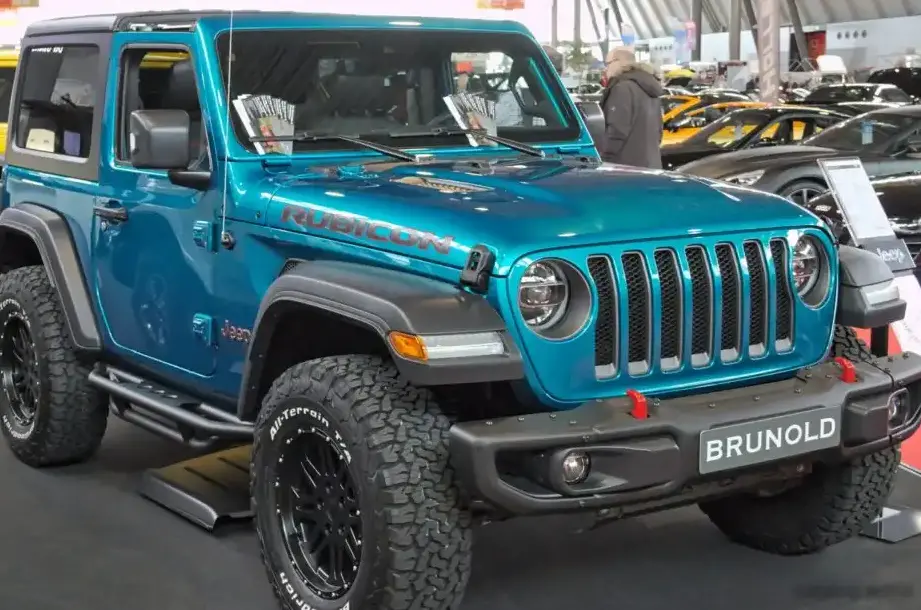
The Jeep Wrangler JL Sahara 2.2 CRDi, produced from August 2018 to December 2020, represents a significant iteration of the iconic Wrangler lineage. Falling within the fourth generation (JL) of the Wrangler, this variant was primarily aimed at the European market, offering a diesel-powered option with a focus on balancing on-road refinement with the Wrangler’s renowned off-road capability. Positioned as a mid-range trim, the Sahara 2.2 CRDi offered a step up in comfort and features compared to the base models, while remaining more accessible than the Rubicon, which prioritized extreme off-road performance. This model combined a 2.2-liter turbocharged diesel engine with an eight-speed automatic transmission, a configuration designed to provide adequate power and torque for both daily driving and challenging terrain.
Technical Specifications
| Brand | Jeep |
| Model | Wrangler |
| Generation | Wrangler IV (JL) |
| Type | Sahara 2.2 CRDi (200 Hp) 4×4 Automatic |
| Start of production | August, 2018 |
| End of production | December, 2020 |
| Powertrain Architecture | Internal Combustion engine |
| Body type | Off-road vehicle |
| Seats | 4 |
| Doors | 2 |
| Fuel consumption (urban) | 10.3 l/100 km (22.8 US mpg, 27.4 UK mpg, 9.7 km/l) |
| Fuel consumption (extra urban) | 6.5 l/100 km (36.2 US mpg, 43.5 UK mpg, 15.4 km/l) |
| Fuel consumption (combined) | 7.9 l/100 km (29.8 US mpg, 35.8 UK mpg, 12.7 km/l) |
| CO2 emissions | 209 g/km |
| Fuel Type | Diesel |
| Acceleration 0 – 100 km/h | 8.9 sec |
| Acceleration 0 – 62 mph | 8.9 sec |
| Acceleration 0 – 60 mph | 8.5 sec |
| Maximum speed | 180 km/h (111.85 mph) |
| Emission standard | Euro 6d-TEMP |
| Weight-to-power ratio | 9.6 kg/Hp, 104.2 Hp/tonne |
| Weight-to-torque ratio | 4.3 kg/Nm, 234.4 Nm/tonne |
| Power | 200 Hp @ 3500 rpm |
| Power per litre | 93.3 Hp/l |
| Torque | 450 Nm @ 2000 rpm (331.9 lb.-ft. @ 2000 rpm) |
| Engine layout | Front, Longitudinal |
| Engine Model/Code | EBH |
| Engine displacement | 2143 cm3 (130.77 cu. in.) |
| Number of cylinders | 4 |
| Engine configuration | Inline |
| Cylinder Bore | 83 mm (3.27 in.) |
| Piston Stroke | 99 mm (3.9 in.) |
| Compression ratio | 15.5:1 |
| Number of valves per cylinder | 4 |
| Fuel injection system | Diesel Commonrail |
| Engine aspiration | Turbocharger, Intercooler |
| Valvetrain | DOHC |
| Engine oil capacity | 4.73 l (5 US qt | 4.16 UK qt) |
| Coolant capacity | 9.54 l (10.08 US qt | 8.39 UK qt) |
| Kerb Weight | 1920 kg (4232.88 lbs.) |
| Max. weight | 2404 kg (5299.91 lbs.) |
| Max load | 484 kg (1067.04 lbs.) |
| Trunk (boot) space – minimum | 203 l (7.17 cu. ft.) |
| Trunk (boot) space – maximum | 508 l (17.94 cu. ft.) |
| Fuel tank capacity | 66 l (17.44 US gal | 14.52 UK gal) |
| AdBlue tank | 19 l (5.02 US gal | 4.18 UK gal) |
| Permitted trailer load with brakes (12%) | 1497 kg (3300.32 lbs.) |
| Permitted trailer load without brakes | 750 kg (1653.47 lbs.) |
| Length | 4334 mm (170.63 in.) |
| Width | 1894 mm (74.57 in.) |
| Height | 1839 mm (72.4 in.) |
| Wheelbase | 2459 mm (96.81 in.) |
| Ride height (ground clearance) | 260 mm (10.24 in.) |
| Minimum turning circle | 10.4 m (34.12 ft.) |
| Approach angle | 37.4° |
| Departure angle | 30.5° |
| Ramp-over angle | 26.2° |
| Wading depth | 760 mm (29.92 in.) |
| Drivetrain Architecture | All wheel drive (4×4). ICE drives rear wheels, front wheels engaged via clutch. |
| Number of gears | 8 |
| Gearbox type | Automatic transmission |
| Front suspension | Coil spring, Rigid axle, Transverse stabilizer |
| Rear suspension | Rigid axle, Transverse stabilizer, Coil spring |
| Front brakes | Ventilated discs |
| Rear brakes | Disc |
INTRODUCTION
The Jeep Wrangler JL Sahara 2.2 CRDi, launched in 2018, marked a significant step forward for the Wrangler in terms of refinement and efficiency, particularly for the European market. Built on the 1HX0 platform (shared with the Gladiator), the JL generation introduced independent front suspension, a departure from the solid front axle of previous generations, improving on-road handling and ride comfort. The Sahara trim level, positioned above the base Sport model, added features like larger alloy wheels, upgraded interior materials, and additional convenience items. The 2.2-liter diesel engine, a first for the Wrangler in many markets, was intended to appeal to buyers seeking better fuel economy and torque for towing and off-road adventures. This variant aimed to broaden the Wrangler’s appeal beyond its core enthusiast base.
Powertrain & Engine Architecture
The heart of the Sahara 2.2 CRDi is the EBH engine, a 2.2-liter inline-four cylinder turbocharged diesel. This engine is part of the GME (Global Medium Engines) family developed by Fiat Chrysler Automobiles (FCA), now Stellantis. It utilizes a common-rail direct injection system, delivering fuel at extremely high pressure for optimized combustion. The engine features a single turbocharger with an intercooler to increase air density and boost power output. The valvetrain employs a double overhead camshaft (DOHC) design with four valves per cylinder, enhancing breathing and efficiency. The engine produces 200 horsepower at 3500 rpm and a substantial 450 Nm (331.9 lb-ft) of torque at 2000 rpm. This torque output is particularly beneficial for off-road driving and towing. Paired with the engine is an eight-speed automatic transmission (8HP75), known for its smooth shifting and wide gear ratio spread. This transmission contributes to both fuel efficiency and responsive acceleration.
Driving Characteristics
The 2.2 CRDi automatic combination delivers a surprisingly refined driving experience for a Wrangler. While not as overtly powerful as the gasoline-powered V6 options available in North America, the diesel provides ample torque for everyday driving and tackling moderate off-road obstacles. The eight-speed automatic transmission is well-tuned, offering smooth and timely gear changes. The gear ratios are optimized for both fuel economy and pulling power. Compared to a manual transmission, the automatic offers greater convenience, especially in urban environments and during technical off-road sections. However, some enthusiasts may prefer the greater control offered by a manual gearbox. The diesel engine’s torque curve is relatively flat, providing strong acceleration across a wide range of engine speeds. While the 0-60 mph time of around 8.5 seconds isn’t particularly quick, it’s adequate for most driving situations. The independent front suspension of the JL generation significantly improves on-road handling compared to previous Wranglers, reducing body roll and providing a more comfortable ride.
Equipment & Trim Levels
The Sahara trim level included a number of standard features designed to enhance comfort and convenience. These typically included air conditioning, power windows and locks, a touchscreen infotainment system with Apple CarPlay and Android Auto compatibility, and a rearview camera. Interior upholstery consisted of cloth seats, although leather options were available. The dashboard featured a combination of analog gauges and a digital display. Optional extras for the Sahara 2.2 CRDi could include a premium sound system, navigation system, heated seats, and a hardtop roof. The Sahara also featured alloy wheels, fog lights, and side steps as standard equipment.
Chassis & Braking
The Wrangler JL utilizes a body-on-frame construction, providing robust durability and off-road capability. The front suspension features independent coil springs and a stabilizer bar, while the rear suspension employs a solid axle with coil springs and a stabilizer bar. This combination provides a good balance between on-road comfort and off-road articulation. The braking system consists of ventilated discs at the front and solid discs at the rear. Anti-lock braking system (ABS) is standard. The steering system is an electric power-assisted recirculating ball system, providing precise and responsive steering feel.
Market Reception & Comparison
The Jeep Wrangler JL Sahara 2.2 CRDi was generally well-received by automotive critics in Europe. The diesel engine was praised for its fuel efficiency and torque, making it a practical choice for long-distance driving and towing. The eight-speed automatic transmission was also commended for its smooth operation. Compared to the gasoline-powered Wrangler models, the 2.2 CRDi offered better fuel economy, but slightly less overall power. Compared to other trims in the Wrangler lineup, the Sahara 2.2 CRDi offered a good balance between comfort, features, and capability. The Rubicon, with its more aggressive off-road features, was aimed at hardcore enthusiasts, while the Sport model was a more basic and affordable option.
Legacy
The 2.2 CRDi engine has proven to be a relatively reliable powertrain in the Wrangler JL. While diesel engines generally require more maintenance than gasoline engines, the GME engine family has a good reputation for durability. In the used car market, the Sahara 2.2 CRDi holds its value reasonably well, particularly examples that have been well-maintained and have a full service history. The combination of fuel efficiency, torque, and off-road capability makes it a desirable option for buyers seeking a versatile and capable SUV. The JL generation Wrangler, as a whole, has been a commercial success for Jeep, and the 2.2 CRDi variant has played a significant role in expanding the Wrangler’s appeal to a wider audience.