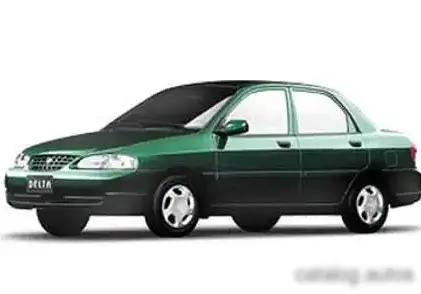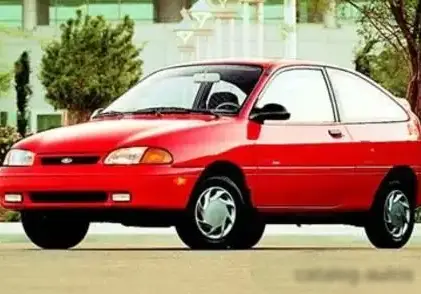
The Kia Avella 1.3 i 16V, producing 76 horsepower, was a subcompact hatchback manufactured by Kia Motors from 1994 to 2000. Positioned as an entry-level offering within the Avella range, it represented Kia’s initial foray into the European and Asian markets with a modern, affordable vehicle. The Avella, internally designated as the B-segment car, aimed to provide practical transportation for small families and urban commuters. This particular 1.3L variant was a key component of that strategy, offering a balance between fuel efficiency and acceptable performance for its intended role. It was sold alongside other engine options, including a 1.5L variant, but the 1.3L was often the most accessible price point.
Technical Specifications
| Brand | Kia |
| Model | Avella |
| Generation | Avella |
| Type (Engine) | 1.3 i 16V (76 Hp) |
| Start of production | March, 1994 |
| End of production | 2000 |
| Powertrain Architecture | Internal Combustion engine |
| Body type | Hatchback |
| Seats | 5 |
| Doors | 5 |
| Fuel Type | Petrol (Gasoline) |
| Maximum speed | 160 km/h (99.42 mph) |
| Weight-to-power ratio | 10.5 kg/Hp, 95.6 Hp/tonne |
| Weight-to-torque ratio | 8 kg/Nm, 125.8 Nm/tonne |
| Power | 76 Hp @ 6500 rpm |
| Power per litre | 57.4 Hp/l |
| Torque | 100 Nm @ 6500 rpm (73.76 lb.-ft. @ 6500 rpm) |
| Engine layout | Front, Transverse |
| Engine displacement | 1324 cm3 (80.8 cu. in.) |
| Number of cylinders | 4 |
| Engine configuration | Inline |
| Cylinder Bore | 71 mm (2.8 in.) |
| Piston Stroke | 83.6 mm (3.29 in.) |
| Compression ratio | 9.7:1 |
| Number of valves per cylinder | 4 |
| Fuel injection system | Multi-port manifold injection |
| Engine aspiration | Naturally aspirated engine |
| Kerb Weight | 795 kg (1752.67 lbs.) |
| Max. weight | 1270 kg (2799.87 lbs.) |
| Max load | 475 kg (1047.2 lbs.) |
| Trunk (boot) space – minimum | 205 l (7.24 cu. ft.) |
| Trunk (boot) space – maximum | 510 l (18.01 cu. ft.) |
| Fuel tank capacity | 38 l (10.04 US gal | 8.36 UK gal) |
| Length | 3565 mm (140.35 in.) |
| Width | 1605 mm (63.19 in.) |
| Height | 1460 mm (57.48 in.) |
| Wheelbase | 2295 mm (90.35 in.) |
| Front track | 1401 mm (55.16 in.) |
| Rear (Back) track | 1385 mm (54.53 in.) |
| Drivetrain Architecture | The Internal combustion engine (ICE) drives the front wheels of the vehicle. |
| Drive wheel | Front wheel drive |
| Number of gears and type of gearbox | 5 gears, manual transmission |
| Front suspension | Transverse stabilizer |
| Rear suspension | Torsion |
| Front brakes | Disc |
| Rear brakes | Drum |
| Assisting systems | ABS (Anti-lock braking system) |
| Steering type | Steering rack and pinion |
| Tires size | 145 R13 |
Powertrain & Engine Architecture
The heart of the Avella 1.3 i 16V is a 1324cc inline-four cylinder engine. This engine, often identified by its internal codes, utilized a multi-port fuel injection system to deliver fuel to the cylinders. The 16-valve cylinder head, featuring four valves per cylinder, was designed to improve breathing and enhance high-rpm performance, although the overall output remained modest. The engine’s compression ratio of 9.7:1 was a typical value for the era, balancing efficiency and power. The engine was transversely mounted, driving the front wheels. The five-speed manual transmission was the standard offering, providing a reasonable spread of gears for both city driving and highway cruising. The transmission was chosen for its cost-effectiveness and simplicity, rather than outright performance.
Driving Characteristics
The Avella 1.3 i 16V offered a predictable, if uninspiring, driving experience. With 76 horsepower and 100 Nm of torque, acceleration was adequate for everyday driving, but overtaking maneuvers required careful planning. The five-speed manual transmission allowed drivers to keep the engine in its optimal power band, but the engine lacked the low-end grunt of larger displacement alternatives. Compared to the 1.5L Avella, the 1.3L felt noticeably slower, particularly when fully loaded. The gear ratios were tuned for fuel economy, resulting in a relatively tall final drive. Handling was safe and predictable, but the torsion beam rear suspension and relatively narrow tires limited cornering grip. The steering, utilizing a rack and pinion system, provided reasonable feedback.
Equipment & Trim Levels
The Avella 1.3 i 16V was typically offered with a basic level of equipment, reflecting its position as an entry-level model. Standard features generally included power steering, central locking, and a basic audio system. Interior upholstery was typically cloth, with a simple dashboard layout. Optional extras, depending on the market, could include air conditioning, electric windows, and upgraded audio systems. The trim levels were often differentiated by minor cosmetic changes, such as different wheel covers or interior fabric patterns. The focus was on providing a functional and affordable vehicle, rather than luxury or extensive features.
Chassis & Braking
The Avella’s chassis was a conventional monocoque construction, designed to provide a balance between rigidity and weight. The front suspension utilized MacPherson struts with a transverse stabilizer bar, while the rear suspension employed a torsion beam setup. This configuration was common for vehicles in this class, offering a compromise between cost, space efficiency, and ride comfort. The braking system featured disc brakes on the front wheels and drum brakes on the rear. An Anti-lock Braking System (ABS) was often offered as an optional extra, enhancing safety in emergency braking situations. The tires were typically 145 R13 size, prioritizing fuel economy over grip.
Market Reception & Comparison
The Kia Avella 1.3 i 16V was generally well-received as an affordable and practical subcompact. Critics praised its value for money and its relatively spacious interior for its size. However, the engine’s modest power output and the car’s somewhat basic interior were often cited as drawbacks. Compared to competitors like the Ford Fiesta or the Opel Corsa, the Avella offered a similar level of practicality but often at a lower price point. The 1.5L Avella offered a noticeable performance improvement, but at a higher cost. Fuel economy was a strong point for the 1.3L variant, making it an attractive option for budget-conscious buyers.
Legacy
The Kia Avella, and specifically the 1.3 i 16V variant, played a significant role in establishing Kia as a viable automotive manufacturer in Europe and Asia. While not known for exceptional performance or groundbreaking technology, the Avella offered a reliable and affordable transportation solution. The powertrain, while simple, proved to be reasonably durable, and many examples remain on the road today. In the used car market, the Avella 1.3 i 16V is often sought after as a cheap and cheerful runabout, appreciated for its simplicity and low running costs. Parts availability can be a challenge, but the engine’s robust design and relatively straightforward mechanics make it a popular choice for DIY mechanics.