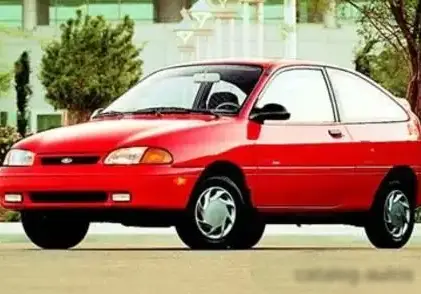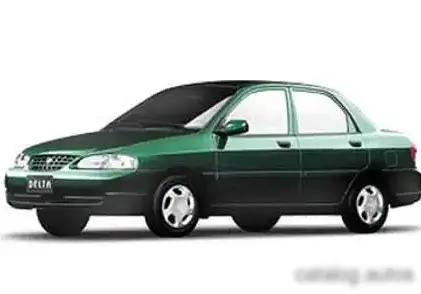
The Kia Avella Delta 1.5 i 16V, producing 105 horsepower, was a subcompact sedan manufactured by Kia Motors from March 1994 to 2000. It represented a significant step forward for Kia in terms of design and engineering, aiming to compete in the increasingly competitive global subcompact car market. The Delta designation signified a facelift and improvements over the original Avella, primarily focusing on styling and interior refinements. This particular variant, with its 1.5-liter engine and 16-valve head, occupied a mid-range position within the Avella Delta lineup, offering a balance between affordability and performance. It was primarily sold in Europe, Asia, and select emerging markets, serving as an entry point into the Kia brand for many consumers.
Technical Specifications
| Brand | Kia |
| Model | Avella |
| Generation | Avella Delta |
| Type (Engine) | 1.5 i 16V (105 Hp) |
| Start of production | March, 1994 |
| End of production | 2000 |
| Powertrain Architecture | Internal Combustion engine |
| Body type | Sedan |
| Seats | 5 |
| Doors | 4 |
| Fuel consumption (urban) | 8.5 l/100 km (27.7 US mpg, 33.2 UK mpg, 11.8 km/l) |
| Fuel consumption (extra urban) | 5.5 l/100 km (42.8 US mpg, 51.4 UK mpg, 18.2 km/l) |
| Fuel consumption (combined) | 7 l/100 km (33.6 US mpg, 40.4 UK mpg, 14.3 km/l) |
| Fuel Type | Petrol (Gasoline) |
| Acceleration 0 – 100 km/h | 12.3 sec |
| Acceleration 0 – 62 mph | 12.3 sec |
| Acceleration 0 – 60 mph | 11.7 sec |
| Maximum speed | 183 km/h (113.71 mph) |
| Weight-to-power ratio | 8.9 kg/Hp, 112.9 Hp/tonne |
| Weight-to-torque ratio | 6.3 kg/Nm, 158.1 Nm/tonne |
| Power | 105 Hp @ 5500 rpm |
| Power per litre | 70.1 Hp/l |
| Torque | 147 Nm @ 4000 rpm (108.42 lb.-ft. @ 4000 rpm) |
| Engine layout | Front, Transverse |
| Engine displacement | 1498 cm3 (91.41 cu. in.) |
| Number of cylinders | 4 |
| Engine configuration | Inline |
| Cylinder Bore | 78 mm (3.07 in.) |
| Piston Stroke | 78.4 mm (3.09 in.) |
| Compression ratio | 9.3:1 |
| Number of valves per cylinder | 4 |
| Fuel injection system | Multi-port manifold injection |
| Engine aspiration | Naturally aspirated engine |
| Valvetrain | DOHC |
| Kerb Weight | 930 kg (2050.3 lbs.) |
| Fuel tank capacity | 43 l (11.36 US gal | 9.46 UK gal) |
| Length | 4165 mm (163.98 in.) |
| Width | 1665 mm (65.55 in.) |
| Height | 1450 mm (57.09 in.) |
| Wheelbase | 2390 mm (94.09 in.) |
| Front track | 1420 mm (55.91 in.) |
| Rear track | 1400 mm (55.12 in.) |
| Drivetrain Architecture | The Internal combustion engine (ICE) drives the front wheels of the vehicle. |
| Drive wheel | Front wheel drive |
| Number of gears and type of gearbox | 5 gears, manual transmission |
| Front suspension | Transverse stabilizer |
| Rear suspension | Torsion |
| Front brakes | Disc |
| Rear brakes | Drum |
| Assisting systems | ABS (Anti-lock braking system) |
| Steering type | Steering rack and pinion |
| Tires size | 165/70 R13 |
Powertrain & Engine Architecture
The heart of the Avella Delta 1.5 i 16V was the G155 engine, a 1.5-liter inline-four cylinder gasoline engine. This engine utilized a multi-port fuel injection system, which improved fuel atomization and combustion efficiency compared to earlier carburetor-based systems. The 16-valve dual overhead camshaft (DOHC) configuration allowed for improved breathing and higher engine speeds, contributing to the engine’s 105 horsepower output at 5500 rpm and 147 Nm (108.42 lb-ft) of torque at 4000 rpm. The engine was transversely mounted in the front of the vehicle, driving the front wheels. The standard transmission for this variant was a five-speed manual gearbox, although a four-speed automatic transmission was also offered as an option. The automatic transmission, while providing convenience, did slightly diminish acceleration performance due to its less efficient power transfer.
Driving Characteristics
The Avella Delta 1.5 i 16V offered a reasonably comfortable and practical driving experience. With 105 horsepower, acceleration was adequate for everyday driving, with a 0-60 mph time of around 11.7 seconds. However, it wasn’t a particularly sporty vehicle. The five-speed manual transmission allowed drivers to keep the engine in its optimal power band, providing better responsiveness. The automatic transmission, while smooth, resulted in slower acceleration and a more relaxed driving style. The suspension, tuned for comfort, absorbed bumps reasonably well, but handling was not particularly sharp. Compared to the base 1.3-liter engine, the 1.5-liter offered a noticeable improvement in performance, especially when fully loaded or tackling inclines. It was a significant upgrade over the lower-powered options, but still lagged behind competitors offering larger displacement engines.
Equipment & Trim Levels
The Avella Delta 1.5 i 16V typically came equipped with features considered standard for its class in the mid-1990s. These included power steering, central locking, and an AM/FM radio. Higher trim levels offered options such as air conditioning, electric windows, and upgraded interior upholstery. Interior materials were generally durable but basic, reflecting the car’s affordable price point. The dashboard layout was functional and straightforward, prioritizing ease of use over aesthetic flair. The base models often featured cloth upholstery, while higher trims might offer partial leather or more premium fabric options. Alloy wheels were also available as an optional extra, enhancing the car’s visual appeal.
Chassis & Braking
The Avella Delta utilized a front-wheel-drive chassis with a transverse engine layout. The front suspension consisted of MacPherson struts with a transverse stabilizer bar, while the rear suspension employed a torsion beam axle. This setup provided a reasonable balance between ride comfort and handling. Braking duties were handled by disc brakes on the front wheels and drum brakes on the rear wheels. An Anti-lock Braking System (ABS) was available as an option, enhancing safety by preventing wheel lockup during hard braking. The relatively lightweight construction of the Avella Delta (around 930 kg or 2050 lbs) helped to offset the modest engine output, contributing to acceptable performance.
Market Reception & Comparison
The Kia Avella Delta 1.5 i 16V was generally well-received as an affordable and reliable subcompact car. Critics praised its value for money and practical interior space. However, it was often criticized for its somewhat bland styling and lack of refinement compared to more established European and Japanese competitors. Fuel economy was a strong point, with combined fuel consumption figures around 7 liters per 100 kilometers (33.6 US mpg). Compared to the lower-powered 1.3-liter Avella, the 1.5-liter offered a noticeable performance boost, making it a more appealing option for drivers who frequently traveled on highways or carried passengers. The automatic transmission variant, while convenient, suffered from slightly lower fuel economy and slower acceleration compared to the manual version.
Legacy
The Kia Avella Delta, including the 1.5 i 16V variant, played a crucial role in establishing Kia as a viable automotive manufacturer in global markets. While not known for exceptional performance or groundbreaking technology, it offered a dependable and affordable transportation solution. The G155 engine proved to be relatively robust and reliable, and many examples are still on the road today. In the used car market, the Avella Delta 1.5 i 16V is often sought after for its simplicity, low running costs, and ease of maintenance. Parts availability can be a challenge in some regions, but the engine’s straightforward design makes it relatively easy to repair. It represents a significant milestone in Kia’s history, demonstrating the company’s commitment to producing quality vehicles at competitive prices.