
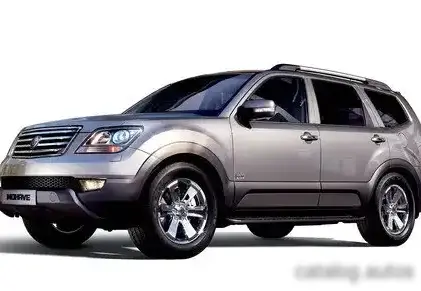
The Kia Borrego 3.8i V6, produced from 2008 to 2016, represented Kia’s entry into the mid-size SUV segment, primarily aimed at the North American market. Positioned as a larger, more capable alternative to the Kia Sorento, the Borrego sought to offer a blend of family-friendly practicality, respectable off-road ability, and a relatively affordable price point. It was sold as the Kia Mohave in some international markets, including South Korea. The 3.8i V6 variant, equipped with a six-speed automatic transmission, served as the mainstay of the Borrego lineup throughout its production run, offering a balance between performance and fuel economy within the range.
Technical Specifications
| Brand | Kia |
| Model | Borrego |
| Generation | Borrego |
| Type (Engine) | 3.8i V6 (274 Hp) |
| Start of production | 2008 year |
| End of production | 2016 year |
| Powertrain Architecture | Internal Combustion engine |
| Body type | SUV |
| Seats | 5 |
| Doors | 5 |
| Fuel Type | Petrol (Gasoline) |
| Emission standard | Euro 5 |
| Power | 274 Hp @ 6000 rpm |
| Power per litre | 72.5 Hp/l |
| Torque | 369 Nm @ 4500 rpm |
| Torque (lb-ft) | 272.16 lb.-ft. @ 4500 rpm |
| Engine layout | Front, Transverse |
| Engine Model/Code | Lambda II / G6DA |
| Engine displacement | 3778 cm3 |
| Engine displacement (cu. in.) | 230.55 cu. in. |
| Number of cylinders | 6 |
| Engine configuration | V-engine |
| Cylinder Bore | 96 mm |
| Cylinder Bore (in.) | 3.78 in. |
| Piston Stroke | 87 mm |
| Piston Stroke (in.) | 3.43 in. |
| Compression ratio | 10.4:1 |
| Number of valves per cylinder | 4 |
| Fuel injection system | Multi-port manifold injection |
| Engine aspiration | Naturally aspirated engine |
| Engine oil capacity | 5.2 l |
| Engine oil capacity (US qt) | 5.49 US qt |
| Engine oil capacity (UK qt) | 4.58 UK qt |
| Coolant | 10.7 l |
| Coolant (US qt) | 11.31 US qt |
| Coolant (UK qt) | 9.41 UK qt |
| Length | 4935 mm |
| Length (in.) | 194.29 in. |
| Width | 1915 mm |
| Width (in.) | 75.39 in. |
| Height | 1810 mm |
| Height (in.) | 71.26 in. |
| Wheelbase | 2895 mm |
| Wheelbase (in.) | 113.98 in. |
| Front track | 1630 mm |
| Front track (in.) | 64.17 in. |
| Rear track | 1640 mm |
| Rear track (in.) | 64.57 in. |
| Drive wheel | All wheel drive (4×4) |
| Number of gears | 6 |
| Gearbox type | automatic transmission |
| Front brakes | Disc |
| Rear brakes | Disc |
| Assisting systems | ABS (Anti-lock braking system) |
| Steering type | Steering rack and pinion |
| Power steering | Hydraulic Steering |
Powertrain & Engine Architecture
The heart of the Borrego 3.8i V6 is the Kia-developed Lambda II engine, specifically the G6DA variant. This 3.8-liter, naturally aspirated V6 engine utilizes a 60-degree V-angle configuration. It features a dual overhead camshaft (DOHC) design with four valves per cylinder, contributing to its respectable power output. The engine employs multi-port fuel injection, delivering fuel directly into the intake ports. The Lambda II engine was known for its relatively smooth operation and decent refinement for its class. The six-speed automatic transmission, sourced from Hyundai (Kia’s parent company), was the sole transmission option for the 3.8i. This transmission offered a relatively smooth shift quality, though it wasn’t particularly known for its sportiness or quick responsiveness. The transmission was designed to balance fuel efficiency with acceptable acceleration.
Driving Characteristics
The Borrego 3.8i V6, with its 274 horsepower and 272 lb-ft of torque, provided adequate, but not exhilarating, performance. Acceleration from 0 to 60 mph typically took around 7.5 to 8.5 seconds, depending on weight and drivetrain configuration. The automatic transmission’s gear ratios were tuned for everyday drivability rather than aggressive performance. Compared to the optional V8 engine offered in some Borrego trims, the 3.8i felt noticeably less powerful, particularly when fully loaded or towing. However, the V6 offered a significant improvement in fuel economy. The all-wheel-drive system, standard on many 3.8i models, provided enhanced traction in inclement weather and light off-road conditions, but it wasn’t designed for serious off-roading. The ride quality was generally comfortable, prioritizing a smooth experience over sporty handling.
Equipment & Trim Levels
The Borrego 3.8i V6 was typically offered in base and EX trim levels. The base model included standard features such as air conditioning, power windows and locks, a basic audio system, and alloy wheels. The EX trim added features like leather upholstery, heated front seats, a sunroof, upgraded audio system, and automatic climate control. Optional extras included a navigation system, rear-seat entertainment system, and a premium sound system. Interior materials were generally of good quality for the price point, though they didn’t match the luxury of more expensive SUVs. The dashboard layout was functional and straightforward, with easy-to-use controls.
Chassis & Braking
The Borrego utilized a body-on-frame construction, a traditional SUV design that contributed to its robust feel and towing capacity. The suspension consisted of independent front suspension with coil springs and a multi-link rear suspension. The rear suspension design varied depending on the drivetrain configuration; two-wheel-drive models often featured a simpler setup, while all-wheel-drive models received a more sophisticated multi-link system. Braking duties were handled by disc brakes on all four wheels, with ABS (Anti-lock Braking System) as standard equipment. The braking performance was adequate for everyday driving, but the Borrego’s weight limited its stopping power compared to lighter, car-based SUVs.
Market Reception & Comparison
The Kia Borrego 3.8i V6 received mixed reviews from automotive critics. It was praised for its spacious interior, comfortable ride, and competitive price. However, it was criticized for its somewhat uninspired styling, average fuel economy, and lack of a truly engaging driving experience. Compared to rivals like the Toyota 4Runner and Honda Pilot, the Borrego offered a lower price point but lacked the established reputation and refinement of those models. The 3.8i V6 variant was generally considered a good value for buyers who prioritized practicality and affordability over performance. Fuel economy was rated around 16 mpg city and 22 mpg highway, which was typical for a mid-size SUV of its era.
Legacy
The Kia Borrego was discontinued after the 2016 model year, replaced by the Kia Telluride. While not a massive sales success, the Borrego played an important role in Kia’s brand evolution, demonstrating the company’s ability to produce a competitive mid-size SUV. The Lambda II V6 engine proved to be a relatively reliable powertrain, with few widespread mechanical issues reported. Today, used Borrego 3.8i V6 models are available at very affordable prices, making them an attractive option for budget-conscious buyers seeking a spacious and capable SUV. However, potential buyers should be aware of the vehicle’s age and potential maintenance needs. Parts availability is generally good, but some components may be becoming increasingly difficult to find.
