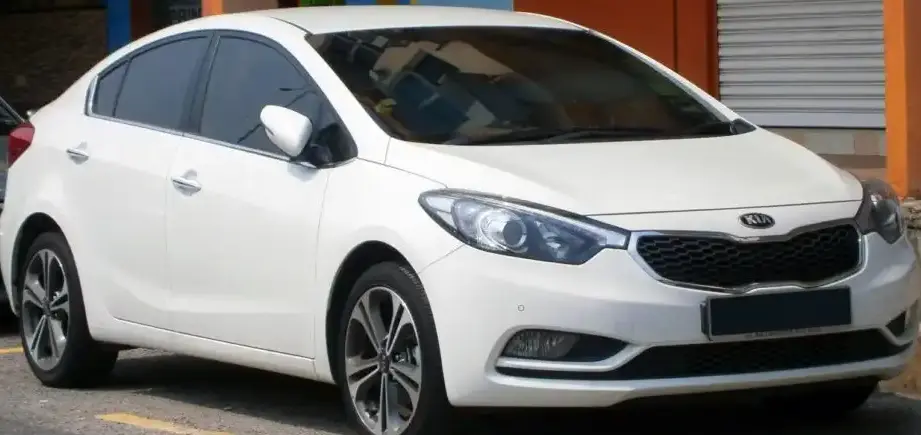
The Kia Cerato III Sedan 1.6 MPI (130 hp) represents a significant entry in Kia’s lineup during its production run from 2012 to 2016. Positioned as a mainstream compact sedan, it served as a key model for Kia as they continued to expand their presence in the North American and global markets. This variant, powered by the Gamma 1.6-liter engine and typically paired with a six-speed manual transmission, aimed to deliver a balance of fuel efficiency, affordability, and practicality for everyday drivers. It was part of the third generation of the Cerato (known as the K3 in some markets), built on the TD platform, and represented a step forward in design and refinement compared to its predecessors.
Technical Specifications
| Brand | Kia |
| Model | Cerato |
| Generation | Cerato III Sedan |
| Type (Engine) | 1.6 MPI (130 Hp) |
| Start of production | 2012 |
| End of production | 2016 |
| Powertrain Architecture | Internal Combustion engine |
| Body type | Sedan |
| Seats | 5 |
| Doors | 4 |
| CO2 emissions | 154 g/km |
| Fuel Type | Petrol (Gasoline) |
| Acceleration 0 – 100 km/h | 10.1 sec |
| Acceleration 0 – 62 mph | 10.1 sec |
| Acceleration 0 – 60 mph | 9.6 sec |
| Maximum speed | 200 km/h (124.27 mph) |
| Weight-to-power ratio | 8.9 kg/Hp, 112.1 Hp/tonne |
| Weight-to-torque ratio | 7.4 kg/Nm, 135.3 Nm/tonne |
| Power | 130 Hp @ 6300 rpm |
| Power per litre | 81.7 Hp/l |
| Torque | 157 Nm @ 4850 rpm (115.8 lb.-ft. @ 4850 rpm) |
| Engine layout | Front, Transverse |
| Engine Model/Code | Gamma/G4FG |
| Engine displacement | 1591 cm3 (97.09 cu. in.) |
| Number of cylinders | 4 |
| Engine configuration | Inline |
| Cylinder Bore | 77 mm (3.03 in.) |
| Piston Stroke | 85.44 mm (3.36 in.) |
| Compression ratio | 10.5:1 |
| Number of valves per cylinder | 4 |
| Fuel injection system | Multi-port manifold injection |
| Valvetrain | DOHC, Dual-CVVT |
| Engine oil capacity | 4 l (4.23 US qt | 3.52 UK qt) |
| Coolant | 5.9 l (6.23 US qt | 5.19 UK qt) |
| Kerb Weight | 1160-1260 kg (2557.36 – 2777.82 lbs.) |
| Max. weight | 1720 kg (3791.95 lbs.) |
| Max load | 460-560 kg (1014.13 – 1234.59 lbs.) |
| Trunk (boot) space – minimum | 482 l (17.02 cu. ft.) |
| Fuel tank capacity | 50 l (13.21 US gal | 11 UK gal) |
| Permitted trailer load with brakes (12%) | 1200 kg (2645.55 lbs.) |
| Permitted trailer load without brakes | 610 kg (1344.82 lbs.) |
| Length | 4560 mm (179.53 in.) |
| Width | 1780 mm (70.08 in.) |
| Height | 1445 mm (56.89 in.) |
| Wheelbase | 2700 mm (106.3 in.) |
| Front track | 1555 mm (61.22 in.) |
| Rear (Back) track | 1566 mm (61.65 in.) |
| Front overhang | 880 mm (34.65 in.) |
| Rear overhang | 980 mm (38.58 in.) |
| Ride height (ground clearance) | 150 mm (5.91 in.) |
| Drag coefficient (Cd) | 0.27 |
| Minimum turning circle (turning diameter) | 10.6 m (34.78 ft.) |
| Drivetrain Architecture | The Internal combustion engine (ICE) drives the front wheels of the vehicle. |
| Drive wheel | Front wheel drive |
| Number of gears and type of gearbox | 6 gears, manual transmission |
| Front suspension | Independent type McPherson |
| Rear suspension | Torsion |
| Front brakes | Ventilated discs, 280 mm |
| Rear brakes | Disc, 262 mm |
| Assisting systems | ABS (Anti-lock braking system) |
| Steering type | Steering rack and pinion |
| Power steering | Electric Steering |
| Tires size | 205/55 R16 |
| Wheel rims size | 16 |
INTRODUCTION
The Kia Cerato III Sedan 1.6 MPI (130 hp) was introduced as a core offering within the Cerato range, targeting buyers seeking an affordable and reliable compact sedan. Produced between 2012 and 2016, this model represented a significant evolution in Kia’s design language and build quality. It aimed to compete with established players like the Honda Civic, Toyota Corolla, and Hyundai Elantra. The 1.6-liter engine and six-speed manual transmission combination was positioned as the entry-level powertrain, offering a balance between fuel economy and acceptable performance for daily commuting and general use.
Powertrain & Engine Architecture
At the heart of the Cerato 1.6 MPI is the Kia Gamma engine, specifically the G4FG code. This 1.6-liter inline-four cylinder engine utilizes a multi-point fuel injection system, delivering fuel directly into the intake ports. The engine features a double overhead camshaft (DOHC) valvetrain with Kia’s Dual-CVVT (Continuously Variable Valve Timing) technology. This system optimizes valve timing for both intake and exhaust valves, improving engine efficiency and responsiveness across the rev range. The 130 horsepower output is achieved at 6300 rpm, while peak torque of 157 Nm (115.8 lb-ft) arrives at 4850 rpm. The six-speed manual transmission provides a relatively direct connection between the engine and the front wheels. Gear ratios are tuned for fuel efficiency and smooth operation, rather than outright performance.
Driving Characteristics
The driving experience in the Cerato 1.6 MPI is characterized by its practicality and ease of use. Acceleration from 0-60 mph takes approximately 9.6 seconds, which is adequate for everyday driving but doesn’t offer particularly brisk performance. The six-speed manual transmission allows for a degree of driver engagement, but the engine’s modest torque output means frequent downshifts are often necessary when overtaking or climbing hills. Compared to higher-trim Ceratos equipped with the more powerful 2.0-liter engine, the 1.6 MPI feels noticeably less responsive. However, the lighter engine weight contributes to slightly better handling and fuel economy. The suspension is tuned for comfort, providing a reasonably smooth ride over most road surfaces.
Equipment & Trim Levels
The 1.6 MPI variant typically served as the base trim level for the Cerato III Sedan. Standard equipment generally included air conditioning, power windows and locks, a basic audio system with USB connectivity, and standard safety features like ABS, airbags, and stability control. Interior upholstery was typically cloth, and the dashboard featured a straightforward design with easy-to-use controls. Optional extras available for this trim often included alloy wheels, a more advanced audio system, a rearview camera, and Bluetooth connectivity. Higher trim levels added features like leather upholstery, a sunroof, and automatic climate control.
Chassis & Braking
The Cerato III Sedan utilizes a front-wheel-drive layout with an independent McPherson strut suspension in the front and a torsion beam suspension in the rear. The front brakes are ventilated discs measuring 280mm, while the rear brakes are solid discs measuring 262mm. ABS (Anti-lock Braking System) is standard, providing enhanced braking performance and control. The steering system is a rack and pinion type with electric power steering, offering a light and responsive feel. The suspension setup is geared towards providing a comfortable ride, prioritizing smoothness over sporty handling. Stabilizer bars are present on both axles to reduce body roll during cornering.
Market Reception & Comparison
The Kia Cerato III Sedan 1.6 MPI was generally well-received by critics as a value-oriented compact sedan. Reviewers praised its affordability, spacious interior, and comprehensive warranty. However, the 1.6-liter engine was often criticized for its lack of power, particularly when compared to competitors offering larger displacement engines. Fuel economy was a strong point, with the 1.6 MPI achieving around 30-35 mpg in combined driving conditions. Compared to the 2.0-liter Cerato, the 1.6 MPI offered lower running costs but sacrificed performance. The 1.6 MPI appealed to budget-conscious buyers and those prioritizing fuel efficiency over outright speed.
Legacy
The Kia Cerato III Sedan 1.6 MPI has proven to be a relatively reliable vehicle in the used car market. The Gamma engine is generally known for its durability, and the six-speed manual transmission is also considered robust. Common maintenance items include routine oil changes, filter replacements, and occasional brake pad replacements. While not known for any major inherent flaws, it’s important to check for signs of wear and tear, particularly in the suspension components. Today, these Ceratos represent an affordable and practical option for buyers seeking a dependable compact sedan. Their relatively low purchase price and reasonable running costs make them an attractive choice for first-time car owners or those seeking a budget-friendly commuter vehicle.