
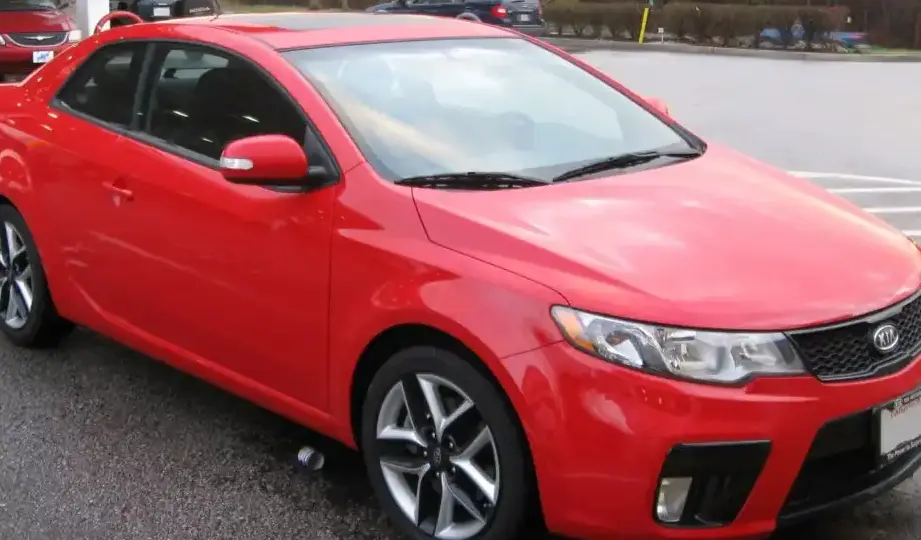
The Kia Forte Koup 2.0, produced from 2010 to 2013, represented Kia’s entry into the sporty coupe market. Positioned as a more stylish alternative to the standard Forte sedan, the Koup aimed to attract younger buyers with its two-door configuration and more aggressive styling. This particular variant, equipped with the 2.0-liter Theta II engine and a six-speed manual transmission, served as the performance-oriented trim level within the Koup lineup, offering a more engaging driving experience than the available automatic transmission option. It was part of the first generation of the Forte (BD) model, which utilized a platform shared with the Hyundai Elantra.
Technical Specifications
| Brand | Kia |
| Model | Forte |
| Generation | Forte I Koup |
| Type (Engine) | 2.0 (156 Hp) Manual 6-speed |
| Start of production | 2010 |
| End of production | 2013 |
| Powertrain Architecture | Internal Combustion engine |
| Body type | Coupe |
| Seats | 5 |
| Doors | 2 |
| Fuel consumption (economy) – urban (EPA) | 9.8 l/100 km (24 US mpg) |
| Fuel consumption (economy) – extra urban (EPA) | 7.1 l/100 km (33.1 US mpg) |
| Fuel Type | Petrol (Gasoline) |
| Emission standard | ULEV |
| Weight-to-power ratio | 8 kg/Hp, 125.7 Hp/tonne |
| Weight-to-torque ratio | 6.4 kg/Nm, 157.1 Nm/tonne |
| Power | 156 Hp @ 6200 rpm |
| Power per litre | 78.1 Hp/l |
| Torque | 195 Nm @ 4300 rpm (143.82 lb.-ft. @ 4300 rpm) |
| Engine layout | Front, Transverse |
| Engine Model/Code | Theta II / G4KD |
| Engine displacement | 1998 cm3 (121.93 cu. in.) |
| Number of cylinders | 4 |
| Engine configuration | Inline |
| Cylinder Bore | 86 mm (3.39 in.) |
| Piston Stroke | 86 mm (3.39 in.) |
| Compression ratio | 10.5:1 |
| Number of valves per cylinder | 4 |
| Fuel injection system | Multi-port manifold injection |
| Engine aspiration | Naturally aspirated engine |
| Valvetrain | DOHC, CVVT |
| Engine oil capacity | 3.9 l (4.12 US qt | 3.43 UK qt) |
| Coolant | 6 l (6.34 US qt | 5.28 UK qt) |
| Kerb Weight | 1241 kg (2735.94 lbs.) |
| Trunk (boot) space – minimum | 357 l (12.61 cu. ft.) |
| Fuel tank capacity | 52 l (13.74 US gal | 11.44 UK gal) |
| Length | 4480 mm (176.38 in.) |
| Width | 1765 mm (69.49 in.) |
| Height | 1400 mm (55.12 in.) |
| Wheelbase | 2650 mm (104.33 in.) |
| Front track | 1560 mm (61.42 in.) |
| Rear (Back) track | 1564 mm (61.57 in.) |
| Ride height (ground clearance) | 140 mm (5.51 in.) |
| Minimum turning circle (turning diameter) | 10.3 m (33.79 ft.) |
| Drivetrain Architecture | The Internal combustion engine (ICE) drives the front wheels of the vehicle. |
| Drive wheel | Front wheel drive |
| Number of gears and type of gearbox | 6 gears, manual transmission |
| Front suspension | Independent, type McPherson with coil spring and anti-roll bar |
| Rear suspension | Transverse stabilizer, Coil spring, Torsion |
| Front brakes | Ventilated discs, 280 mm |
| Rear brakes | Disc, 262 mm |
| Assisting systems | ABS (Anti-lock braking system) |
| Steering type | Steering rack and pinion |
| Power steering | Hydraulic Steering |
| Tires size | 205/55 R16 |
| Wheel rims size | 6J x 16 |
INTRODUCTION
The Kia Forte Koup 2.0, launched in 2010, was a significant step for Kia in terms of design and market positioning. It aimed to broaden Kia’s appeal beyond value-conscious buyers and attract those seeking a more stylish and sporty compact car. The Koup differentiated itself from the Forte sedan with its two-door body style, a lower roofline, and more aggressive front and rear fascias. The 2.0-liter engine paired with a six-speed manual transmission was the top-tier performance option, offering a noticeable upgrade over the base 1.6-liter engine and the available four-speed automatic transmission.
Powertrain & Engine Architecture
At the heart of the Forte Koup 2.0 lies the Theta II 2.0-liter inline-four cylinder engine, designated G4KD. This engine is a naturally aspirated powerplant featuring multi-port fuel injection and a double overhead camshaft (DOHC) valvetrain with continuously variable valve timing (CVVT) on both intake and exhaust camshafts. The CVVT system optimizes engine performance and fuel efficiency by adjusting valve timing based on engine speed and load. The engine produces 156 horsepower at 6200 rpm and 195 Nm (143.82 lb-ft) of torque at 4300 rpm. The six-speed manual transmission provides drivers with greater control over the engine’s power delivery. The transmission’s gear ratios are tuned to balance acceleration and fuel economy, with a relatively short final drive ratio to enhance off-the-line responsiveness.
Driving Characteristics
The 2.0-liter engine and six-speed manual combination in the Forte Koup delivered a noticeably more engaging driving experience compared to the base engine or the automatic transmission variants. While not a high-performance sports car, the Koup 2.0 offered respectable acceleration and a willing engine that enjoyed being revved. The manual transmission allowed drivers to fully utilize the engine’s powerband, and the gear ratios were well-matched for everyday driving. The steering, while hydraulically assisted, lacked some of the feedback found in more performance-focused vehicles. The suspension, tuned for comfort, provided a reasonably compliant ride, but body roll was noticeable during aggressive cornering. Compared to the automatic version, the manual Koup felt more responsive and connected to the driver.
Equipment & Trim Levels
The Forte Koup 2.0 typically came standard with features such as air conditioning, power windows and locks, a six-speaker audio system with a USB input, and keyless entry. Higher trim levels, and optional packages, added features like alloy wheels, a sunroof, upgraded interior upholstery, and a premium audio system. Interior materials were generally of good quality for the price point, but the overall design was functional rather than luxurious. The dashboard layout was straightforward and easy to use, with clearly labeled controls. Available options included a sport package that added a rear spoiler and upgraded suspension components.
Chassis & Braking
The Forte Koup utilized a front-wheel-drive chassis with an independent McPherson strut suspension in the front and a torsion beam rear suspension. The front suspension incorporated a coil spring and anti-roll bar to reduce body roll. Braking duties were handled by ventilated discs in the front and solid discs in the rear. The braking system was equipped with an Anti-lock Braking System (ABS) to enhance stability during hard braking. The Koup’s suspension tuning prioritized ride comfort over outright handling performance, but it provided adequate stability and control for everyday driving. The standard tire size was 205/55 R16, mounted on 6J x 16 inch alloy wheels.
Market Reception & Comparison
The Kia Forte Koup 2.0 was generally well-received by automotive critics as a stylish and affordable coupe. Reviewers praised its attractive design, spacious interior, and generous standard features. The 2.0-liter engine and six-speed manual transmission were lauded for providing a more engaging driving experience than the base engine and automatic transmission options. However, some critics noted that the Koup’s handling was not as sharp as some of its competitors, such as the Honda Civic Coupe or the Mazda3. In terms of fuel economy, the Koup 2.0 achieved an EPA rating of 24 mpg city and 33 mpg highway, which was competitive for its class. Compared to the 1.6-liter Forte Koup, the 2.0-liter version offered significantly more power and acceleration, but at the expense of slightly lower fuel economy.
Legacy
The Kia Forte Koup 2.0, while not a groundbreaking vehicle, played an important role in Kia’s brand transformation. It demonstrated Kia’s ability to design and build stylish, well-equipped, and affordable cars that appealed to a wider range of buyers. The Theta II engine proved to be a reliable powerplant, and the six-speed manual transmission was generally well-regarded. On the used car market today, the Forte Koup 2.0 remains an attractive option for buyers seeking an affordable and sporty coupe. Maintenance costs are generally reasonable, and parts availability is good. However, potential buyers should be aware of the potential for age-related issues, such as worn suspension components and aging rubber seals.
