Technical Specifications
| Brand | Kia |
| Model | Forte |
| Generation | Forte5 II (YD) |
| Type (Engine) | 1.6 T-GDI (201 Hp) |
| Start of production | 2013 |
| End of production | 2016 |
| Powertrain Architecture | Internal Combustion engine |
| Body type | Hatchback |
| Seats | 5 |
| Doors | 5 |
| Fuel consumption (economy) – urban (EPA) | 11.2 l/100 km (21 US mpg, 25.2 UK mpg, 8.9 km/l) |
| Fuel consumption (economy) – extra urban (EPA) | 8.1 l/100 km (29 US mpg, 34.9 UK mpg, 12.3 km/l) |
| Fuel consumption (economy) – combined (EPA) | 9.8 l/100 km (24 US mpg, 28.8 UK mpg, 10.2 km/l) |
| Fuel Type | Petrol (Gasoline) |
| Emission standard | ULEV-II |
| Weight-to-power ratio | 6.7 kg/Hp, 149.2 Hp/tonne |
| Weight-to-torque ratio | 5.1 kg/Nm, 196 Nm/tonne |
| Power | 201 Hp @ 6000 rpm |
| Power per litre | 126.3 Hp/l |
| Torque | 264 Nm @ 1750-4500 rpm (194.72 lb.-ft. @ 1750-4500 rpm) |
| Engine layout | Front, Transverse |
| Engine Model/Code | Gamma II / G4FJ |
| Engine displacement | 1591 cm3 (97.09 cu. in.) |
| Number of cylinders | 4 |
| Engine configuration | Inline |
| Cylinder Bore | 77 mm (3.03 in.) |
| Piston Stroke | 85.4 mm (3.36 in.) |
| Compression ratio | 9.5:1 |
| Number of valves per cylinder | 4 |
| Fuel injection system | Direct injection |
| Engine aspiration | Twin-scroll turbo, Intercooler |
| Valvetrain | DOHC, D-CVVT |
| Engine oil capacity | 4.5 l (4.76 US qt | 3.96 UK qt) |
| Coolant | 6.1 l (6.45 US qt | 5.37 UK qt) |
| Kerb Weight | 1347-1391 kg (2969.63 – 3066.63 lbs.) |
| Max. weight | 1810 kg (3990.37 lbs.) |
| Max load | 419-463 kg (923.74 – 1020.74 lbs.) |
| Trunk (boot) space – minimum | 657 l (23.2 cu. ft.) |
| Fuel tank capacity | 50 l (13.21 US gal | 11 UK gal) |
| Length | 4350 mm (171.26 in.) |
| Width | 1780 mm (70.08 in.) |
| Height | 1450 mm (57.09 in.) |
| Wheelbase | 2700 mm (106.3 in.) |
| Front track | 1545 mm (60.83 in.) |
| Rear (Back) track | 1558 mm (61.34 in.) |
| Front overhang | 880 mm (34.65 in.) |
| Rear overhang | 770 mm (30.31 in.) |
| Ride height (ground clearance) | 140 mm (5.51 in.) |
| Minimum turning circle (turning diameter) | 10.6 m (34.78 ft.) |
| Approach angle | 15.2° |
| Departure angle | 25.1° |
| Drivetrain Architecture | The Internal combustion engine (ICE) drives the front wheels of the vehicle. |
| Drive wheel | Front wheel drive |
| Number of gears and type of gearbox | 6 gears, manual transmission |
| Front suspension | Independent, type McPherson with coil spring and anti-roll bar |
| Rear suspension | Coil spring, Torsion |
| Front brakes | Ventilated discs, 300 mm |
| Rear brakes | Disc, 262 mm |
| Assisting systems | ABS (Anti-lock braking system) |
| Steering type | Steering rack and pinion |
| Power steering | Electric Steering |
| Tires size | 225/40 R18 |
| Wheel rims size | 7.5J x 18 |
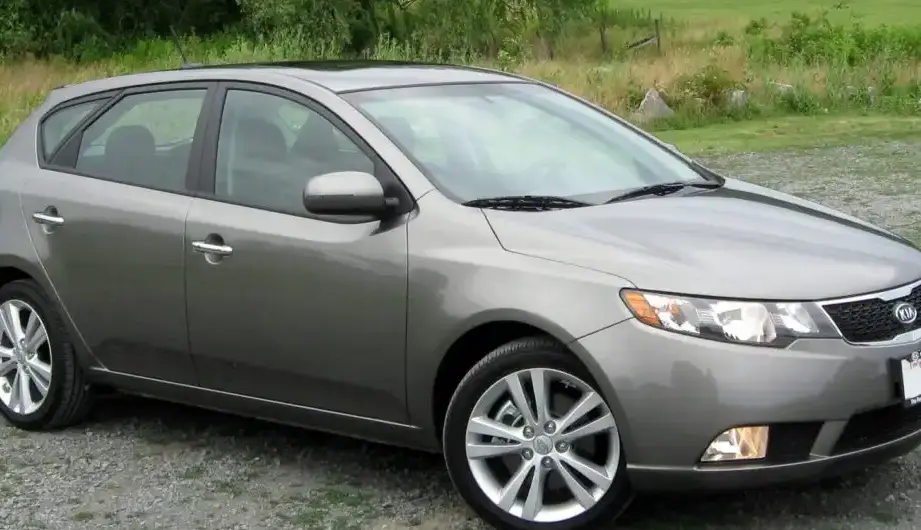
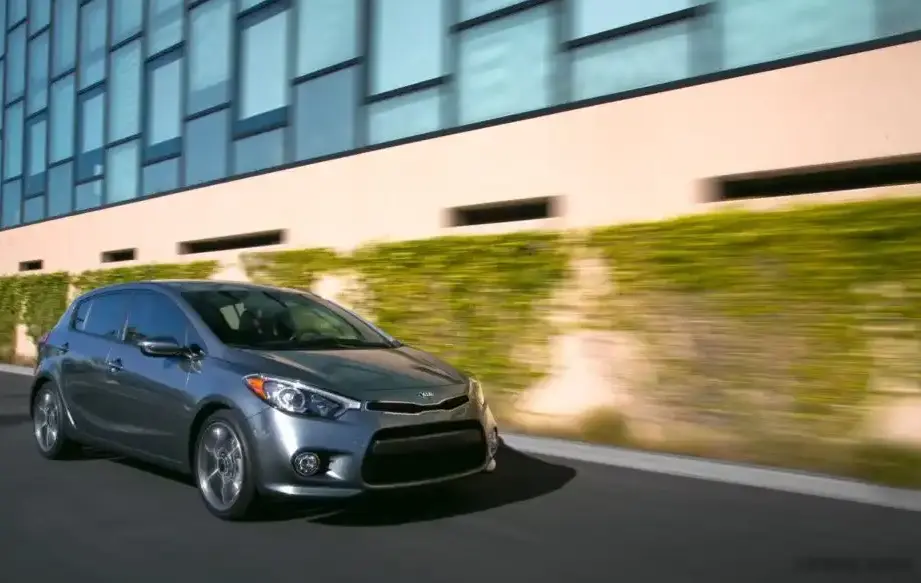
The Kia Forte5 II (YD) 1.6 T-GDI, produced from 2013 to 2016, marked a significant evolution for Kia in the compact hatchback market. This variant, equipped with the Gamma II 1.6-liter turbocharged gasoline direct injection (T-GDI) engine generating 201 horsepower, was positioned as the performance-oriented trim within the second-generation Forte5 range. It aimed to attract buyers desiring a sporty and efficient alternative to conventional compact cars, particularly in regions where hatchbacks were gaining traction. The YD generation Forte5 represented Kia’s effort to deliver a more sophisticated and refined product, moving beyond the brand’s earlier reputation for value-focused vehicles.
Powertrain & Engine Architecture
The core of the Forte5 1.6 T-GDI is the Gamma II engine, a 1.6-liter inline-four cylinder powerplant. This engine employs direct fuel injection (GDI) and a twin-scroll turbocharger to achieve a robust 201 horsepower and 264 Nm (194.72 lb-ft) of torque. The twin-scroll turbocharger design is engineered to minimize turbo lag, resulting in a more responsive driving experience. The engine also incorporates a double overhead camshaft (DOHC) valvetrain with continuously variable valve timing (D-CVVT) on both intake and exhaust valves, optimizing engine performance and efficiency across a broad spectrum of engine speeds. The engine code, G4FJ, is essential for identifying specific parts and accessing service information. A 6-speed manual transmission was standard, providing drivers with complete control over the engine’s power delivery.
Driving Characteristics
The 1.6 T-GDI version of the Forte5 delivered a noticeably more engaging driving experience compared to the base 1.8-liter engine. The turbocharger provides a strong mid-range surge, making overtaking and highway merging effortless. While not a dedicated sports car, the 201 hp output and relatively lightweight chassis (approximately 1350 kg) enabled brisk acceleration. The 6-speed manual transmission, while offering precise shifts, had a slightly longer throw compared to some competitors. The suspension tuning aimed for a balance between comfort and handling, providing a reasonably compliant ride without excessive body roll. The power delivery was linear and predictable, making it easy to modulate the throttle in various driving situations.
Equipment & Trim Levels
The 1.6 T-GDI trim typically included features such as alloy wheels, a sport-tuned suspension, and upgraded interior trim. Standard equipment often encompassed air conditioning, power windows and locks, a touchscreen infotainment system with Bluetooth connectivity, and a rearview camera. Optional extras could include a sunroof, leather upholstery, and a premium audio system. The interior design was modern for its time, prioritizing ergonomics and user-friendliness. The dashboard layout was intuitive, and the controls were easily accessible to the driver.
Chassis & Braking
The Forte5 utilized a McPherson strut front suspension and a torsion beam rear suspension. This configuration provided a good compromise between ride comfort and handling for a vehicle in its class. The braking system consisted of ventilated front discs and solid rear discs, delivering adequate stopping power for everyday driving. Anti-lock Braking System (ABS) was standard. The steering was electrically assisted, offering a light and responsive feel. The chassis was designed to minimize weight and maximize rigidity, contributing to the car’s overall handling characteristics.
Market Reception & Comparison
The Forte5 1.6 T-GDI was generally well-received by automotive critics, who lauded its sporty performance and appealing styling. However, some reviewers pointed out that the interior materials weren’t quite as refined as those found in certain competing models. Compared to the base 1.8-liter Forte5, the 1.6 T-GDI offered significantly more power and a more engaging driving experience, but at a higher price point. Fuel economy was comparable to other turbocharged compact cars, averaging around 24 mpg combined. It competed with models like the Mazda3, Ford Focus, and Volkswagen Golf, offering a compelling alternative with its combination of performance, features, and value.
Legacy
The Kia Forte5 1.6 T-GDI played a role in establishing Kia as a more credible competitor in the compact car segment. The Gamma II engine proved to be relatively reliable, although regular maintenance, including oil changes and timing belt replacements, is crucial for long-term durability. On the used car market, these models are often sought after by enthusiasts looking for an affordable and sporty hatchback. While not without its flaws, the Forte5 1.6 T-GDI remains a compelling option for buyers seeking a practical and fun-to-drive compact car. Its impact can be seen in Kia’s continued success in the compact car market and its growing reputation for building well-equipped and reliable vehicles.