Technical Specifications
| Brand | Kia |
| Model | Forte |
| Generation | Forte5 II (YD) |
| Type (Engine) | 1.6 T-GDI (201 Hp) Automatic |
| Start of production | 2013 |
| End of production | 2016 |
| Powertrain Architecture | Internal Combustion engine |
| Body type | Hatchback |
| Seats | 5 |
| Doors | 5 |
| Fuel consumption (economy) – urban (EPA) | 11.2 l/100 km (21 US mpg, 25.2 UK mpg, 8.9 km/l) |
| Fuel consumption (economy) – extra urban (EPA) | 8.1 l/100 km (29 US mpg, 34.9 UK mpg, 12.3 km/l) |
| Fuel consumption (economy) – combined (EPA) | 9.8 l/100 km (24 US mpg, 28.8 UK mpg, 10.2 km/l) |
| Fuel Type | Petrol (Gasoline) |
| Emission standard | ULEV-II |
| Weight-to-power ratio | 6.8 kg/Hp, 146.5 Hp/tonne |
| Weight-to-torque ratio | 5.2 kg/Nm, 192.4 Nm/tonne |
| Power | 201 Hp @ 6000 rpm |
| Power per litre | 126.3 Hp/l |
| Torque | 264 Nm @ 1750-4500 rpm (194.72 lb.-ft. @ 1750-4500 rpm) |
| Engine layout | Front, Transverse |
| Engine Model/Code | Gamma II / G4FJ |
| Engine displacement | 1591 cm3 (97.09 cu. in.) |
| Number of cylinders | 4 |
| Engine configuration | Inline |
| Cylinder Bore | 77 mm (3.03 in.) |
| Piston Stroke | 85.4 mm (3.36 in.) |
| Compression ratio | 9.5:1 |
| Number of valves per cylinder | 4 |
| Fuel injection system | Direct injection |
| Engine aspiration | Twin-scroll turbo, Intercooler |
| Valvetrain | DOHC, D-CVVT |
| Engine oil capacity | 4.5 l (4.76 US qt | 3.96 UK qt) |
| Coolant | 5.7 l (6.02 US qt | 5.02 UK qt) |
| Kerb Weight | 1372-1416 kg (3024.74 – 3121.75 lbs.) |
| Max. weight | 1840 kg (4056.51 lbs.) |
| Max load | 424-468 kg (934.76 – 1031.76 lbs.) |
| Trunk (boot) space – minimum | 657 l (23.2 cu. ft.) |
| Fuel tank capacity | 50 l (13.21 US gal | 11 UK gal) |
| Length | 4350 mm (171.26 in.) |
| Width | 1780 mm (70.08 in.) |
| Height | 1450 mm (57.09 in.) |
| Wheelbase | 2700 mm (106.3 in.) |
| Front track | 1545 mm (60.83 in.) |
| Rear (Back) track | 1558 mm (61.34 in.) |
| Front overhang | 880 mm (34.65 in.) |
| Rear overhang | 770 mm (30.31 in.) |
| Ride height (ground clearance) | 140 mm (5.51 in.) |
| Minimum turning circle (turning diameter) | 10.6 m (34.78 ft.) |
| Approach angle | 15.2° |
| Departure angle | 25.1° |
| Drivetrain Architecture | The Internal combustion engine (ICE) drives the front wheels of the vehicle. |
| Drive wheel | Front wheel drive |
| Number of gears and type of gearbox | 6 gears, automatic transmission |
| Front suspension | Independent, type McPherson with coil spring and anti-roll bar |
| Rear suspension | Coil spring, Torsion |
| Front brakes | Ventilated discs, 300 mm |
| Rear brakes | Disc, 262 mm |
| Assisting systems | ABS (Anti-lock braking system) |
| Steering type | Steering rack and pinion |
| Power steering | Electric Steering |
| Tires size | 225/40 R18 |
| Wheel rims size | 7.5J x 18 |
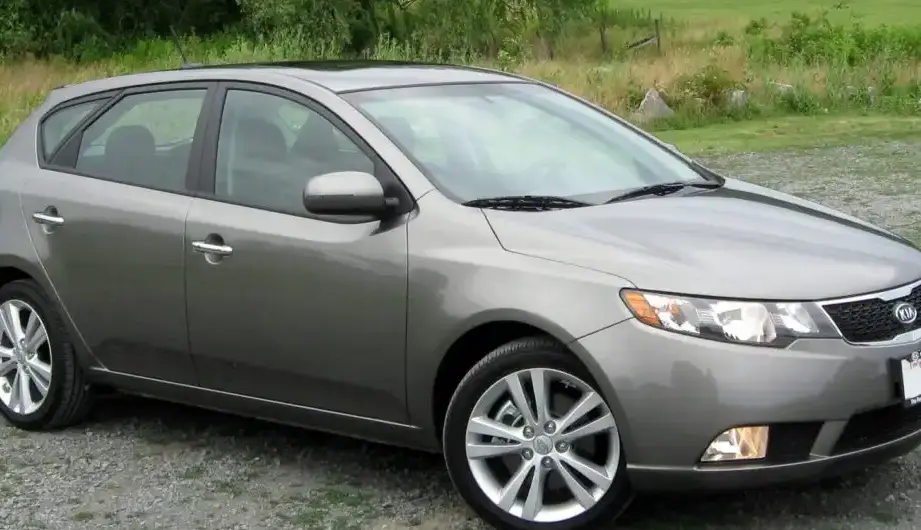
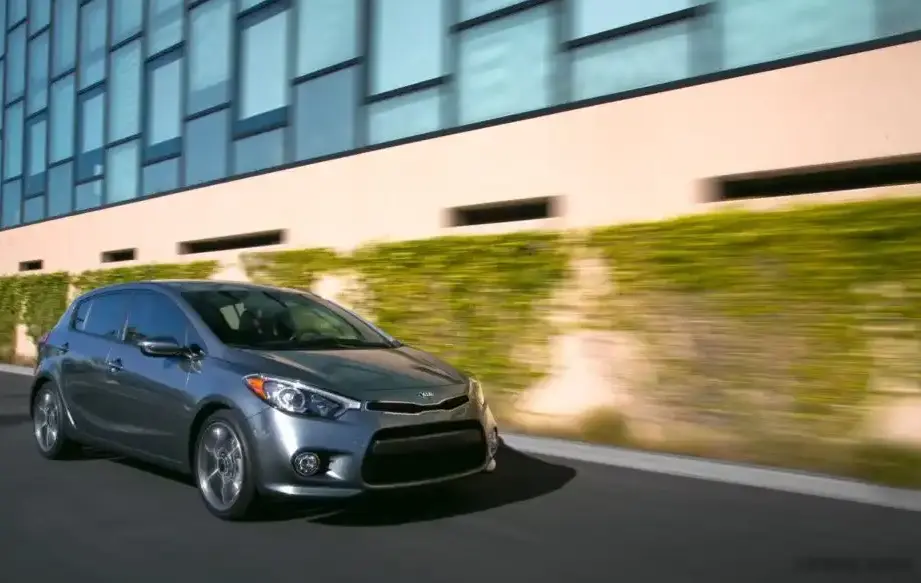
The Kia Forte5 II (YD) 1.6 T-GDI Automatic, launched in 2013, was a pivotal model for Kia as they sought to establish themselves as a mainstream competitor in the compact car market. Built on the YD platform, the Forte5 offered a five-door hatchback body style, providing increased practicality compared to the traditional Forte sedan. The 1.6 T-GDI variant, with its turbocharged engine and automatic transmission, was positioned as the sportier option within the Forte5 lineup, appealing to buyers who desired a balance of performance and convenience. It was sold primarily in North America, Europe, and select Asian markets.
Powertrain & Engine Architecture
At the heart of the Forte5 1.6 T-GDI was the Gamma II engine, specifically the G4FJ code. This 1.6-liter inline-four cylinder engine featured direct fuel injection and a twin-scroll turbocharger, enabling it to produce 201 horsepower at 6000 rpm and 264 Nm (194.72 lb.-ft.) of torque between 1750 and 4500 rpm. The direct injection system improved fuel efficiency and reduced emissions, while the twin-scroll turbo minimized turbo lag for a more responsive driving experience. The engine also incorporated Kia’s Dual Continuously Variable Valve Timing (D-CVVT) technology, optimizing valve timing for improved performance and fuel economy across the engine’s operating range. The engine was paired with a six-speed automatic transmission, designed to provide smooth and efficient gear changes. This transmission wasn’t known for being particularly sporty, prioritizing comfort and fuel economy over aggressive shifting.
Driving Characteristics
The 1.6 T-GDI Automatic offered a noticeable step up in performance compared to the base 1.8-liter naturally aspirated engine. While not a true hot hatch, the turbocharger provided ample low-end torque, making it easy to accelerate from a standstill and navigate city traffic. The automatic transmission, while smooth, could feel somewhat hesitant during quick acceleration, and lacked the engagement of a manual gearbox. The gear ratios were tuned for fuel efficiency, meaning the engine sometimes felt strained during aggressive driving. Compared to a manual transmission equipped Forte5, the automatic version sacrificed some responsiveness for ease of use. The weight distribution was fairly balanced, contributing to predictable handling, but the suspension was tuned more for comfort than outright sportiness.
Equipment & Trim Levels
The 1.6 T-GDI Automatic typically came with a generous level of standard equipment. This included features such as air conditioning, power windows and locks, a touchscreen infotainment system with Bluetooth connectivity, and a rearview camera. Higher trim levels offered upgrades like leather upholstery, a sunroof, heated front seats, and a premium audio system. The interior design was modern and functional, with a focus on ergonomics. The hatchback body style provided ample cargo space, making it a practical choice for families or individuals with active lifestyles. Optional extras included navigation systems and advanced safety features like lane departure warning and forward collision alert.
Chassis & Braking
The Forte5 utilized a McPherson strut front suspension and a torsion beam rear suspension. This setup provided a comfortable ride quality, absorbing bumps and imperfections in the road effectively. The front brakes were ventilated discs measuring 300mm, while the rear brakes were solid discs measuring 262mm. Anti-lock Braking System (ABS) was standard. The steering was electrically assisted, providing light and precise control. The chassis was designed to balance handling and ride comfort, prioritizing stability over outright sportiness. Stabilizer bars were included both front and rear to reduce body roll during cornering.
Market Reception & Comparison
The Kia Forte5 1.6 T-GDI Automatic was generally well-received by automotive critics. It was praised for its stylish design, generous features, and strong engine performance. However, some reviewers noted that the automatic transmission could be slow to respond and that the ride quality was not as refined as some of its competitors. Compared to other trims in the Forte5 lineup, the 1.6 T-GDI offered a significant performance advantage, but at a higher price point. Fuel economy was comparable to other turbocharged compact cars, but slightly lower than the base 1.8-liter engine. Competitors included the Ford Focus, Mazda3, and Volkswagen Golf.
Legacy
The Kia Forte5 II (YD) 1.6 T-GDI Automatic played a crucial role in Kia’s brand transformation. It demonstrated that Kia could produce a stylish, well-equipped, and genuinely enjoyable compact car. The Gamma II engine proved to be relatively reliable, although some owners have reported issues with the turbocharger and fuel injectors over time. On the used car market, these models remain relatively affordable and offer a good value proposition for buyers seeking a practical and efficient hatchback with a bit of extra power. The success of the Forte5 paved the way for Kia’s continued growth and expansion in the global automotive market.