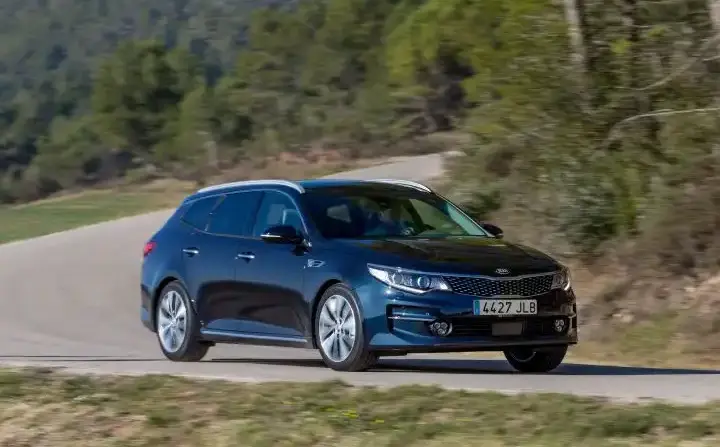
The Kia Optima IV Sportswagon 1.7 CRDI (141 hp) ISG was a front-wheel-drive station wagon produced between 2016 and 2018. Positioned as a fuel-efficient option within the fourth generation (JF) Optima lineup, it catered to buyers seeking practicality and economy in a stylish package. This variant utilized Kia’s U II / D4FD 1.7-liter diesel engine paired with a six-speed manual transmission, offering a balance between performance and fuel consumption. The “ISG” designation indicates the inclusion of Kia’s Idle Stop & Go system, a fuel-saving technology that automatically shuts off the engine when the vehicle is stationary.
Technical Specifications
| Brand | Kia |
| Model | Optima |
| Generation | Optima IV Sportswagon |
| Type (Engine) | 1.7 CRDI (141 Hp) ISG |
| Start of production | 2016 |
| End of production | 2018 |
| Powertrain Architecture | Internal Combustion engine |
| Body type | Station wagon (estate) |
| Seats | 5 |
| Doors | 5 |
| Fuel consumption (urban) | 5.2 l/100 km (45.2 US mpg, 54.3 UK mpg, 19.2 km/l) |
| Fuel consumption (extra urban) | 3.8 l/100 km (61.9 US mpg, 74.3 UK mpg, 26.3 km/l) |
| Fuel consumption (combined) | 4.4 l/100 km (53.5 US mpg, 64.2 UK mpg, 22.7 km/l) |
| CO2 emissions | 113 g/km |
| Fuel Type | Diesel |
| Acceleration 0 – 100 km/h | 10.2 sec |
| Acceleration 0 – 62 mph | 10.2 sec |
| Acceleration 0 – 60 mph | 9.7 sec |
| Maximum speed | 200 km/h (124.27 mph) |
| Emission standard | Euro 6 |
| Weight-to-power ratio | 11 kg/Hp, 91.3 Hp/tonne |
| Weight-to-torque ratio | 4.5 kg/Nm, 220.1 Nm/tonne |
| Power | 141 Hp @ 4000 rpm |
| Power per litre | 83.7 Hp/l |
| Torque | 340 Nm @ 1750-2500 rpm (250.77 lb.-ft. @ 1750-2500 rpm) |
| Engine layout | Front, Transverse |
| Engine Model/Code | U II / D4FD |
| Engine displacement | 1685 cm3 (102.83 cu. in.) |
| Number of cylinders | 4 |
| Engine configuration | Inline |
| Cylinder Bore | 77.2 mm (3.04 in.) |
| Piston Stroke | 90 mm (3.54 in.) |
| Compression ratio | 15.7:1 |
| Number of valves per cylinder | 4 |
| Fuel injection system | Diesel Commonrail |
| Engine aspiration | Turbocharger, Intercooler |
| Engine oil capacity | 5.3 l (5.6 US qt | 4.66 UK qt) |
| Coolant capacity | 7.1 l (7.5 US qt | 6.25 UK qt) |
| Kerb Weight | 1545-1675 kg (3406.14 – 3692.74 lbs.) |
| Max. weight | 2140 kg (4717.89 lbs.) |
| Max load | 465-595 kg (1025.15 – 1311.75 lbs.) |
| Trunk (boot) space – minimum | 552 l (19.49 cu. ft.) |
| Trunk (boot) space – maximum | 1686 l (59.54 cu. ft.) |
| Fuel tank capacity | 70 l (18.49 US gal | 15.4 UK gal) |
| Max. roof load | 100 kg (220.46 lbs.) |
| Permitted trailer load with brakes (12%) | 1800 kg (3968.32 lbs.) |
| Permitted trailer load without brakes | 750 kg (1653.47 lbs.) |
| Permitted towbar download | 80 kg (176.37 lbs.) |
| Length | 4855 mm (191.14 in.) |
| Width | 1860 mm (73.23 in.) |
| Width including mirrors | 2120 mm (83.46 in.) |
| Height | 1470 mm (57.87 in.) |
| Wheelbase | 2805 mm (110.43 in.) |
| Front track | 1597-1607 mm (62.87 – 63.27 in.) |
| Rear (Back) track | 1604-1614 mm (63.15 – 63.54 in.) |
| Front overhang | 965 mm (37.99 in.) |
| Rear overhang | 1085 mm (42.72 in.) |
| Ride height (ground clearance) | 135 mm (5.31 in.) |
| Minimum turning circle | 10.9 m (35.76 ft.) |
| Drivetrain | Front wheel drive |
| Number of gears and type of gearbox | 6 gears, manual transmission |
| Front suspension | Independent, type McPherson with coil spring and anti-roll bar |
| Rear suspension | Independent multi-link suspension |
| Front brakes | Ventilated discs |
| Rear brakes | Disc |
| Assisting systems | ABS (Anti-lock braking system) |
| Steering type | Steering rack and pinion |
| Power steering | Electric Steering |
| Tires size | 215/60 R16 95V; 215/55 R17 94W; 235/45 ZR18 98Y |
| Wheel rims size | 6.5J x 16; 7.5J x 17; 7.5J x 18 |
Powertrain & Engine Architecture
The heart of the Optima Sportswagon 1.7 CRDI is Kia’s U II / D4FD 1.7-liter inline-four cylinder diesel engine. This engine is a common-rail direct injection (CRDI) unit, meaning fuel is delivered directly into the combustion chamber at extremely high pressure for optimized combustion. The engine utilizes a variable geometry turbocharger (VGT) and an intercooler to enhance power and efficiency. The VGT adjusts the turbine vanes to optimize airflow across the engine’s operating range, improving both low-end torque and high-end power. The engine features four valves per cylinder (DOHC) and a compression ratio of 15.7:1. The six-speed manual transmission provides precise gear changes and contributes to the vehicle’s overall fuel efficiency. The Idle Stop & Go (ISG) system further enhances fuel economy by automatically shutting off the engine when the vehicle is stopped, such as at traffic lights, and restarting it when the driver depresses the clutch pedal.
Driving Characteristics
The 141 hp and 340 Nm (250 lb-ft) of torque delivered by the 1.7 CRDI engine provided adequate performance for everyday driving. While not a sports car, the Optima Sportswagon offered sufficient power for highway cruising and overtaking maneuvers. The manual transmission allowed for driver engagement and control, and the relatively low weight of the vehicle (1545-1675 kg) helped to maintain a reasonable power-to-weight ratio. Compared to higher-output versions of the Optima, such as the 2.0-liter petrol engine, the 1.7 CRDI prioritized fuel economy over outright acceleration. The gear ratios were tuned for efficiency, with a taller final drive contributing to lower engine speeds at highway speeds. The engine’s peak torque, available from 1750-2500 rpm, provided strong pulling power in the mid-range, making it well-suited for carrying passengers and cargo.
Equipment & Trim Levels
The 1.7 CRDI ISG trim typically came with a respectable level of standard equipment. Interior features included cloth upholstery, a leather-wrapped steering wheel, and air conditioning. Infotainment systems varied depending on the specific market and optional packages, but generally included a touchscreen display, Bluetooth connectivity, and USB ports. Safety features such as ABS, Electronic Stability Control (ESC), and multiple airbags were standard. Optional extras included features like a panoramic sunroof, leather seats, a navigation system, and parking sensors. The trim level generally sat in the mid-range of the Optima Sportswagon lineup, offering a good balance of features and affordability.
Chassis & Braking
The Optima Sportswagon featured a McPherson strut front suspension and a multi-link rear suspension, providing a comfortable and controlled ride. The suspension was tuned to prioritize ride comfort over sporty handling, but still offered decent body control. The front brakes were ventilated discs, while the rear brakes were solid discs, providing adequate stopping power for the vehicle’s weight and performance. Electric power steering provided light and precise steering feel. The vehicle’s chassis was designed to minimize noise, vibration, and harshness (NVH), contributing to a refined driving experience.
Market Reception & Comparison
The Kia Optima IV Sportswagon 1.7 CRDI ISG was generally well-received by automotive critics for its fuel efficiency, practicality, and value for money. It was often praised for its spacious interior and large cargo area. Compared to other diesel station wagons in its class, the Optima offered a competitive level of equipment and a long warranty. However, some critics noted that the engine could be somewhat noisy and that the manual transmission was not as refined as those found in some European competitors. Fuel economy figures consistently demonstrated the variant’s efficiency, making it an attractive option for drivers covering long distances.
Legacy
The U II / D4FD 1.7-liter diesel engine has proven to be a relatively reliable powertrain when properly maintained. Common issues include diesel particulate filter (DPF) clogging, particularly on vehicles used primarily for short trips, and occasional issues with the turbocharger. However, these issues are not uncommon for modern diesel engines. On the used car market, the Optima Sportswagon 1.7 CRDI ISG remains a popular choice for buyers seeking a practical and fuel-efficient station wagon. Its affordability, spaciousness, and long warranty (when originally purchased) continue to make it an attractive option.