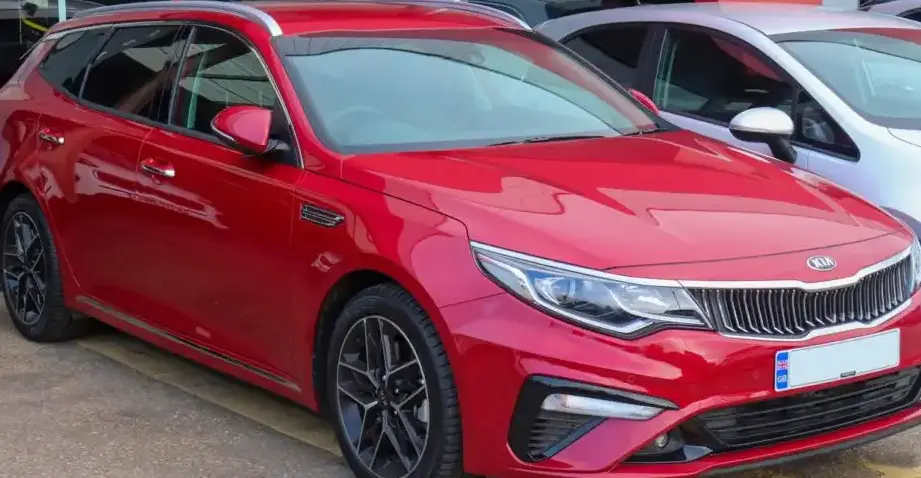
The Kia Optima IV Sportswagon, specifically the facelifted version produced from 2018 to 2020, represented Kia’s entry into the competitive European D-segment wagon market. This variant, powered by a 1.6-liter T-GDI engine producing 180 horsepower and paired with a 7-speed Dual Clutch Transmission (DCT), aimed to balance fuel efficiency, performance, and practicality for family buyers. Positioned as a mid-range offering within the Sportswagon lineup, it slotted between the lower-powered diesel variants and the more performance-focused, though not available in all markets, higher-output gasoline engines. The facelift brought updated styling cues and refined interior appointments, enhancing the Optima’s appeal.
Technical Specifications
| Brand | Kia |
| Model | Optima |
| Generation | Optima IV Sportswagon (facelift 2018) |
| Type (Engine) | 1.6 T-GDI (180 Hp) DCT |
| Start of production | 2018 |
| End of production | 2020 |
| Powertrain Architecture | Internal Combustion engine |
| Body type | Station wagon (estate) |
| Seats | 5 |
| Doors | 5 |
| Fuel consumption (urban) | 7.7-8.1 l/100 km (30.5 – 29 US mpg) |
| Fuel consumption (extra urban) | 5.2-5.6 l/100 km (45.2 – 42 US mpg) |
| Fuel consumption (combined) | 6.1-6.5 l/100 km (38.6 – 36.2 US mpg) |
| CO2 emissions | 140-148 g/km |
| Fuel Type | Petrol (Gasoline) |
| Acceleration 0 – 100 km/h | 8.9 sec |
| Acceleration 0 – 62 mph | 8.9 sec |
| Acceleration 0 – 60 mph | 8.5 sec |
| Maximum speed | 210 km/h (130.49 mph) |
| Emission standard | Euro 6d – TEMP |
| Weight-to-power ratio | 8.3 kg/Hp |
| Weight-to-torque ratio | 5.6 kg/Nm |
| Power | 180 Hp @ 5500 rpm |
| Torque | 265 Nm @ 1500-4500 rpm (195.45 lb.-ft. @ 1500-4500 rpm) |
| Engine layout | Front, Transverse |
| Engine Model/Code | Gamma II / G4FJ |
| Engine displacement | 1591 cm3 (97.09 cu. in.) |
| Number of cylinders | 4 |
| Engine configuration | Inline |
| Cylinder Bore | 77 mm (3.03 in.) |
| Piston Stroke | 85.4 mm (3.36 in.) |
| Compression ratio | 10:1 |
| Number of valves per cylinder | 4 |
| Fuel injection system | Direct injection |
| Engine aspiration | Twin-Turbo, Intercooler |
| Engine oil capacity | 4.5 l (4.76 US qt | 3.96 UK qt) |
| Coolant capacity | 6.5 l (6.87 US qt | 5.72 UK qt) |
| Kerb Weight | 1495-1610 kg (3295.91 – 3549.44 lbs.) |
| Max. weight | 2080 kg (4585.62 lbs.) |
| Max load | 470-585 kg (1036.17 – 1289.7 lbs.) |
| Trunk (boot) space – minimum | 552 l (19.49 cu. ft.) |
| Trunk (boot) space – maximum | 1686 l (59.54 cu. ft.) |
| Fuel tank capacity | 70 l (18.49 US gal | 15.4 UK gal) |
| Max. roof load | 100 kg (220.46 lbs.) |
| Permitted trailer load with brakes (12%) | 1400 kg (3086.47 lbs.) |
| Permitted trailer load without brakes | 700 kg (1543.24 lbs.) |
| Permitted towbar download | 80 kg (176.37 lbs.) |
| Length | 4855 mm (191.14 in.) |
| Width | 1860 mm (73.23 in.) |
| Width including mirrors | 2120 mm (83.46 in.) |
| Height | 1470 mm (57.87 in.) |
| Wheelbase | 2805 mm (110.43 in.) |
| Front track | 1597-1607 mm (62.87 – 63.27 in.) |
| Rear track | 1604-1614 mm (63.15 – 63.54 in.) |
| Front overhang | 965 mm (37.99 in.) |
| Rear overhang | 1085 mm (42.72 in.) |
| Ride height (ground clearance) | 135 mm (5.31 in.) |
| Minimum turning circle | 10.9 m (35.76 ft.) |
| Drivetrain | Front wheel drive |
| Number of gears and type of gearbox | 7 gears, automatic transmission DCT |
| Front suspension | Independent type McPherson |
| Rear suspension | Independent multi-link suspension |
| Front brakes | Ventilated discs |
| Rear brakes | Disc |
| Assisting systems | ABS (Anti-lock braking system) |
| Steering type | Steering rack and pinion |
| Power steering | Electric Steering |
| Tires size | 215/60 R16; 215/55 R17; 235/45 ZR18 |
| Wheel rims size | 6.5J x 16; 7.5J x 17; 7.5 x 18 |
Powertrain & Engine Architecture
The heart of this Optima variant is the Gamma II 1.6 T-GDI engine, designated G4FJ. This is a four-cylinder, inline gasoline engine featuring direct injection and a twin-scroll turbocharger. The direct injection system allows for precise fuel delivery, improving efficiency and reducing emissions. The twin-scroll turbocharger minimizes turbo lag, providing a more responsive driving experience. The engine produces 180 horsepower at 5500 rpm and 265 Nm (195 lb-ft) of torque between 1500 and 4500 rpm. This broad torque curve is a key characteristic of the engine, providing good pulling power across a wide range of engine speeds. The engine is paired with a 7-speed Dual Clutch Transmission (DCT). DCTs offer faster and smoother gear changes compared to traditional automatic transmissions, contributing to both performance and fuel economy.
Driving Characteristics
The 1.6 T-GDI with the 7-speed DCT delivers a respectable driving experience. Acceleration from 0 to 60 mph takes approximately 8.5 seconds, and the car has a top speed of 130 mph. While not a sports car, the engine provides sufficient power for everyday driving and overtaking maneuvers. The DCT contributes to a responsive feel, and the broad torque band means the engine doesn’t feel strained when accelerating. Compared to the diesel variants, the 1.6 T-GDI offers a more refined and responsive engine character, albeit with slightly lower fuel economy. Compared to higher-output gasoline engines (if offered in the Sportswagon range), this variant prioritizes efficiency over outright performance. The DCT’s gear ratios are tuned for a balance of acceleration and fuel efficiency, with taller gears for highway cruising.
Equipment & Trim Levels
The 1.6 T-GDI Sportswagon typically came equipped with a good level of standard features. These included air conditioning, a touchscreen infotainment system with Apple CarPlay and Android Auto compatibility, Bluetooth connectivity, and a suite of safety features such as ABS, ESC, and multiple airbags. Higher trim levels added features like leather upholstery, a panoramic sunroof, heated front seats, and advanced driver-assistance systems like lane departure warning and automatic emergency braking. Interior upholstery was typically cloth on base models, with leather options available on higher trims. Dashboard configuration was consistent across the range, featuring a modern and functional design.
Chassis & Braking
The Optima Sportswagon utilizes an independent McPherson strut suspension at the front and an independent multi-link suspension at the rear. This setup provides a comfortable ride quality while maintaining good handling characteristics. The front brakes are ventilated discs, while the rear brakes are solid discs. ABS (Anti-lock Braking System) is standard, providing enhanced braking performance in emergency situations. Stabilizer bars are fitted to both the front and rear axles to reduce body roll during cornering. The suspension tuning is geared towards comfort and stability, making it well-suited for long journeys.
Market Reception & Comparison
The Kia Optima Sportswagon 1.6 T-GDI was generally well-received by automotive critics. It was praised for its stylish design, spacious interior, and good value for money. The engine was considered a good compromise between performance and fuel efficiency. However, some critics noted that the ride could be a little firm on rough roads. Compared to rivals like the Volkswagen Passat Estate and Ford Mondeo Estate, the Optima offered a more distinctive design and a longer warranty. Fuel economy was competitive, typically achieving around 38-40 mpg in mixed driving conditions. Reliability reports have been generally positive, with few major issues reported with the 1.6 T-GDI engine and DCT transmission.
Legacy
The Kia Optima IV Sportswagon 1.6 T-GDI represents a significant step forward for Kia in the European market. It demonstrated Kia’s ability to produce a competitive and well-equipped wagon that could challenge established European brands. The 1.6 T-GDI engine and 7-speed DCT have proven to be relatively reliable powertrains, and used examples continue to offer good value for money. While the Optima Sportswagon has been discontinued in some markets, it remains a popular choice for buyers looking for a practical, stylish, and efficient estate car.