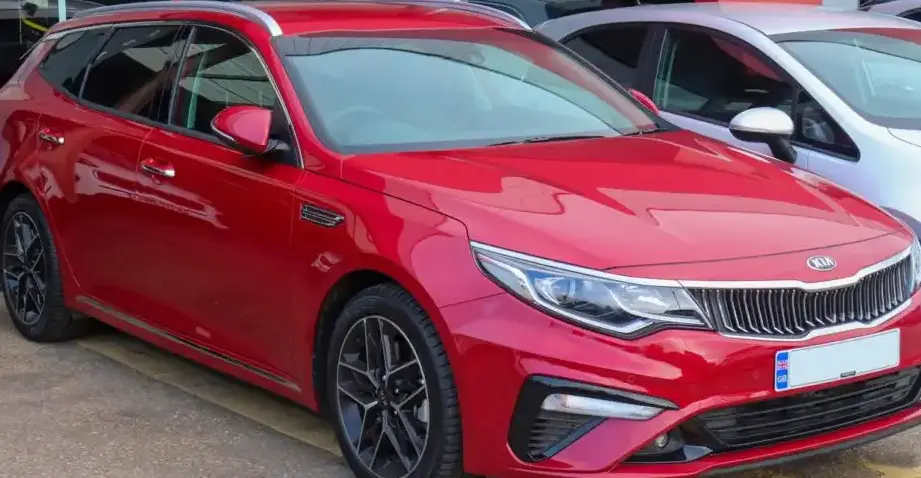
The Kia Optima IV Sportswagon (facelift, 2018) 2.0 CVVL (163 hp) represents a mid-cycle refresh of Kia’s D-segment wagon, sold primarily in European and Asian markets. Introduced in 2018 and continuing through 2020, this variant aimed to provide a practical and stylish alternative to traditional saloons, offering increased cargo capacity and versatility. Positioned as a mid-range offering within the Sportswagon lineup, it slotted between the lower-powered diesel variants and the more performance-focused, albeit less common, turbocharged petrol options. The facelift brought updated styling cues, improved technology, and refinements to the existing powertrain options.
Technical Specifications
| Brand | Kia |
| Model | Optima |
| Generation | Optima IV Sportswagon (facelift 2018) |
| Type (Engine) | 2.0 CVVL (163 Hp) |
| Start of production | 2018 |
| End of production | 2020 |
| Powertrain Architecture | Internal Combustion engine |
| Body type | Station wagon (estate) |
| Seats | 5 |
| Doors | 5 |
| Fuel consumption (urban) | 10.4-10.6 l/100 km (22.6 – 22.2 US mpg) |
| Fuel consumption (extra urban) | 6.1-6.3 l/100 km (38.6 – 37.3 US mpg) |
| Fuel consumption (combined) | 7.7-7.9 l/100 km (30.5 – 29.8 US mpg) |
| CO2 emissions | 176-181 g/km |
| Fuel Type | Petrol (Gasoline) |
| Acceleration 0 – 100 km/h | 9.6 sec |
| Acceleration 0 – 62 mph | 9.6 sec |
| Acceleration 0 – 60 mph | 9.1 sec |
| Maximum speed | 206 km/h (128 mph) |
| Emission standard | Euro 6d – TEMP |
| Weight-to-power ratio | 9 kg/Hp |
| Weight-to-torque ratio | 7.5 kg/Nm |
| Power | 163 Hp @ 6500 rpm |
| Torque | 196 Nm @ 4800 rpm (144.56 lb.-ft. @ 4800 rpm) |
| Engine layout | Front, Transverse |
| Engine Model/Code | G4ND |
| Engine displacement | 1999 cm3 (121.99 cu. in.) |
| Number of cylinders | 4 |
| Engine configuration | Inline |
| Cylinder Bore | 81 mm (3.19 in.) |
| Piston Stroke | 97 mm (3.82 in.) |
| Compression ratio | 10.3:1 |
| Number of valves per cylinder | 4 |
| Fuel injection system | Multi-port manifold injection |
| Engine aspiration | Naturally aspirated engine |
| Engine oil capacity | 4.3 l (4.54 US qt | 3.78 UK qt) |
| Coolant capacity | 5.9 l (6.23 US qt | 5.19 UK qt) |
| Kerb Weight | 1475-1600 kg (3251.82 – 3527.4 lbs.) |
| Max. weight | 2070 kg (4563.57 lbs.) |
| Max load | 470-595 kg (1036.17 – 1311.75 lbs.) |
| Trunk (boot) space – minimum | 552 l (19.49 cu. ft.) |
| Trunk (boot) space – maximum | 1686 l (59.54 cu. ft.) |
| Fuel tank capacity | 70 l (18.49 US gal | 15.4 UK gal) |
| Max. roof load | 100 kg (220.46 lbs.) |
| Permitted trailer load with brakes (12%) | 1700 kg (3747.86 lbs.) |
| Permitted trailer load without brakes | 750 kg (1653.47 lbs.) |
| Permitted towbar download | 80 kg (176.37 lbs.) |
| Length | 4855 mm (191.14 in.) |
| Width | 1860 mm (73.23 in.) |
| Width including mirrors | 2120 mm (83.46 in.) |
| Height | 1470 mm (57.87 in.) |
| Wheelbase | 2805 mm (110.43 in.) |
| Front track | 1597-1607 mm (62.87 – 63.27 in.) |
| Rear track | 1604-1614 mm (63.15 – 63.54 in.) |
| Front overhang | 965 mm (37.99 in.) |
| Rear overhang | 1085 mm (42.72 in.) |
| Ride height (ground clearance) | 135 mm (5.31 in.) |
| Minimum turning circle | 10.9 m (35.76 ft.) |
| Drivetrain | Front wheel drive |
| Number of gears and type of gearbox | 6 gears, manual transmission |
| Front suspension | Independent type McPherson |
| Rear suspension | Independent multi-link suspension |
| Front brakes | Ventilated discs |
| Rear brakes | Disc |
| Assisting systems | ABS (Anti-lock braking system) |
| Steering type | Steering rack and pinion |
| Power steering | Electric Steering |
| Tires size | 215/60 R16; 215/55 R17; 235/45 ZR18 |
| Wheel rims size | 6.5J x 16; 7.5J x 17; 7.5 x 18 |
INTRODUCTION
The 2018 facelift of the Kia Optima Sportswagon, powered by the 2.0 CVVL engine producing 163 horsepower, was designed to appeal to European buyers seeking a practical yet stylish estate car. Built on the PF platform (shared with the Hyundai i40), the Sportswagon offered a compelling alternative to more established brands in the segment. This particular engine and transmission combination represented a sweet spot in the lineup, balancing affordability with reasonable performance and fuel efficiency. It was aimed at families and individuals who needed the extra space of a wagon but didn’t require the higher running costs or performance of the more powerful engine options.
Powertrain & Engine Architecture
The heart of this Optima variant is the G4ND 2.0-liter naturally aspirated four-cylinder engine. This engine utilizes a dual continuously variable valve timing (CVVL) system, enhancing both power and fuel economy. The CVVL system adjusts the timing of both intake and exhaust valves based on engine speed and load, optimizing cylinder filling and scavenging. Fuel delivery is managed by a multi-port fuel injection system. The engine produces 163 hp at 6500 rpm and 196 Nm (144.56 lb-ft) of torque at 4800 rpm. The engine’s relatively simple design contributes to its reliability. The standard transmission is a 6-speed manual gearbox, providing direct control over the engine’s power. While an automatic transmission was available in some markets, it wasn’t as commonly paired with this specific engine.
Driving Characteristics
The 2.0 CVVL engine, paired with the 6-speed manual transmission, delivers adequate performance for everyday driving. Acceleration from 0-60 mph takes approximately 9.1 seconds, and top speed is rated at 128 mph. The engine feels responsive at lower and mid-range speeds, making it suitable for urban and highway driving. However, it does require more aggressive throttle input when overtaking or climbing hills. Compared to the more powerful turbocharged engines offered in the Optima Sportswagon, this variant feels less urgent. The manual transmission provides a satisfying driving experience, with well-defined shift points and a relatively light clutch. The gear ratios are tuned for fuel efficiency, which can sometimes result in the engine feeling slightly strained at higher speeds.
Equipment & Trim Levels
The 2.0 CVVL Sportswagon typically came equipped with a respectable level of standard features. These included air conditioning, power windows and mirrors, a touchscreen infotainment system with Bluetooth connectivity, and a suite of safety features such as ABS, ESC, and multiple airbags. Higher trim levels added features like leather upholstery, heated front seats, a panoramic sunroof, and advanced driver-assistance systems (ADAS) such as lane departure warning and automatic emergency braking. Interior upholstery was typically cloth on the base models, with leather options available on higher trims. Dashboard configuration was consistent across the range, featuring a modern and ergonomic design.
Chassis & Braking
The Optima Sportswagon utilizes an independent McPherson strut suspension at the front and an independent multi-link suspension at the rear, providing a comfortable and controlled ride. Stabilizer bars are fitted to both axles to reduce body roll during cornering. Braking duties are handled by ventilated discs at the front and solid discs at the rear, providing adequate stopping power. The ABS system prevents wheel lockup during hard braking, enhancing safety. The suspension tuning is geared towards comfort, prioritizing ride quality over outright handling prowess. The steering is electrically assisted, providing a light and precise feel.
Market Reception & Comparison
The Kia Optima Sportswagon 2.0 CVVL was generally well-received by automotive critics. It was praised for its spacious interior, comfortable ride, and attractive styling. However, some reviewers noted that the engine lacked the punch of its turbocharged counterparts. Fuel economy was considered to be competitive within its class. Compared to other wagons in the segment, such as the Volkswagen Passat Estate and the Ford Mondeo Estate, the Optima Sportswagon offered a compelling value proposition, with a generous level of standard equipment and a long warranty. The 1.7 CRDi diesel variants were often favored for their superior fuel economy, while the 1.6 T-GDi petrol engine offered more spirited performance.
Legacy
The G4ND 2.0 CVVL engine has proven to be a reliable and durable unit, with few reported major issues. The Optima Sportswagon, in general, has gained a reputation for being a practical and dependable family car. On the used car market, these models represent good value for money, offering a lot of car for the price. Maintenance costs are relatively low, and parts availability is generally good. While not as sought-after as the more powerful or technologically advanced variants, the 2.0 CVVL Sportswagon remains a viable option for buyers seeking a spacious, comfortable, and affordable estate car.