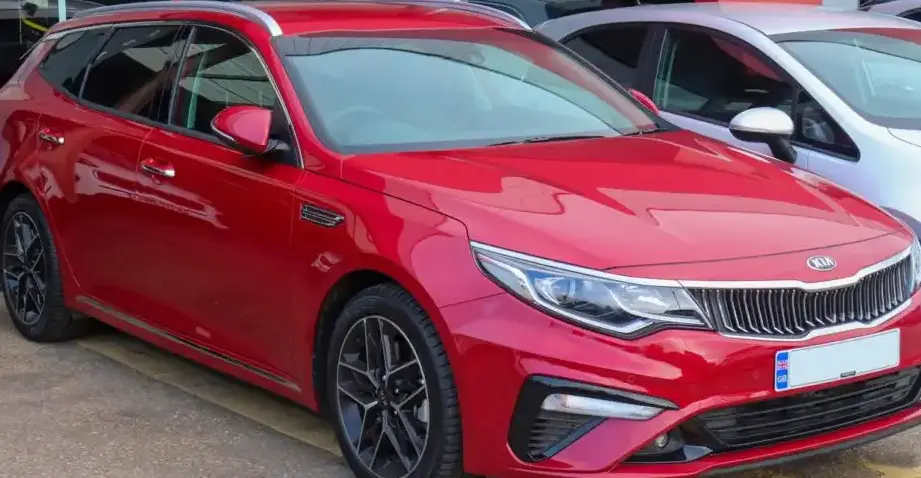
The Kia Optima IV Sportswagon 2.0 GDI Plug-in Hybrid Automatic, produced from 2018 to 2020, represents Kia’s entry into the increasingly popular plug-in hybrid estate (wagon) market. This variant, part of the facelifted fourth-generation Optima (JF) series, aimed to combine the practicality of a station wagon with the fuel efficiency and reduced emissions of a plug-in hybrid powertrain. Positioned as a mid-to-upper trim level within the Optima Sportswagon range, it offered a more sophisticated and environmentally conscious alternative to the standard gasoline-powered models. The Optima Sportswagon itself was primarily a European market vehicle, designed to compete with established players like the Volkswagen Passat Variant and Ford Mondeo Estate, offering a compelling blend of style, space, and technology.
Technical Specifications
| Brand | Kia |
| Model | Optima |
| Generation | Optima IV Sportswagon (facelift 2018) |
| Type (Engine) | 2.0 GDI (205 Hp) Plug-in Hybrid Automatic |
| Start of production | 2018 |
| End of production | 2020 |
| Powertrain Architecture | PHEV (Plug-in Hybrid Electric Vehicle) |
| Body type | Station wagon (estate) |
| Seats | 5 |
| Doors | 5 |
| Fuel consumption (combined NEDC) | 1.4 l/100 km (168 US mpg, 201.8 UK mpg, 71.4 km/l) |
| CO2 emissions (NEDC) | 33 g/km |
| Fuel Type | Petrol / electricity |
| Acceleration 0 – 100 km/h | 9.7 sec |
| Acceleration 0 – 62 mph | 9.7 sec |
| Acceleration 0 – 60 mph | 9.2 sec |
| Maximum speed | 192 km/h (119.3 mph) |
| Emission standard | Euro 6d-TEMP |
| Weight-to-power ratio | 8.5 kg/Hp, 117.8 Hp/tonne |
| Weight-to-torque ratio | 4.6 kg/Nm, 215.5 Nm/tonne |
| Gross battery capacity | 11.3 kWh |
| Net (usable) battery capacity | 9 kWh |
| Battery voltage | 360 V |
| Battery technology | Lithium-polymer (LiPo) |
| Battery weight | 131 kg (288.81 lbs) |
| Battery location | Under the trunk |
| All-electric range (NEDC) | 62 km (38.53 mi) |
| Average Energy consumption (NEDC) | 12.3 kWh/100 km (19.79 kWh/100 mi, 170 MPGe, 8.1 km/kWh, 5.1 mi/kWh) |
| Max speed (electric) | 120 km/h (74.56 mph) |
| Electric motor power | 68 Hp @ 2330-3300 rpm |
| Electric motor Torque | 205 Nm @ 0-2330 rpm (151.2 lb.-ft. @ 0-2330 rpm) |
| Electric motor location | Between the combustion engine and the transmission |
| System power | 205 Hp @ 6000 rpm |
| System torque | 375 Nm @ 2330 rpm (276.59 lb.-ft. @ 2330 rpm) |
| Power | 154 Hp @ 6000 rpm |
| Torque | 187 Nm @ 5000 rpm (137.92 lb.-ft. @ 5000 rpm) |
| Engine layout | Front, Transverse |
| Engine Model/Code | G4NG |
| Engine displacement | 1999 cm3 (121.99 cu. in.) |
| Number of cylinders | 4 |
| Engine configuration | Inline |
| Cylinder Bore | 81 mm (3.19 in.) |
| Piston Stroke | 97 mm (3.82 in.) |
| Compression ratio | 13.5:1 |
| Number of valves per cylinder | 4 |
| Fuel injection system | Direct injection |
| Engine aspiration | Naturally aspirated engine |
| Valvetrain | DOHC, Dual CVVT |
| Engine oil capacity | 4.1 l (4.33 US qt | 3.61 UK qt) |
| Coolant | 6.7 l (7.08 US qt | 5.9 UK qt) |
| Kerb Weight | 1740-1805 kg (3836.04 – 3979.34 lbs) |
| Max. weight | 2270 kg (5004.49 lbs) |
| Max load | 465-530 kg (1025.15 – 1168.45 lbs) |
| Trunk (boot) space – minimum | 440 l (15.54 cu. ft.) |
| Trunk (boot) space – maximum | 1574 l (55.59 cu. ft.) |
| Fuel tank capacity | 55 l (14.53 US gal | 12.1 UK gal) |
| Max. roof load | 100 kg (220.46 lbs) |
| Permitted trailer load with brakes (12%) | 1500 kg (3306.93 lbs) |
| Permitted trailer load without brakes | 750 kg (1653.47 lbs) |
| Permitted towbar download | 80 kg (176.37 lbs) |
| Length | 4855 mm (191.14 in.) |
| Width | 1860 mm (73.23 in.) |
| Width including mirrors | 2120 mm (83.46 in.) |
| Height | 1470 mm (57.87 in.) |
| Wheelbase | 2805 mm (110.43 in.) |
| Front track | 1602 mm (63.07 in.) |
| Rear (Back) track | 1609 mm (63.35 in.) |
| Front overhang | 965 mm (37.99 in.) |
| Rear overhang | 1085 mm (42.72 in.) |
| Ride height (ground clearance) | 135 mm (5.31 in.) |
| Drag coefficient (Cd) | 0.28 |
| Minimum turning circle (turning diameter) | 10.9 m (35.76 ft.) |
| Drivetrain Architecture | The Internal combustion engine (ICE) and electric motor drive the front wheels of the car with the ability to work in full electric or mixed mode. |
| Drive wheel | Front wheel drive |
| Number of gears and type of gearbox | 6 gears, automatic transmission |
| Front suspension | Independent, type McPherson with coil spring and anti-roll bar |
| Rear suspension | Independent multi-link spring suspension with stabilizer |
| Front brakes | Ventilated discs, 300 mm |
| Rear brakes | Disc, 300 mm |
| Assisting systems | ABS (Anti-lock braking system) |
| Steering type | Steering rack and pinion |
| Power steering | Electric Steering |
| Tires size | 215/55 R17 |
| Wheel rims size | 7J x 17 |
Powertrain & Engine Architecture
The heart of the Optima Sportswagon PHEV is a combination of a 2.0-liter naturally aspirated gasoline engine (G4NG) and a 68 horsepower electric motor. The gasoline engine utilizes direct injection and Kia’s Dual Continuous Variable Valve Timing (CVVT) technology to optimize efficiency and power delivery. The engine produces 154 hp and 137.92 lb-ft of torque. The electric motor, positioned between the engine and the six-speed automatic transmission, contributes an additional 68 hp and 151.2 lb-ft of torque. The combined system output is 205 hp and 276.59 lb-ft of torque. The 9 kWh lithium-polymer battery pack is located under the trunk floor, impacting cargo space but allowing for an all-electric range of up to 38.53 miles (NEDC). The plug-in hybrid system allows for operation in several modes: all-electric, hybrid, and gasoline-only, providing flexibility depending on driving conditions and charging availability.
Driving Characteristics
The 2.0 GDI Plug-in Hybrid Automatic Optima Sportswagon offers a refined and comfortable driving experience. The electric motor provides instant torque, resulting in brisk acceleration from a standstill, particularly in electric mode. The six-speed automatic transmission is well-tuned for smooth gear changes, although it isn’t as sporty or responsive as some dual-clutch transmissions found in competitors. In hybrid mode, the system seamlessly switches between gasoline and electric power, prioritizing efficiency. While the combined power output of 205 hp is adequate, it doesn’t deliver the same level of performance as the higher-powered gasoline-only Optima variants. The added weight of the battery pack does slightly impact handling, making it feel less agile than its lighter counterparts. However, the well-tuned suspension provides a comfortable ride, even on uneven surfaces.
Equipment & Trim Levels
The Optima Sportswagon 2.0 GDI Plug-in Hybrid Automatic typically came well-equipped, reflecting its position as a mid-to-upper trim level. Standard features often included leather upholstery, heated front seats, a touchscreen infotainment system with navigation, a rearview camera, parking sensors, and automatic climate control. Safety features such as ABS, electronic stability control, and multiple airbags were also standard. Optional extras could include a panoramic sunroof, premium sound system, and advanced driver-assistance systems like adaptive cruise control and lane-keeping assist.
Chassis & Braking
The Optima Sportswagon utilizes an independent suspension setup, with McPherson struts at the front and a multi-link system at the rear. This configuration provides a good balance between ride comfort and handling. The braking system consists of ventilated discs at the front and solid discs at the rear. The added weight of the plug-in hybrid components necessitates a slightly more robust braking system compared to the standard gasoline models. Electric regenerative braking also helps to recapture energy and improve efficiency.
Market Reception & Comparison
The Kia Optima Sportswagon 2.0 GDI Plug-in Hybrid Automatic was generally well-received by automotive critics. It was praised for its fuel efficiency, comfortable ride, and spacious interior. However, some reviewers noted that its performance wasn’t as exciting as some competitors, and the battery pack reduced cargo space. Compared to the standard gasoline-powered Optima Sportswagon, the PHEV variant offered significantly better fuel economy and lower emissions, but at a higher purchase price. Compared to other plug-in hybrid estates, it offered a competitive combination of features, price, and practicality.
Legacy
The Kia Optima IV Sportswagon 2.0 GDI Plug-in Hybrid Automatic represents an important step in Kia’s development of electrified vehicles. While not a high-volume seller, it demonstrated Kia’s commitment to offering environmentally friendly options to consumers. The powertrain, while not without its complexities, has proven to be reasonably reliable in the long term. On the used car market, these models are sought after by buyers looking for a fuel-efficient and practical estate car with the added benefit of electric driving capability. Maintenance costs can be slightly higher due to the hybrid components, but the potential fuel savings often offset these expenses.