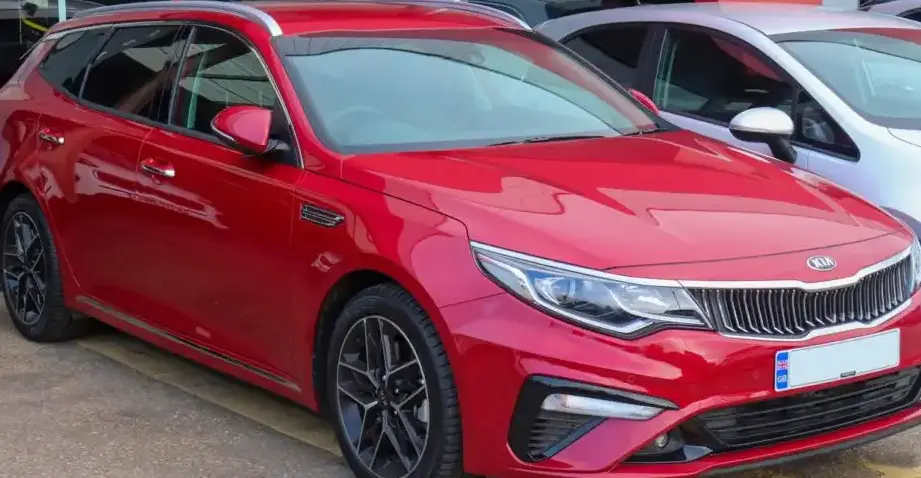
The Kia Optima IV Sportswagon GT 2.0 T-GDI (238 Hp) GPF Sportmatic, produced from 2018 to 2020, represents the performance-oriented variant of Kia’s D-segment wagon. This model, part of the facelifted fourth generation (JF) Optima range, aimed to provide a more engaging driving experience and a sportier aesthetic compared to the standard Optima Sportswagon. It was primarily marketed in Europe and select international markets, offering a blend of practicality, technology, and performance within the competitive station wagon segment. The “GPF” designation indicates the inclusion of a Gasoline Particulate Filter, reflecting increasingly stringent European emissions regulations.
Technical Specifications
| Brand | Kia |
| Model | Optima |
| Generation | Optima IV Sportswagon (facelift 2018) |
| Type | GT 2.0 T-GDI (238 Hp) GPF Sportmatic |
| Start of production | 2018 |
| End of production | 2020 |
| Powertrain Architecture | Internal Combustion engine |
| Body type | Station wagon (estate) |
| Seats | 5 |
| Doors | 5 |
| Fuel consumption (urban) | 13.1-13.2 l/100 km (18 – 17.8 US mpg) |
| Fuel consumption (extra urban) | 6.4-7 l/100 km (36.8 – 33.6 US mpg) |
| Fuel consumption (combined) | 8.9-9.3 l/100 km (26.4 – 25.3 US mpg) |
| CO2 emissions | 203-212 g/km |
| Fuel Type | Petrol (Gasoline) |
| Acceleration 0 – 100 km/h | 7.6 sec |
| Acceleration 0 – 62 mph | 7.6 sec |
| Acceleration 0 – 60 mph | 7.2 sec |
| Maximum speed | 240 km/h (149.13 mph) |
| Emission standard | Euro 6d – TEMP |
| Weight-to-power ratio | 6.7 kg/Hp |
| Weight-to-torque ratio | 4.5 kg/Nm |
| Power | 238 Hp @ 6000 rpm |
| Torque | 353 Nm @ 1350-4000 rpm (260.36 lb.-ft.) |
| Engine layout | Front, Transverse |
| Engine Model/Code | Theta II / G4KH |
| Engine displacement | 1998 cm3 (121.93 cu. in.) |
| Number of cylinders | 4 |
| Engine configuration | Inline |
| Cylinder Bore | 86 mm (3.39 in.) |
| Piston Stroke | 86 mm (3.39 in.) |
| Compression ratio | 10:1 |
| Number of valves per cylinder | 4 |
| Fuel injection system | Direct injection |
| Engine aspiration | Twin-scroll turbo, Intercooler |
| Valvetrain | DOHC |
| Engine oil capacity | 4.8 l (5.07 US qt | 4.22 UK qt) |
| Coolant capacity | 7.3 l (7.71 US qt | 6.42 UK qt) |
| Kerb Weight | 1605-1720 kg (3538.42 – 3791.95 lbs.) |
| Max. weight | 2190 kg (4828.12 lbs.) |
| Max load | 470-585 kg (1036.17 – 1289.7 lbs.) |
| Trunk (boot) space – minimum | 552 l (19.49 cu. ft.) |
| Trunk (boot) space – maximum | 1686 l (59.54 cu. ft.) |
| Fuel tank capacity | 70 l (18.49 US gal | 15.4 UK gal) |
| Max. roof load | 100 kg (220.46 lbs.) |
| Permitted trailer load with brakes (12%) | 1400 kg (3086.47 lbs.) |
| Permitted trailer load without brakes | 700 kg (1543.24 lbs.) |
| Permitted towbar download | 80 kg (176.37 lbs.) |
| Length | 4855 mm (191.14 in.) |
| Width | 1860 mm (73.23 in.) |
| Width including mirrors | 2120 mm (83.46 in.) |
| Height | 1470-1480 mm (57.87 – 58.27 in.) |
| Wheelbase | 2805 mm (110.43 in.) |
| Front track | 1597-1607 mm (62.87 – 63.27 in.) |
| Rear track | 1604-1614 mm (63.15 – 63.54 in.) |
| Front overhang | 965 mm (37.99 in.) |
| Rear overhang | 1085 mm (42.72 in.) |
| Ride height (ground clearance) | 125 mm (4.92 in.) |
| Minimum turning circle | 10.9 m (35.76 ft.) |
| Drivetrain | Front wheel drive |
| Number of gears | 6 |
| Gearbox type | automatic transmission Sportmatic |
| Front suspension | Independent, type McPherson with coil spring and anti-roll bar |
| Rear suspension | Independent multi-link spring suspension with stabilizer |
| Front brakes | Ventilated discs |
| Rear brakes | Disc |
| Steering type | Steering rack and pinion |
| Power steering | Electric |
| Tires size | 215/60 R16; 215/55 R17; 235/45 R18 |
| Wheel rims size | 6.5J x 16; 7.5J x 17; 7.5J x 18 |
Powertrain & Engine Architecture
The heart of the Optima Sportswagon GT is the Theta II 2.0 T-GDI engine, specifically the G4KH code. This is a turbocharged, direct-injection four-cylinder gasoline engine displacing 1998cc. The engine utilizes a twin-scroll turbocharger and intercooler to enhance performance and efficiency. Direct injection allows for precise fuel delivery, optimizing combustion and reducing emissions. The engine produces 238 horsepower at 6000 rpm and 353 Nm (260.36 lb-ft) of torque between 1350 and 4000 rpm. This broad torque curve contributes to strong acceleration and responsive performance. The engine is paired with a six-speed ‘Sportmatic’ automatic transmission, offering both fully automatic operation and the ability for the driver to manually select gears. This transmission was chosen for its balance of efficiency and responsiveness, although it doesn’t offer the lightning-fast shifts of some dual-clutch transmissions.
Driving Characteristics
The 2.0 T-GDI engine delivers brisk acceleration, achieving 0-60 mph in approximately 7.2 seconds and a top speed of 149 mph. The Sportmatic transmission is generally smooth in operation, but can sometimes feel hesitant during quick downshifts. The engine’s strong low-end torque makes it well-suited for everyday driving, providing ample power for overtaking and merging onto highways. Compared to lower-powered Optima Sportswagon variants, the GT offers a significantly more engaging driving experience. While not a true sports car, it provides a noticeable step up in performance and responsiveness. The suspension is tuned for a balance between comfort and handling, offering a reasonably controlled ride without being overly harsh.
Equipment & Trim Levels
The GT trim level came generously equipped as standard. Key features included leather upholstery, heated and ventilated front seats, a panoramic sunroof, a premium audio system, and a suite of advanced driver-assistance systems (ADAS) such as adaptive cruise control, lane-keeping assist, and automatic emergency braking. The interior featured a sporty design with unique trim accents and GT badging. Optional extras included a navigation system, a rear-view camera, and upgraded wheel designs. The overall interior ambiance was a step above the lower trims, offering a more premium feel.
Chassis & Braking
The Optima Sportswagon GT utilizes an independent suspension setup at all four corners. The front suspension employs McPherson struts with coil springs and an anti-roll bar, while the rear features a multi-link setup with a stabilizer bar. This configuration provides a good balance of ride comfort and handling precision. The braking system consists of ventilated discs at the front and solid discs at the rear. ABS (Anti-lock Braking System) is standard, providing enhanced stopping power and stability. The steering is electrically assisted, offering a light and precise feel.
Market Reception & Comparison
The Optima Sportswagon GT was generally well-received by automotive critics, who praised its stylish design, spacious interior, and strong performance. However, some reviewers noted that the automatic transmission could be occasionally sluggish. Compared to rivals such as the Skoda Octavia Combi, Volkswagen Passat Estate, and Ford Mondeo Estate, the Optima Sportswagon GT offered a competitive package with a focus on value and features. Fuel economy was respectable, but not class-leading, with combined figures ranging from 26.4 to 25.3 US mpg. Reliability reports have been generally positive, although some owners have reported minor issues with the infotainment system.
Legacy
The Kia Optima IV Sportswagon GT 2.0 T-GDI represents a significant step forward for Kia in terms of design, performance, and technology. The Theta II engine, while not without its occasional issues, has proven to be a relatively durable and reliable powerplant. On the used car market, these models hold their value reasonably well, particularly those in good condition with low mileage. The Sportswagon GT remains a practical and stylish choice for buyers seeking a versatile and engaging station wagon.