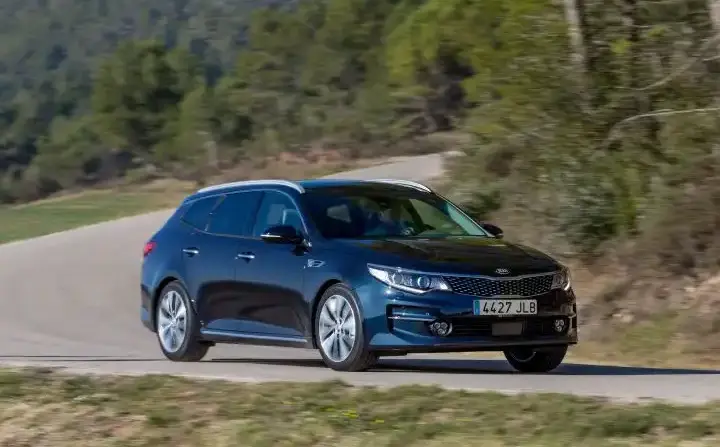
The Kia Optima IV Sportswagon GT 2.0 T-GDI Automatic, produced from 2016 to 2018, represents a compelling offering in the mid-size wagon segment. Positioned as the performance-oriented variant of the fourth-generation Optima (JF), the Sportswagon GT aimed to blend practicality with a more engaging driving experience. It was primarily marketed in Europe and other regions where wagons maintain significant popularity, offering a stylish alternative to traditional SUVs. This particular configuration, featuring the 2.0-liter turbocharged gasoline engine paired with a six-speed automatic transmission, sat at the top of the Sportswagon lineup, offering the highest power output and a more refined driving experience compared to lower-trim models.
Technical Specifications
| Brand | Kia |
| Model | Optima |
| Generation | Optima IV Sportswagon |
| Type (Engine) | GT 2.0 T-GDI (245 Hp) Automatic |
| Start of production | 2016 |
| End of production | 2018 |
| Powertrain Architecture | Internal Combustion engine |
| Body type | Station wagon (estate) |
| Seats | 5 |
| Doors | 5 |
| Fuel consumption (urban) | 11.8 l/100 km (19.9 US mpg, 23.9 UK mpg, 8.5 km/l) |
| Fuel consumption (extra urban) | 6.1 l/100 km (38.6 US mpg, 46.3 UK mpg, 16.4 km/l) |
| Fuel consumption (combined) | 8.2 l/100 km (28.7 US mpg, 34.4 UK mpg, 12.2 km/l) |
| CO2 emissions | 191 g/km |
| Fuel Type | Petrol (Gasoline) |
| Acceleration 0 – 100 km/h | 7.6 sec |
| Acceleration 0 – 62 mph | 7.6 sec |
| Acceleration 0 – 60 mph | 7.2 sec |
| Maximum speed | 232 km/h (144.16 mph) |
| Emission standard | Euro 6 |
| Weight-to-power ratio | 6.6 kg/Hp, 152.6 Hp/tonne |
| Weight-to-torque ratio | 4.5 kg/Nm, 219.9 Nm/tonne |
| Power | 245 Hp @ 6000 rpm |
| Power per litre | 122.6 Hp/l |
| Torque | 353 Nm @ 1350-4000 rpm (260.36 lb.-ft. @ 1350-4000 rpm) |
| Engine layout | Front, Transverse |
| Engine Model/Code | G4KH |
| Engine displacement | 1998 cm3 (121.93 cu. in.) |
| Number of cylinders | 4 |
| Engine configuration | Inline |
| Cylinder Bore | 86 mm (3.39 in.) |
| Piston Stroke | 86 mm (3.39 in.) |
| Compression ratio | 10:1 |
| Number of valves per cylinder | 4 |
| Fuel injection system | Direct injection |
| Engine aspiration | Twin-Turbo, Intercooler |
| Engine oil capacity | 4.8 l (5.07 US qt | 4.22 UK qt) |
| Coolant | 7.3 l (7.71 US qt | 6.42 UK qt) |
| Kerb Weight | 1605-1720 kg (3538.42 – 3791.95 lbs.) |
| Max. weight | 2190 kg (4828.12 lbs.) |
| Max load | 470-585 kg (1036.17 – 1289.7 lbs.) |
| Trunk (boot) space – minimum | 552 l (19.49 cu. ft.) |
| Trunk (boot) space – maximum | 1686 l (59.54 cu. ft.) |
| Fuel tank capacity | 70 l (18.49 US gal | 15.4 UK gal) |
| Max. roof load | 100 kg (220.46 lbs.) |
| Permitted trailer load with brakes (12%) | 1400 kg (3086.47 lbs.) |
| Permitted trailer load without brakes | 700 kg (1543.24 lbs.) |
| Permitted towbar download | 80 kg (176.37 lbs.) |
| Length | 4855 mm (191.14 in.) |
| Width | 1860 mm (73.23 in.) |
| Width including mirrors | 2120 mm (83.46 in.) |
| Height | 1470 mm (57.87 in.) |
| Wheelbase | 2805 mm (110.43 in.) |
| Front track | 1597 mm (62.87 in.) |
| Rear (Back) track | 1608 mm (63.31 in.) |
| Front overhang | 965 mm (37.99 in.) |
| Rear overhang | 1085 mm (42.72 in.) |
| Ride height (ground clearance) | 135 mm (5.31 in.) |
| Minimum turning circle (turning diameter) | 10.9 m (35.76 ft.) |
| Drivetrain Architecture | The Internal combustion engine (ICE) drives the front wheels of the vehicle. |
| Drive wheel | Front wheel drive |
| Number of gears and type of gearbox | 6 gears, automatic transmission |
| Front suspension | Independent, type McPherson with coil spring and anti-roll bar |
| Rear suspension | Independent multi-link suspension |
| Front brakes | Ventilated discs |
| Rear brakes | Disc |
| Assisting systems | ABS (Anti-lock braking system) |
| Steering type | Steering rack and pinion |
| Power steering | Electric Steering |
| Tires size | 215/60 R16 95V; 215/55 R17 94W; 235/45 ZR18 98Y |
| Wheel rims size | 6.5J x 16; 7.5J x 17; 7.5J x 18 |
INTRODUCTION
The Kia Optima IV Sportswagon GT 2.0 T-GDI Automatic, launched in 2016 and continuing through 2018, was a key model in Kia’s expansion into the European wagon market. Built on the Optima JF platform (also known as the 1HX0), the Sportswagon variant offered a practical and stylish alternative to more conventional sedan offerings. The “GT” designation signified the high-performance trim level, distinguished by its more powerful engine, sport-tuned suspension, and unique styling cues. This model aimed to attract buyers seeking a blend of family-friendly space and a more dynamic driving experience.
Powertrain & Engine Architecture
At the heart of the Sportswagon GT lies the G4KH 2.0-liter turbocharged four-cylinder engine. This engine utilizes direct injection technology to maximize efficiency and power output. The G4KH engine is part of Kia’s “Smartstream” engine family, designed for improved fuel economy and reduced emissions. The twin-scroll turbocharger, coupled with an intercooler, helps to minimize turbo lag and deliver a broad torque curve. The engine produces 245 horsepower at 6000 rpm and 353 Nm (260.36 lb-ft) of torque between 1350 and 4000 rpm. This power is delivered through a six-speed automatic transmission, chosen for its smooth shifting and responsiveness. While not a dual-clutch transmission, the automatic was programmed for quicker shifts in Sport mode.
Driving Characteristics
The 2.0 T-GDI engine, paired with the six-speed automatic, provides brisk acceleration. The 0-60 mph sprint takes approximately 7.2 seconds, and the car has a top speed of 144 mph. The automatic transmission is well-matched to the engine’s characteristics, offering smooth upshifts and downshifts. However, it doesn’t offer the same level of engagement as a manual transmission or a dual-clutch system. The Sport mode does sharpen throttle response and hold gears longer, improving the driving experience. The Sportswagon GT’s suspension is tuned for a balance between comfort and handling, providing a more controlled ride than the standard Optima Sportswagon. The steering is precise, but lacks significant feedback.
Equipment & Trim Levels
The GT trim level came standard with a generous array of features. Interior appointments included leather upholstery, heated and ventilated front seats, and a panoramic sunroof. Infotainment was provided by a 7-inch touchscreen display with navigation, Apple CarPlay, and Android Auto compatibility. Safety features included automatic emergency braking, lane departure warning, and blind-spot monitoring. Optional extras included a premium sound system, adaptive cruise control, and a rear cross-traffic alert system. Exterior styling cues included unique front and rear bumpers, side skirts, and a rear spoiler.
Chassis & Braking
The Optima Sportswagon GT utilizes an independent McPherson strut suspension in the front and an independent multi-link suspension in the rear. This setup provides a good balance of ride comfort and handling. The GT model featured stiffer springs and dampers compared to lower trims. Braking duties are handled by ventilated discs at the front and solid discs at the rear. The car is equipped with ABS, Electronic Stability Control (ESC), and Traction Control System (TCS) as standard safety features. The steering system is a rack-and-pinion type with electric power assistance.
Market Reception & Comparison
The Optima Sportswagon GT was generally well-received by automotive critics. It was praised for its stylish design, spacious interior, and strong performance. However, some reviewers noted that the automatic transmission wasn’t as engaging as a manual, and the ride could be firm on rough roads. Compared to other trims in the Optima Sportswagon lineup, the GT offered a significant performance upgrade. The 1.7 CRDi diesel, for example, prioritized fuel economy over outright speed. The GT’s higher price point reflected its increased performance and equipment levels. Competitors included the Ford Mondeo Estate, Volkswagen Passat Estate, and Skoda Superb Estate.
Legacy
The Kia Optima IV Sportswagon GT 2.0 T-GDI Automatic has proven to be a relatively reliable vehicle in the used car market. The G4KH engine, while turbocharged, has demonstrated good durability with regular maintenance. The six-speed automatic transmission is also known for its reliability. Common issues reported by owners include minor electrical glitches and wear on suspension components. Today, the Sportswagon GT represents a compelling option for buyers seeking a stylish, practical, and reasonably powerful wagon. Its combination of performance, features, and value has helped it maintain a loyal following in the used car market.