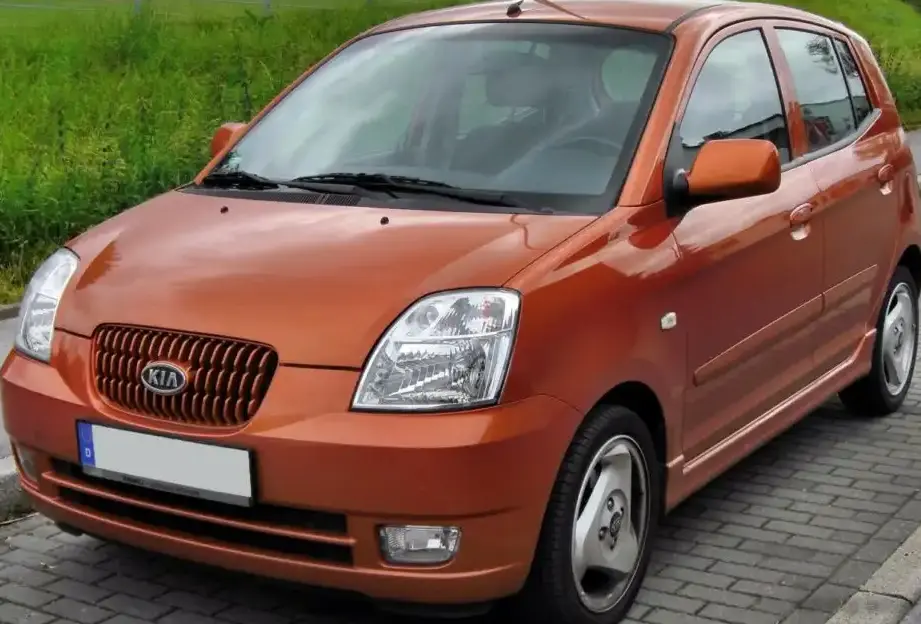
The Kia Picanto first generation (TA), produced from 2004 to 2007, represented Kia’s entry into the highly competitive city car segment. The 1.1i 12V (64 hp) Automatic variant, powered by the G4HG engine, was a key offering aimed at buyers prioritizing ease of use and affordability. This model occupied the base trim level within the Picanto range, offering a practical and economical transportation solution. It was primarily marketed in Europe and Asia, where demand for small, fuel-efficient vehicles was high. The Picanto aimed to provide a more refined and feature-rich alternative to established competitors like the Fiat Panda and Daewoo Matiz.
Technical Specifications
| Brand | Kia |
| Model | Picanto |
| Generation | Picanto I |
| Type (Engine) | 1.1i 12V (64 Hp) Automatic |
| Start of production | 2004 |
| End of production | 2007 |
| Powertrain Architecture | Internal Combustion engine |
| Body type | Hatchback |
| Seats | 5 |
| Doors | 5 |
| Fuel consumption (urban) | 6.5 l/100 km (36.2 US mpg, 43.5 UK mpg, 15.4 km/l) |
| Fuel consumption (extra urban) | 4.4 l/100 km (53.5 US mpg, 64.2 UK mpg, 22.7 km/l) |
| Fuel consumption (combined) | 4.9 l/100 km (48 US mpg, 57.6 UK mpg, 20.4 km/l) |
| Fuel Type | Petrol (Gasoline) |
| Acceleration 0 – 100 km/h | 15.4 sec |
| Acceleration 0 – 62 mph | 15.4 sec |
| Acceleration 0 – 60 mph | 14.6 sec |
| Maximum speed | 154 km/h (95.69 mph) |
| Weight-to-power ratio | 15.1 kg/Hp, 66.3 Hp/tonne |
| Weight-to-torque ratio | 10 kg/Nm, 100.4 Nm/tonne |
| Power | 64 Hp @ 5500 rpm |
| Power per litre | 58.9 Hp/l |
| Torque | 97 Nm @ 2800 rpm (71.54 lb.-ft. @ 2800 rpm) |
| Engine layout | Front, Transverse |
| Engine Model/Code | G4HG |
| Engine displacement | 1086 cm3 (66.27 cu. in.) |
| Number of cylinders | 4 |
| Engine configuration | Inline |
| Cylinder Bore | 67 mm (2.64 in.) |
| Piston Stroke | 77 mm (3.03 in.) |
| Compression ratio | 10:1 |
| Number of valves per cylinder | 3 |
| Fuel injection system | Multi-port manifold injection |
| Engine aspiration | Naturally aspirated engine |
| Valvetrain | OHC |
| Engine oil capacity | 3 l (3.17 US qt | 2.64 UK qt) |
| Coolant capacity | 4.7 l (4.97 US qt | 4.14 UK qt) |
| Kerb Weight | 966 kg (2129.67 lbs.) |
| Max. weight | 1350 kg (2976.24 lbs.) |
| Max load | 384 kg (846.58 lbs.) |
| Trunk (boot) space – minimum | 220 l (7.77 cu. ft.) |
| Trunk (boot) space – maximum | 882 l (31.15 cu. ft.) |
| Fuel tank capacity | 35 l (9.25 US gal | 7.7 UK gal) |
| Length | 3495 mm (137.6 in.) |
| Width | 1595 mm (62.8 in.) |
| Height | 1480 mm (58.27 in.) |
| Wheelbase | 2370 mm (93.31 in.) |
| Front track | 1400 mm (55.12 in.) |
| Rear track | 1385 mm (54.53 in.) |
| Minimum turning circle | 9.2 m (30.18 ft.) |
| Drivetrain Architecture | Front wheel drive |
| Number of gears | 4 |
| Gearbox type | Automatic transmission |
| Front suspension | Spring Strut |
| Rear suspension | Torsion |
| Front brakes | Disc |
| Rear brakes | Disc |
| Assisting systems | ABS (Anti-lock braking system) |
| Steering type | Steering rack and pinion |
| Tires size | 165/65 R14 |
| Wheel rims size | 5J x 14 |
Powertrain & Engine Architecture
The heart of the Picanto 1.1i Automatic is the G4HG engine, a 1.1-liter inline-four cylinder gasoline engine. This engine utilizes a single overhead camshaft (SOHC) valvetrain with three valves per cylinder (two intake, one exhaust). The G4HG employs multi-point fuel injection, delivering fuel directly into the intake ports. This system, while relatively simple, provided adequate fuel atomization for the engine’s modest power output. The engine’s design prioritized fuel efficiency and reliability over outright performance. The four-speed automatic transmission was a conventional torque converter type, chosen for its smoothness and ease of use, particularly appealing to the target demographic. It wasn’t known for rapid shifts, but rather for providing a comfortable driving experience in urban environments.
Driving Characteristics
The 1.1i Automatic Picanto offered a decidedly unhurried driving experience. With only 64 horsepower, acceleration was slow, taking approximately 15.4 seconds to reach 62 mph. The automatic transmission, while smooth, contributed to this lack of urgency. Gear ratios were optimized for fuel economy rather than performance, meaning the engine often felt strained during overtaking maneuvers or when climbing hills. However, within city limits, the Picanto proved surprisingly nimble and easy to maneuver. The light steering and compact dimensions made parking a breeze. The automatic transmission eliminated the need for constant gear changes, making it ideal for stop-and-go traffic. Compared to the five-speed manual version, the automatic sacrificed some fuel economy and responsiveness, but gained significantly in driver convenience.
Equipment & Trim Levels
The 1.1i Automatic trim level was generally considered the entry-level Picanto. Standard features typically included power steering, central locking, electric front windows, and an immobilizer. Interior upholstery was usually a basic cloth material. Air conditioning was often an optional extra, as were features like alloy wheels and a radio/CD player. The dashboard layout was functional and straightforward, prioritizing usability over aesthetics. Safety features were relatively basic for the time, typically including driver and passenger airbags and ABS brakes.
Chassis & Braking
The Picanto’s chassis was a simple, yet effective, design. It utilized a MacPherson strut front suspension and a torsion beam rear suspension. This setup provided a comfortable ride quality, although it wasn’t particularly sporty. The front brakes were ventilated discs, while the rear brakes were solid discs – a relatively uncommon setup for a car in this class at the time. ABS (Anti-lock Braking System) was standard, enhancing braking performance and safety. The steering was a rack and pinion system, providing light and precise steering feel.
Market Reception & Comparison
The Kia Picanto 1.1i Automatic was generally well-received as an affordable and practical city car. Critics praised its fuel efficiency, ease of use, and surprisingly spacious interior for its size. However, the engine’s lack of power and the automatic transmission’s sluggishness were common criticisms. Compared to other Picanto variants, such as the 1.0-liter manual, the 1.1i Automatic offered slightly more power but at the cost of fuel economy. Against competitors like the Fiat Panda and Daewoo Matiz, the Picanto offered a more refined interior and a longer warranty, contributing to its growing popularity.
Legacy
The G4HG engine and the four-speed automatic transmission pairing in the first-generation Kia Picanto proved to be reasonably reliable. While not known for exceptional longevity, these components generally held up well with regular maintenance. Today, these Picantos are relatively inexpensive to purchase on the used car market. Common issues include wear and tear on suspension components and occasional problems with the automatic transmission. However, parts are generally affordable and readily available. The Picanto 1.1i Automatic remains a viable option for those seeking a basic, economical, and easy-to-drive city car, particularly for short commutes and urban driving.