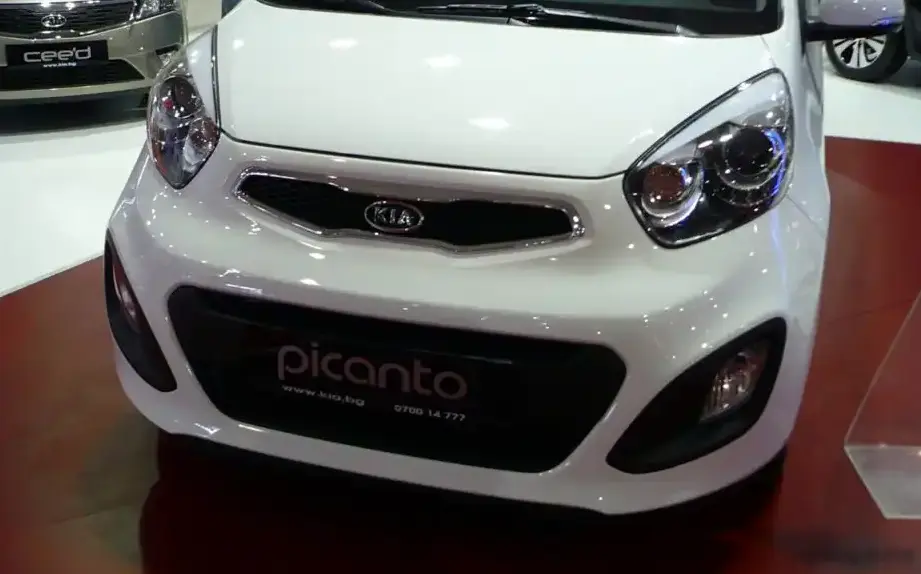
The Kia Picanto II 3D 1.2 16V (85 hp) represents a significant entry in the subcompact city car segment, produced between 2011 and 2015. This variant, part of the second generation (TA) Picanto, was primarily aimed at the European and Asian markets, offering an affordable and practical transportation solution. It sat within the Picanto II lineup as the standard engine and transmission combination, positioned below the more powerful (though not widely available) engine options. The Picanto II, built on the HA3 platform, aimed to improve upon the first generation with enhanced styling, interior space, and safety features, while maintaining a focus on fuel efficiency and low running costs.
Technical Specifications
| Brand | Kia |
| Model | Picanto |
| Generation | Picanto II 3D |
| Type (Engine) | 1.2 16V (85 Hp) |
| Start of production | 2011 |
| End of production | 2015 |
| Powertrain Architecture | Internal Combustion engine |
| Body type | Hatchback |
| Seats | 5 |
| Doors | 3 |
| Fuel consumption (urban) | 5.8 l/100 km (40.6 US mpg, 48.7 UK mpg, 17.2 km/l) |
| Fuel consumption (extra urban) | 3.8 l/100 km (61.9 US mpg, 74.3 UK mpg, 26.3 km/l) |
| Fuel consumption (combined) | 4.5 l/100 km (52.3 US mpg, 62.8 UK mpg, 22.2 km/l) |
| Fuel Type | Petrol (Gasoline) |
| Acceleration 0 – 100 km/h | 11.4 sec |
| Acceleration 0 – 62 mph | 11.4 sec |
| Acceleration 0 – 60 mph | 10.8 sec |
| Maximum speed | 171 km/h (106.25 mph) |
| Emission standard | Euro 5 |
| Weight-to-power ratio | 10 kg/Hp |
| Weight-to-torque ratio | 7.1 kg/Nm |
| Power | 85 Hp |
| Power per litre | 68.1 Hp/l |
| Torque | 120 Nm @ 4000 rpm (88.51 lb.-ft. @ 4000 rpm) |
| Engine layout | Front, Transverse |
| Engine Model/Code | G4LA |
| Engine displacement | 1248 cm3 (76.16 cu. in.) |
| Number of cylinders | 4 |
| Engine configuration | Inline |
| Fuel injection system | Multi-port manifold injection |
| Engine aspiration | Naturally aspirated engine |
| Engine oil capacity | 3.5 l (3.7 US qt | 3.08 UK qt) |
| Coolant capacity | 5.1 l (5.39 US qt | 4.49 UK qt) |
| Kerb Weight | 850 kg (1873.93 lbs.) |
| Max. weight | 1330 kg (2932.15 lbs.) |
| Max load | 480 kg (1058.22 lbs.) |
| Trunk (boot) space – minimum | 200 l (7.06 cu. ft.) |
| Trunk (boot) space – maximum | 605 l (21.37 cu. ft.) |
| Fuel tank capacity | 35 l (9.25 US gal | 7.7 UK gal) |
| Length | 3595 mm (141.54 in.) |
| Width | 1595 mm (62.8 in.) |
| Height | 1480 mm (58.27 in.) |
| Wheelbase | 2385 mm (93.9 in.) |
| Front track | 1421 mm (55.94 in.) |
| Rear track | 1424 mm (56.06 in.) |
| Minimum turning circle | 9.8 m (32.15 ft.) |
| Drivetrain | Front wheel drive |
| Number of gears | 5 |
| Gearbox type | Manual transmission |
| Assisting systems | ABS (Anti-lock braking system) |
| Steering type | Steering rack and pinion |
| Tires size | 165/60 R14 |
| Wheel rims size | 14 |
Powertrain & Engine Architecture
The heart of the Picanto II 3D 1.2 16V is the Kia G4LA engine, a 1.248-liter inline-four cylinder gasoline engine. This engine utilizes a multi-point fuel injection system, delivering fuel directly into the intake ports. The engine features a double overhead camshaft (DOHC) valvetrain, optimizing airflow for improved efficiency and power output. The G4LA is a relatively simple and robust design, prioritizing reliability and low maintenance costs. Paired with this engine is a five-speed manual transmission, chosen for its affordability and efficiency. The transmission’s gear ratios are tuned for city driving, providing adequate acceleration from a standstill while maintaining reasonable fuel economy at highway speeds. The engine’s 85 horsepower and 120 Nm (88.5 lb-ft) of torque are modest, but sufficient for navigating urban environments and lighter loads.
Driving Characteristics
The 1.2L engine and five-speed manual transmission combination in the Picanto II 3D delivers a driving experience geared towards practicality and economy. Acceleration is not brisk, taking approximately 11.4 seconds to reach 62 mph (100 km/h). However, the engine is responsive enough for everyday driving, and the light weight of the vehicle (around 850 kg or 1874 lbs) helps to mitigate the lack of outright power. The gear ratios are well-spaced, allowing for smooth shifts and maintaining engine speed within the optimal torque band. Compared to potential higher-output variants (which were rarely offered in this configuration), this setup prioritizes fuel efficiency and ease of use over performance. The steering is light and precise, making it easy to maneuver in tight spaces. The suspension, while basic, provides a comfortable ride on most road surfaces.
Equipment & Trim Levels
The Picanto II 3D 1.2 16V typically came with a fairly basic level of standard equipment, reflecting its position as an entry-level vehicle. Standard features generally included power steering, central locking, electric front windows, and an ABS anti-lock braking system. Interior upholstery was typically cloth, with a simple dashboard layout. Optional extras could include air conditioning, alloy wheels, and a radio/CD player. Higher trim levels, if available in specific markets, might add features like body-colored door handles and mirrors, and upgraded interior trim. The focus was on providing essential features at an affordable price point.
Chassis & Braking
The Picanto II 3D utilizes a front-wheel-drive chassis with a MacPherson strut front suspension and a torsion beam rear suspension. This setup provides a good balance between ride comfort and handling. The braking system consists of disc brakes on the front wheels and drum brakes on the rear wheels. ABS (Anti-lock Braking System) was standard, enhancing safety by preventing wheel lockup during hard braking. The relatively light weight of the vehicle contributes to its braking performance. Stabilizer bars were typically fitted to the front suspension to reduce body roll during cornering.
Market Reception & Comparison
The Kia Picanto II 3D 1.2 16V was generally well-received by critics as an affordable and practical city car. Its fuel efficiency was a major selling point, and its compact size made it easy to park and maneuver in urban environments. Compared to other vehicles in its class, such as the Fiat Panda or Volkswagen Up!, the Picanto offered a good level of standard equipment for its price. However, some critics noted that the engine was underpowered, particularly when carrying passengers or luggage. Reliability was generally considered good, and maintenance costs were relatively low. The 1.2L engine proved to be a dependable unit, and the simple mechanical design minimized the potential for expensive repairs.
Legacy
The Kia Picanto II 3D 1.2 16V has proven to be a reliable and durable vehicle in the used car market. The G4LA engine is known for its longevity, and the simple mechanical design makes it relatively easy to maintain. While not a performance car, it remains a popular choice for those seeking an affordable and economical city car. Parts availability is generally good, and repair costs are typically reasonable. The Picanto II 3D continues to be a viable option for first-time car buyers or those looking for a practical and inexpensive mode of transportation.