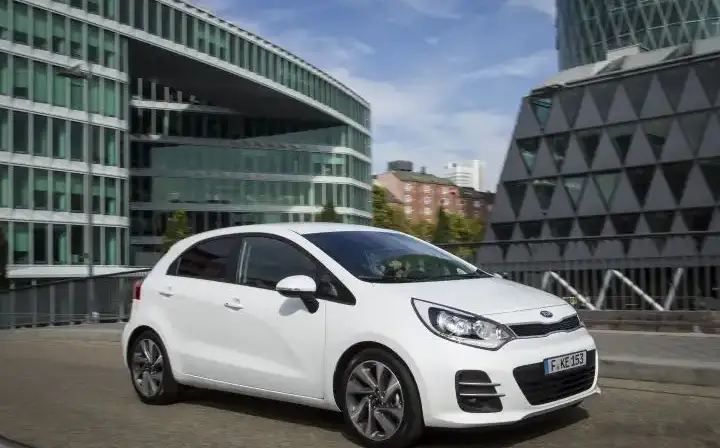
Technical Specifications
| Brand | Kia |
| Model | Rio |
| Generation | Rio III Hatchback (UB, facelift 2015) |
| Type (Engine) | 1.2 (84 Hp) ISG |
| Start of production | 2015 |
| End of production | 2017 |
| Powertrain Architecture | Internal Combustion engine |
| Body type | Hatchback |
| Seats | 5 |
| Doors | 5 |
| Fuel consumption (urban) | 5.9 l/100 km (39.9 US mpg, 47.9 UK mpg, 16.9 km/l) |
| Fuel consumption (extra urban) | 4.1 l/100 km (57.4 US mpg, 68.9 UK mpg, 24.4 km/l) |
| Fuel consumption (combined) | 4.7 l/100 km (50 US mpg, 60.1 UK mpg, 21.3 km/l) |
| CO2 emissions | 109 g/km |
| Fuel Type | Petrol (Gasoline) |
| Acceleration 0 – 100 km/h | 13.4 sec |
| Acceleration 0 – 62 mph | 13.4 sec |
| Acceleration 0 – 60 mph | 12.7 sec |
| Maximum speed | 166 km/h (103.15 mph) |
| Emission standard | Euro 6 |
| Weight-to-power ratio | 12.5 kg/Hp, 79.8 Hp/tonne |
| Weight-to-torque ratio | 8.7 kg/Nm, 115 Nm/tonne |
| Power | 84 Hp @ 6000 rpm |
| Power per litre | 67.3 Hp/l |
| Torque | 121 Nm @ 4000 rpm (89.25 lb.-ft. @ 4000 rpm) |
| Engine layout | Front, Transverse |
| Engine Model/Code | G4LA |
| Engine displacement | 1248 cm3 (76.16 cu. in.) |
| Number of cylinders | 4 |
| Engine configuration | Inline |
| Cylinder Bore | 71 mm (2.8 in.) |
| Piston Stroke | 78.8 mm (3.1 in.) |
| Compression ratio | 10.5:1 |
| Number of valves per cylinder | 4 |
| Fuel injection system | Multi-port manifold injection |
| Engine aspiration | Naturally aspirated engine |
| Engine oil capacity | 3.5 l (3.7 US qt | 3.08 UK qt) |
| Coolant | 4.7 l (4.97 US qt | 4.14 UK qt) |
| Kerb Weight | 1052-1132 kg (2319.26 – 2495.63 lbs.) |
| Max. weight | 1560 kg (3439.21 lbs.) |
| Max load | 428-508 kg (943.58 – 1119.95 lbs.) |
| Trunk (boot) space – minimum | 288 l (10.17 cu. ft.) |
| Trunk (boot) space – maximum | 923 l (32.6 cu. ft.) |
| Fuel tank capacity | 43 l (11.36 US gal | 9.46 UK gal) |
| Max. roof load | 70 kg (154.32 lbs.) |
| Permitted trailer load with brakes (12%) | 900 kg (1984.16 lbs.) |
| Permitted trailer load without brakes | 450 kg (992.08 lbs.) |
| Permitted towbar download | 50 kg (110.23 lbs.) |
| Length | 4050 mm (159.45 in.) |
| Width | 1720 mm (67.72 in.) |
| Width including mirrors | 1985 mm (78.15 in.) |
| Height | 1455 mm (57.28 in.) |
| Wheelbase | 2570 mm (101.18 in.) |
| Front track | 1507-1520 mm (59.33 – 59.84 in.) |
| Rear (Back) track | 1511-1525 mm (59.49 – 60.04 in.) |
| Front overhang | 810 mm (31.89 in.) |
| Rear overhang | 670 mm (26.38 in.) |
| Minimum turning circle | 10.5 m (34.45 ft.) |
| Drivetrain Architecture | Front wheel drive |
| Drive wheel | Front wheel drive |
| Number of gears and type of gearbox | 5 gears, manual transmission |
| Front suspension | Independent, type McPherson with coil spring and anti-roll bar |
| Rear suspension | Semi-independent, coil spring |
| Front brakes | Ventilated discs |
| Rear brakes | Disc |
| Assisting systems | ABS (Anti-lock braking system) |
| Steering type | Steering rack and pinion |
| Power steering | Electric Steering |
| Tires size | 185/65 R15; 195/55 R16; 205/45 R17 |
| Wheel rims size | 5.5J x 15; 6.0J x 16; 6.5J x 17 |
The Kia Rio III Hatchback, specifically the 1.2-liter (84 horsepower) variant with Intelligent Stop & Go (ISG) produced from 2015 to 2017, represented an entry-level offering within the UB facelift generation of the Rio. Positioned as a fuel-efficient and affordable option, this trim aimed at buyers prioritizing economy and practicality over outright performance. The UB series Rio, launched in 2011 and facelifted in 2015, was Kia’s attempt to elevate its presence in the highly competitive subcompact hatchback segment, particularly in the European market, and later expanded to North America. This specific engine and transmission combination was designed to meet increasingly stringent emissions standards while providing a usable, if not exhilarating, driving experience.
Powertrain & Engine Architecture
The heart of this Rio variant is the Kia-developed G4LA 1.2-liter inline-four cylinder engine. This engine utilizes a naturally aspirated configuration with multi-point fuel injection. The G4LA engine, part of Kia’s Gamma engine family, was designed with fuel efficiency as a primary goal. It features a relatively high compression ratio of 10.5:1 to maximize thermal efficiency. The engine’s valvetrain employs four valves per cylinder, contributing to improved breathing and power output. The ISG (Idle Stop & Go) system automatically shuts off the engine when the vehicle comes to a halt, such as at traffic lights, and restarts it instantly when the driver releases the brake pedal, further enhancing fuel economy. The engine is paired with a five-speed manual transmission, delivering power to the front wheels. This transmission was chosen for its simplicity and cost-effectiveness, aligning with the vehicle’s entry-level positioning.
Driving Characteristics
The 1.2-liter Rio offers modest performance. Acceleration from 0 to 60 mph takes approximately 12.7 seconds, and the top speed is around 103 mph. The engine delivers its peak torque at 4000 rpm, meaning drivers often need to utilize the engine’s rev range to achieve adequate acceleration. The five-speed manual transmission provides a reasonable spread of gears, but the relatively low power output means frequent downshifts are necessary, especially when overtaking or climbing hills. Compared to higher-spec Rio models equipped with larger engines, such as the 1.6-liter, this variant feels noticeably slower. However, the lighter engine weight contributes to nimble handling and predictable cornering. The steering is light and easy to use, making it well-suited for urban driving.
Equipment & Trim Levels
The 1.2 ISG trim typically included standard features such as air conditioning, power-assisted steering, electric front windows, and a basic audio system with USB connectivity. Safety features included ABS, airbags, and stability control. Interior upholstery was typically cloth, and the dashboard featured a functional, if somewhat basic, design. Optional extras included alloy wheels, a more advanced audio system, and parking sensors. The trim level aimed to provide essential features at an affordable price point, making it attractive to first-time car buyers or those seeking a cost-effective city car.
Chassis & Braking
The Rio III Hatchback utilizes a McPherson strut front suspension and a semi-independent coil spring rear suspension. This setup provides a comfortable ride quality, particularly on smoother roads. The front brakes are ventilated discs, while the rear brakes are discs, offering adequate stopping power for the vehicle’s weight and performance. The electric power steering provides light and precise steering feel. The chassis is designed to prioritize fuel efficiency and practicality over sporty handling, resulting in a stable and predictable driving experience.
Market Reception & Comparison
The 1.2-liter Rio was generally well-received as a value-for-money option. Critics praised its fuel efficiency and low running costs, but noted its lack of outright performance. Compared to other subcompact hatchbacks in its class, such as the Ford Fiesta or Volkswagen Polo, the Rio offered a competitive price point but lacked the refinement and driving dynamics of its rivals. The ISG system was a notable feature, contributing to its excellent fuel economy figures. Reliability reports suggest that the G4LA engine is generally reliable, although regular maintenance is essential to prevent issues.
Legacy
The Kia Rio III 1.2 ISG has become a popular choice in the used car market due to its affordability and fuel efficiency. The G4LA engine, while not known for its power, has proven to be relatively durable with proper maintenance. Common issues reported by owners include wear and tear on suspension components and occasional problems with the ISG system. Overall, this variant represents a practical and economical option for buyers seeking a reliable and affordable subcompact hatchback.