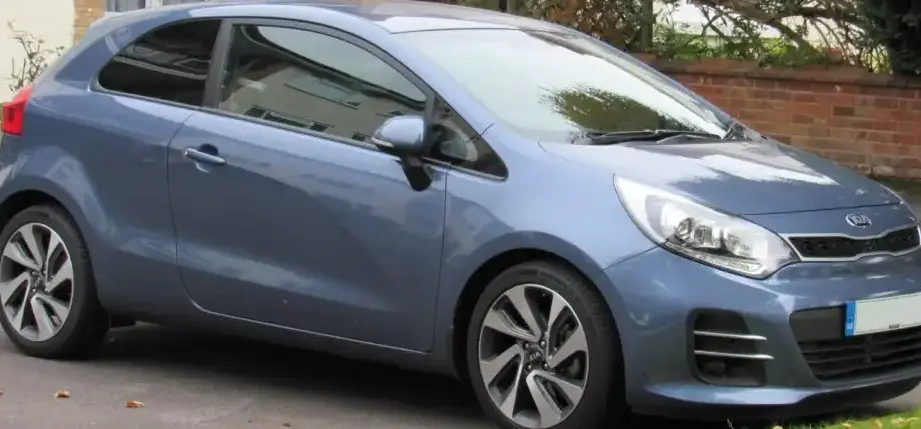
The Kia Rio III Hatchback, specifically the 3-door 1.1 CRDI (75 hp) ISG variant produced from 2015 to 2017, represented an entry-level offering within the Rio lineup during its facelifted generation (UB). Positioned as a fuel-efficient and economical choice, this model catered to buyers prioritizing low running costs and practicality. The “ISG” designation indicates the inclusion of Kia’s Idle Stop & Go system, a fuel-saving technology that automatically shuts off the engine when the vehicle is stationary. This variant was primarily sold in European markets, where demand for small, diesel-powered hatchbacks remained strong. It occupied the lower end of the Rio range, sitting below higher-powered petrol and diesel options, and offered a more affordable alternative to the 5-door body style.
Technical Specifications
| Brand | Kia |
| Model | Rio |
| Generation | Rio III Hatchback (UB, facelift 2015) 3 door |
| Type (Engine) | 1.1 CRDI (75 Hp) ISG |
| Start of production | 2015 |
| End of production | 2017 |
| Powertrain Architecture | Internal Combustion engine |
| Body type | Hatchback |
| Seats | 5 |
| Doors | 3 |
| Fuel consumption (urban) | 4.1 l/100 km (57.4 US mpg, 68.9 UK mpg, 24.4 km/l) |
| Fuel consumption (extra urban) | 3.3 l/100 km (71.3 US mpg, 85.6 UK mpg, 30.3 km/l) |
| Fuel consumption (combined) | 3.6 l/100 km (65.3 US mpg, 78.5 UK mpg, 27.8 km/l) |
| CO2 emissions | 94 g/km |
| Fuel Type | Diesel |
| Acceleration 0 – 100 km/h | 16.5 sec |
| Acceleration 0 – 62 mph | 16.5 sec |
| Acceleration 0 – 60 mph | 15.7 sec |
| Maximum speed | 160 km/h (99.42 mph) |
| Emission standard | Euro 6 |
| Weight-to-power ratio | 15 kg/Hp, 66.7 Hp/tonne |
| Weight-to-torque ratio | 6.6 kg/Nm, 151.1 Nm/tonne |
| Power | 75 Hp @ 4000 rpm |
| Power per litre | 67 Hp/l |
| Torque | 170 Nm @ 1500-2750 rpm (125.39 lb.-ft. @ 1500-2750 rpm) |
| Engine layout | Front, Transverse |
| Engine Model/Code | D3FA |
| Engine displacement | 1120 cm3 (68.35 cu. in.) |
| Number of cylinders | 3 |
| Engine configuration | Inline |
| Cylinder Bore | 75 mm (2.95 in.) |
| Piston Stroke | 84.5 mm (3.33 in.) |
| Compression ratio | 17.8:1 |
| Number of valves per cylinder | 4 |
| Fuel injection system | Diesel Commonrail |
| Engine aspiration | Turbocharger, Intercooler |
| Engine oil capacity | 4.8 l (5.07 US qt | 4.22 UK qt) |
| Coolant capacity | 6.4 l (6.76 US qt | 5.63 UK qt) |
| Kerb Weight | 1125-1205 kg (2480.2 – 2656.57 lbs.) |
| Max. weight | 1640 kg (3615.58 lbs.) |
| Max load | 435-515 kg (959.01 – 1135.38 lbs.) |
| Trunk (boot) space – minimum | 288 l (10.17 cu. ft.) |
| Trunk (boot) space – maximum | 923 l (32.6 cu. ft.) |
| Fuel tank capacity | 43 l (11.36 US gal | 9.46 UK gal) |
| Max. roof load | 70 kg (154.32 lbs.) |
| Permitted trailer load with brakes (12%) | 800 kg (1763.7 lbs.) |
| Permitted trailer load without brakes | 450 kg (992.08 lbs.) |
| Permitted towbar download | 50 kg (110.23 lbs.) |
| Length | 4050 mm (159.45 in.) |
| Width | 1720 mm (67.72 in.) |
| Width including mirrors | 1985 mm (78.15 in.) |
| Height | 1455 mm (57.28 in.) |
| Wheelbase | 2570 mm (101.18 in.) |
| Front track | 1507-1520 mm (59.33 – 59.84 in.) |
| Rear (Back) track | 1511-1525 mm (59.49 – 60.04 in.) |
| Front overhang | 810 mm (31.89 in.) |
| Rear overhang | 670 mm (26.38 in.) |
| Minimum turning circle | 10.5 m (34.45 ft.) |
| Drivetrain | Front wheel drive |
| Number of gears and type of gearbox | 6 gears, manual transmission |
| Front suspension | Independent, type McPherson with coil spring and anti-roll bar |
| Rear suspension | Semi-independent, coil spring |
| Front brakes | Ventilated discs |
| Rear brakes | Disc |
| Assisting systems | ABS (Anti-lock braking system) |
| Steering type | Steering rack and pinion |
| Power steering | Electric Steering |
| Tires size | 185/65 R15; 195/55 R16; 205/45 R17 |
| Wheel rims size | 5.5J x 15; 6.0J x 16; 6.5J x 17 |
Powertrain & Engine Architecture
The heart of this Rio variant is the Kia-developed D3FA 1.1-liter three-cylinder diesel engine. This engine utilizes a common-rail direct injection system, delivering fuel at extremely high pressure for optimized combustion. A small turbocharger with an intercooler is employed to boost power and torque, mitigating the typical power deficit associated with small displacement engines. The engine produces 75 horsepower at 4000 rpm and 170 Nm (125 lb-ft) of torque between 1500 and 2750 rpm. The high compression ratio of 17.8:1 is characteristic of diesel engines, contributing to their efficiency. The engine is transversely mounted in the front of the vehicle. The transmission is a 6-speed manual gearbox, chosen for its efficiency and affordability. While an automatic transmission was offered on other Rio models, it wasn’t available with this specific engine and power output.
Driving Characteristics
The 1.1 CRDI engine, paired with the manual transmission, delivers modest performance. Acceleration from 0 to 60 mph takes approximately 15.7 seconds, and the top speed is around 99 mph. The engine’s torque is readily available from low revs, making it suitable for urban driving and overtaking at lower speeds. However, it can feel strained when climbing hills or carrying a full load. The gear ratios are tuned for fuel economy rather than outright performance. Compared to the 1.25-liter petrol engine offered in the Rio, the 1.1 CRDI provides better fuel economy but less overall power. The manual transmission allows for greater driver control, but the shift quality can feel somewhat notchy.
Equipment & Trim Levels
The 1.1 CRDI ISG typically came with a basic level of equipment, reflecting its position as an entry-level model. Standard features generally included air conditioning, central locking, electric front windows, a basic audio system with USB connectivity, and ABS brakes. Safety features such as airbags were also standard. Optional extras included alloy wheels, a more advanced audio system, and parking sensors. Interior upholstery was typically cloth, and the dashboard featured a simple, functional design. The 3-door body style offered a sportier aesthetic compared to the 5-door version, but at the expense of rear passenger access.
Chassis & Braking
The Rio III utilized a McPherson strut front suspension and a semi-independent coil spring rear suspension. This setup provided a reasonable balance between ride comfort and handling. The front brakes were ventilated discs, while the rear brakes were solid discs. The steering was electrically assisted, providing light and easy steering feel. The weight of the vehicle, ranging from 1125 to 1205 kg (2480 to 2656 lbs), was relatively low, contributing to its fuel efficiency. Stabilizer bars were included on both axles to reduce body roll during cornering.
Market Reception & Comparison
The Kia Rio 1.1 CRDI ISG was generally well-received by critics for its fuel economy and low running costs. However, its performance was often criticized as being underwhelming. Compared to other small diesel hatchbacks, such as the Volkswagen Polo or Ford Fiesta, the Rio offered a more affordable price point but lacked the refinement and driving dynamics of its rivals. Its fuel economy figures of around 65.3 US mpg combined were competitive, making it an attractive option for budget-conscious buyers. Reliability was generally good, with few reported issues with the engine or transmission.
Legacy
The 1.1 CRDI engine proved to be a reliable and durable unit, and many examples are still on the road today. While not known for its performance, it offered a cost-effective and efficient means of transportation. In the used car market, this Rio variant represents a good value proposition for buyers seeking a fuel-efficient and affordable hatchback. However, potential buyers should be aware of the age-related wear and tear associated with any used vehicle, and a thorough inspection is recommended before purchase. The ISG system, while beneficial for fuel economy, may require maintenance or replacement over time.