Technical Specifications
| Brand | Kia |
| Model | Rio |
| Generation | Rio III Hatchback (UB, facelift 2015) 3 door |
| Type (Engine) | 1.4 (109 Hp) ISG |
| Start of production | 2015 |
| End of production | 2017 |
| Powertrain Architecture | Internal Combustion engine |
| Body type | Hatchback |
| Seats | 5 |
| Doors | 3 |
| Fuel consumption (urban) | 6.5 l/100 km (36.2 US mpg, 43.5 UK mpg, 15.4 km/l) |
| Fuel consumption (extra urban) | 4.2 l/100 km (56 US mpg, 67.3 UK mpg, 23.8 km/l) |
| Fuel consumption (combined) | 5.0 l/100 km (47 US mpg, 56.5 UK mpg, 20 km/l) |
| CO2 emissions | 114 g/km |
| Fuel Type | Petrol (Gasoline) |
| Acceleration 0 – 100 km/h | 11.4 sec |
| Acceleration 0 – 62 mph | 11.4 sec |
| Acceleration 0 – 60 mph | 10.8 sec |
| Maximum speed | 183 km/h (113.71 mph) |
| Emission standard | Euro 6 |
| Weight-to-power ratio | 9.8 kg/Hp, 101.7 Hp/tonne |
| Weight-to-torque ratio | 7.8 kg/Nm, 127.8 Nm/tonne |
| Power | 109 Hp @ 6300 rpm |
| Torque | 137 Nm @ 4200 rpm (101.05 lb.-ft. @ 4200 rpm) |
| Engine layout | Front, Transverse |
| Engine Model/Code | G4FA |
| Engine displacement | 1396 cm3 (85.19 cu. in.) |
| Number of cylinders | 4 |
| Engine configuration | Inline |
| Cylinder Bore | 77 mm (3.03 in.) |
| Piston Stroke | 74.9 mm (2.95 in.) |
| Compression ratio | 10.5:1 |
| Number of valves per cylinder | 4 |
| Fuel injection system | Multi-port manifold injection |
| Engine aspiration | Naturally aspirated engine |
| Engine oil capacity | 3.3 l (3.49 US qt | 2.9 UK qt) |
| Coolant capacity | 5.3 l (5.6 US qt | 4.66 UK qt) |
| Kerb Weight | 1072-1152 kg (2363.36 – 2539.73 lbs.) |
| Max. weight | 1590 kg (3505.35 lbs.) |
| Max load | 438-518 kg (965.62 – 1141.99 lbs.) |
| Trunk (boot) space – minimum | 288 l (10.17 cu. ft.) |
| Trunk (boot) space – maximum | 923 l (32.6 cu. ft.) |
| Fuel tank capacity | 43 l (11.36 US gal | 9.46 UK gal) |
| Max. roof load | 70 kg (154.32 lbs.) |
| Permitted trailer load with brakes (12%) | 1050 kg (2314.85 lbs.) |
| Permitted trailer load without brakes | 450 kg (992.08 lbs.) |
| Permitted towbar download | 50 kg (110.23 lbs.) |
| Length | 4050 mm (159.45 in.) |
| Width | 1720 mm (67.72 in.) |
| Width including mirrors | 1985 mm (78.15 in.) |
| Height | 1455 mm (57.28 in.) |
| Wheelbase | 2570 mm (101.18 in.) |
| Front track | 1507-1520 mm (59.33 – 59.84 in.) |
| Rear (Back) track | 1511-1525 mm (59.49 – 60.04 in.) |
| Front overhang | 810 mm (31.89 in.) |
| Rear overhang | 670 mm (26.38 in.) |
| Minimum turning circle | 10.5 m (34.45 ft.) |
| Drivetrain | Front wheel drive |
| Number of gears and type of gearbox | 6 gears, manual transmission |
| Front suspension | Independent, type McPherson with coil spring and anti-roll bar |
| Rear suspension | Semi-independent, coil spring |
| Front brakes | Ventilated discs |
| Rear brakes | Disc |
| Assisting systems | ABS (Anti-lock braking system) |
| Steering type | Steering rack and pinion |
| Power steering | Electric Steering |
| Tires size | 185/65 R15; 195/55 R16; 205/45 R17 |
| Wheel rims size | 5.5J x 15; 6.0J x 16; 6.5J x 17 |
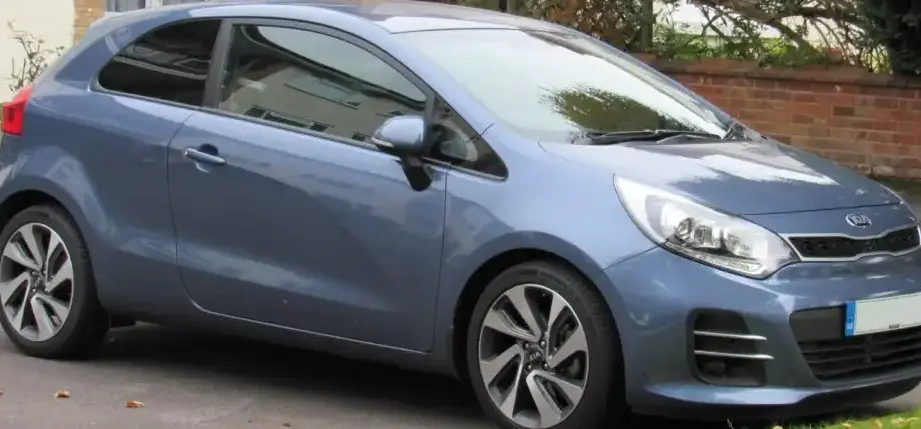
The Kia Rio III (UB) facelift, launched in 2015, represented a mid-cycle refresh of the popular subcompact. The 3-door hatchback version, coupled with the 1.4-liter engine producing 109 horsepower and featuring the ISG system, was aimed at buyers seeking a fuel-efficient and practical city car. This configuration was particularly popular in European markets where smaller cars and lower running costs are highly valued. The UB platform, shared with the Hyundai i20, provided a solid foundation for the Rio, offering improved refinement and features compared to its predecessor.
Powertrain & Engine Architecture
The heart of this Rio variant is the Kia G4FA 1.4-liter inline-four cylinder gasoline engine. This engine utilizes a multi-point fuel injection system, delivering fuel directly into the intake ports. The G4FA engine features dual overhead camshafts (DOHC) and four valves per cylinder, contributing to its relatively efficient operation. The engine’s 109 horsepower output at 6300 rpm and 137 Nm (101 lb-ft) of torque at 4200 rpm are typical for a naturally aspirated engine of this displacement. The ISG (Idle Stop & Go) system is a key feature, automatically shutting off the engine when the vehicle comes to a stop, such as at traffic lights, to reduce fuel consumption and emissions. The engine is paired with a 6-speed manual transmission, providing a balance between fuel economy and driver engagement. While an automatic transmission was offered on other Rio trims, it wasn’t available with this specific engine/trim combination.
Driving Characteristics
The 1.4L 109 hp Rio offers adequate performance for urban driving and shorter highway trips. Acceleration from 0-60 mph takes around 10.8 seconds, and top speed is rated at 113.71 mph. The 6-speed manual transmission allows for precise gear selection, but the engine’s limited torque means frequent downshifts are often necessary, especially when overtaking or climbing hills. Compared to higher-output Rio variants (like those with larger engines), this version feels less responsive. However, the lighter weight of the 3-door body style helps to mitigate some of the performance deficit. The ISG system, while effective at reducing fuel consumption in stop-and-go traffic, can sometimes feel slightly intrusive with a noticeable restart delay.
Equipment & Trim Levels
The 1.4 ISG trim typically included standard features such as air conditioning, power windows, central locking, and a basic audio system with USB connectivity. Safety features included ABS, airbags, and stability control. Higher trim levels offered options like alloy wheels, a touchscreen infotainment system, Bluetooth connectivity, and parking sensors. Interior upholstery was typically cloth, with a relatively simple and functional dashboard layout. The 3-door configuration prioritized a sportier aesthetic over rear passenger access.
Chassis & Braking
The Rio III utilizes a McPherson strut front suspension and a semi-independent coil spring rear suspension. This setup provides a comfortable ride quality, well-suited for everyday driving. The front brakes are ventilated discs, offering good stopping power, while the rear brakes are solid discs. The steering is electrically assisted, providing light and easy maneuverability. The relatively lightweight construction of the Rio contributes to its nimble handling characteristics.
Market Reception & Comparison
The Kia Rio III 1.4 ISG was generally well-received by automotive critics as an affordable and fuel-efficient option in the subcompact segment. Its fuel economy figures of around 47 US mpg were competitive with other vehicles in its class. However, some reviewers noted that the engine lacked outright power and refinement compared to some of its rivals. Compared to the more powerful Rio variants, the 1.4L model offered a lower price point and better fuel economy, making it an attractive option for budget-conscious buyers. The 1.1L diesel version, available in some markets, offered even better fuel economy but at the expense of performance.
Legacy
The Kia Rio III 1.4 ISG has proven to be a relatively reliable vehicle, with few major mechanical issues reported. The G4FA engine is known for its durability, and the ISG system has generally performed reliably. In the used car market, these Rios are often sought after for their affordability and fuel efficiency. While not a performance standout, the 1.4L ISG variant represents a practical and economical choice for those seeking a small, reliable hatchback. Its continued presence on the used car market demonstrates its enduring appeal as a value-oriented transportation option.