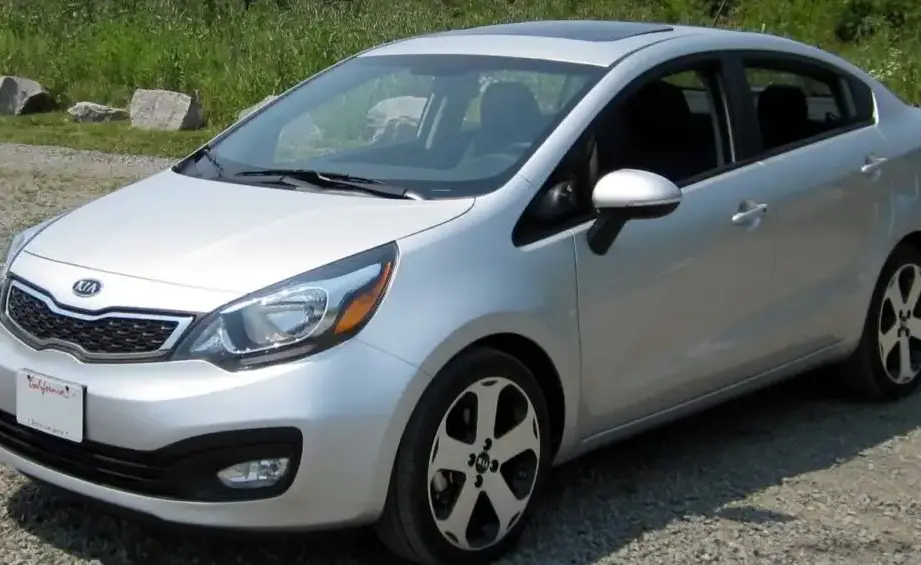
The Kia Rio III Sedan (UB) 1.4 16V, producing 109 horsepower, was a key variant in Kia’s lineup from its introduction in June 2011 until 2015. Positioned as a mainstream offering within the third generation Rio (UB) series, this model aimed to provide a balance of affordability, fuel efficiency, and practicality for the compact sedan market. The UB generation represented a significant step forward for Kia in terms of design and build quality, and the 1.4L engine option was intended to appeal to a broad range of buyers seeking a reliable and economical daily driver. It was built on the Kia UB platform, shared with the Hyundai Accent of the same era.
Technical Specifications
| Brand | Kia |
| Model | Rio |
| Generation | Rio III Sedan (UB) |
| Type (Engine) | 1.4 16V (109 Hp) |
| Start of production | June, 2011 |
| End of production | 2015 |
| Powertrain Architecture | Internal Combustion engine |
| Body type | Sedan |
| Seats | 5 |
| Doors | 4 |
| Fuel consumption (urban) | 7.2 l/100 km (32.7 US mpg) |
| Fuel consumption (extra urban) | 4.5 l/100 km (52.3 US mpg) |
| Fuel consumption (combined) | 5.5 l/100 km (42.8 US mpg) |
| Fuel Type | Petrol (Gasoline) |
| Acceleration 0 – 100 km/h | 11.5 sec |
| Acceleration 0 – 62 mph | 11.5 sec |
| Acceleration 0 – 60 mph | 10.9 sec |
| Maximum speed | 183 km/h (113.71 mph) |
| Emission standard | Euro 5 |
| Weight-to-power ratio | 9.8 kg/Hp |
| Weight-to-torque ratio | 7.8 kg/Nm |
| Power | 109 Hp |
| Torque | 137 Nm @ 4200 rpm (101.05 lb.-ft. @ 4200 rpm) |
| Engine layout | Front, Transverse |
| Engine Model/Code | G4FA |
| Engine displacement | 1396 cm3 (85.19 cu. in.) |
| Number of cylinders | 4 |
| Engine configuration | Inline |
| Number of valves per cylinder | 4 |
| Fuel injection system | Multi-port manifold injection |
| Engine aspiration | Naturally aspirated engine |
| Valvetrain | DOHC |
| Engine oil capacity | 3.3 l (3.49 US qt | 2.9 UK qt) |
| Coolant capacity | 5.3 l (5.6 US qt | 4.66 UK qt) |
| Kerb Weight | 1066 kg (2350.13 lbs.) |
| Max. weight | 1600 kg (3527.4 lbs.) |
| Max load | 534 kg (1177.27 lbs.) |
| Trunk (boot) space – minimum | 500 l (17.66 cu. ft.) |
| Fuel tank capacity | 43 l (11.36 US gal | 9.46 UK gal) |
| Length | 4370 mm (172.05 in.) |
| Width | 1700 mm (66.93 in.) |
| Height | 1470 mm (57.87 in.) |
| Wheelbase | 2570 mm (101.18 in.) |
| Front track | 1495 mm (58.86 in.) |
| Rear track | 1502 mm (59.13 in.) |
| Minimum turning circle | 10.5 m (34.45 ft.) |
| Drivetrain Architecture | Front wheel drive |
| Number of gears | 6 gears, manual transmission |
| Front suspension | Independent, type McPherson with coil spring and anti-roll bar |
| Rear suspension | Semi-independent, coil spring |
| Front brakes | Ventilated discs |
| Rear brakes | Disc |
| Assisting systems | ABS (Anti-lock braking system) |
| Steering type | Steering rack and pinion |
| Tires size | 185/65 R15; 195/55 R16; 205/45 R17 |
| Wheel rims size | 15; 16; 17 |
Powertrain & Engine Architecture
The heart of the Rio III Sedan 1.4 16V is the Kia G4FA engine, a 1.4-liter inline-four cylinder gasoline engine. This engine utilizes a dual overhead camshaft (DOHC) valvetrain with four valves per cylinder, contributing to its relatively efficient operation. The G4FA employs multi-point fuel injection, a common technology at the time, delivering fuel directly into the intake ports. This engine is naturally aspirated, meaning it doesn’t rely on a turbocharger or supercharger for increased power. The engine’s 109 horsepower and 101 lb-ft of torque are modest, but sufficient for everyday driving. The six-speed manual transmission was the standard offering, providing a reasonable balance between fuel economy and driver control. The engine was designed with a focus on reliability and low maintenance costs, typical of Kia’s engineering philosophy during this period.
Driving Characteristics
The 1.4L engine paired with the six-speed manual transmission delivers adequate, though not exhilarating, performance. Acceleration from 0-60 mph takes around 10.9 seconds, making it suitable for urban and highway driving, but not for sporty maneuvers. The gear ratios are tuned for fuel efficiency, meaning the engine needs to be revved somewhat to achieve brisk acceleration. Compared to higher-trim Rio models equipped with larger engines, the 1.4L feels noticeably less powerful, especially when fully loaded with passengers and cargo. However, the lighter weight of the 1.4L variant compared to some of its siblings contributes to slightly better handling and fuel economy. The steering is light and precise, making it easy to maneuver in tight spaces.
Equipment & Trim Levels
The 1.4 16V Rio Sedan typically came with a base level of equipment, focusing on essential features. Standard amenities generally included air conditioning, power windows and locks, a basic audio system with AM/FM radio and CD player, and standard safety features like dual front airbags and ABS brakes. Higher trim levels, such as the LX and EX, offered additional features like alloy wheels, a more advanced audio system with USB connectivity, and features like a trip computer. Interior upholstery was typically cloth, with a relatively simple and functional dashboard layout. Optional extras included a sunroof, upgraded audio systems, and rear parking sensors.
Chassis & Braking
The Rio III Sedan utilizes a McPherson strut front suspension and a semi-independent coil spring rear suspension. This setup provides a comfortable ride quality, absorbing bumps and imperfections in the road reasonably well. The front brakes are ventilated discs, offering good stopping power, while the rear brakes are solid discs. The ABS system helps to prevent wheel lockup during hard braking, enhancing safety. The chassis is relatively lightweight, contributing to the car’s agility and fuel efficiency. Stabilizer bars are present, helping to reduce body roll during cornering, though the handling is not particularly sporty.
Market Reception & Comparison
The Kia Rio III Sedan 1.4 16V was generally well-received by critics as an affordable and practical compact sedan. It was praised for its fuel efficiency, comfortable ride, and generous warranty. However, some reviewers noted that the engine lacked power, particularly when compared to competitors offering larger displacement engines. Compared to other trims in the Rio lineup, the 1.4L offered the most affordable entry point, making it attractive to budget-conscious buyers. Its fuel economy was comparable to, or slightly better than, that of the larger engine options. Reliability was generally good, with few reported issues with the engine or transmission.
Legacy
The Kia Rio III Sedan 1.4 16V has proven to be a relatively reliable and durable vehicle in the used car market. The G4FA engine is known for its longevity, and maintenance costs are generally low. While not a performance standout, it remains a practical and economical choice for those seeking a basic, dependable compact sedan. Parts availability is good, and the car’s simple design makes it relatively easy to repair. Today, these Rios are often found as affordable transportation for students, commuters, or as a second family vehicle.