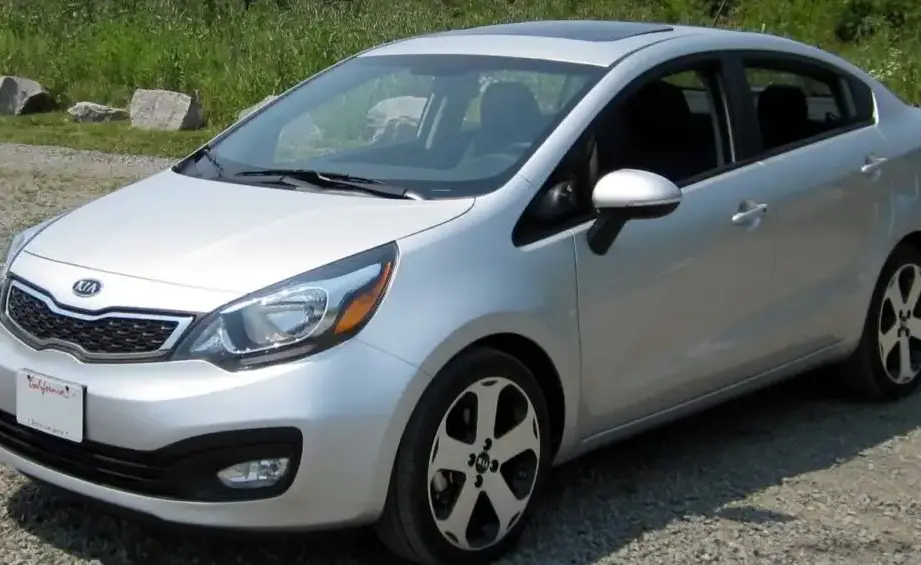
The Kia Rio III Sedan (UB) 1.4 CRDi 16V, producing 90 horsepower, was a key variant in Kia’s lineup from its introduction in June 2011 until 2015. Positioned as an entry-level diesel option within the UB generation Rio sedan range, it aimed to provide fuel efficiency and reasonable performance for budget-conscious buyers. This model played a significant role in establishing Kia as a more competitive player in the European and global compact car segments, offering a diesel alternative to gasoline-powered rivals. The UB Rio represented a substantial step forward in design and quality for the Korean automaker.
Technical Specifications
| Brand | Kia |
| Model | Rio |
| Generation | Rio III Sedan (UB) |
| Type (Engine) | 1.4 CRDi 16V (90 Hp) |
| Start of production | June, 2011 |
| End of production | 2015 |
| Powertrain Architecture | Internal Combustion engine |
| Body type | Sedan |
| Seats | 5 |
| Doors | 4 |
| Fuel consumption (urban) | 5 l/100 km (47 US mpg, 56.5 UK mpg, 20 km/l) |
| Fuel consumption (extra urban) | 3.8 l/100 km (61.9 US mpg, 74.3 UK mpg, 26.3 km/l) |
| Fuel consumption (combined) | 4.3 l/100 km (54.7 US mpg, 65.7 UK mpg, 23.3 km/l) |
| Fuel Type | Diesel |
| Acceleration 0 – 100 km/h | 14.2 sec |
| Acceleration 0 – 62 mph | 14.2 sec |
| Acceleration 0 – 60 mph | 13.5 sec |
| Maximum speed | 172 km/h (106.88 mph) |
| Emission standard | Euro 5 |
| Weight-to-power ratio | 12.9 kg/Hp, 77.3 Hp/tonne |
| Weight-to-torque ratio | 5.3 kg/Nm, 189 Nm/tonne |
| Power | 90 Hp |
| Power per litre | 64.5 Hp/l |
| Torque | 220 Nm @ 1750 rpm (162.26 lb.-ft. @ 1750 rpm) |
| Engine layout | Front, Transverse |
| Engine Model/Code | D4FC |
| Engine displacement | 1396 cm3 (85.19 cu. in.) |
| Number of cylinders | 4 |
| Engine configuration | Inline |
| Number of valves per cylinder | 4 |
| Fuel injection system | Diesel Commonrail |
| Engine aspiration | Turbocharger, Intercooler |
| Valvetrain | DOHC |
| Engine oil capacity | 5.3 l (5.6 US qt | 4.66 UK qt) |
| Coolant capacity | 6.6 l (6.97 US qt | 5.81 UK qt) |
| Kerb Weight | 1164 kg (2566.18 lbs.) |
| Max. weight | 1690 kg (3725.81 lbs.) |
| Max load | 526 kg (1159.63 lbs.) |
| Trunk (boot) space – minimum | 500 l (17.66 cu. ft.) |
| Fuel tank capacity | 43 l (11.36 US gal | 9.46 UK gal) |
| Length | 4370 mm (172.05 in.) |
| Width | 1700 mm (66.93 in.) |
| Height | 1470 mm (57.87 in.) |
| Wheelbase | 2570 mm (101.18 in.) |
| Front track | 1495 mm (58.86 in.) |
| Rear (Back) track | 1502 mm (59.13 in.) |
| Minimum turning circle | 10.5 m (34.45 ft.) |
| Drivetrain Architecture | Front wheel drive |
| Number of gears | 6 gears, manual transmission |
| Front suspension | Independent, type McPherson with coil spring and anti-roll bar |
| Rear suspension | Semi-independent, coil spring |
| Front brakes | Ventilated discs |
| Rear brakes | Disc |
| Assisting systems | ABS (Anti-lock braking system) |
| Steering type | Steering rack and pinion |
| Tires size | 185/65 R15; 195/55 R16; 205/45 R17 |
| Wheel rims size | 15; 16; 17 |
Powertrain & Engine Architecture
The heart of the Rio 1.4 CRDi was the D4FC engine, a 1.4-liter inline-four cylinder diesel. This engine utilized a second-generation common-rail direct injection system, delivering fuel at extremely high pressure for improved combustion efficiency and reduced emissions. The D4FC featured a turbocharger with an intercooler, boosting power output to 90 hp and 220 Nm (162 lb-ft) of torque at 1750 rpm. The engine employed a double overhead camshaft (DOHC) valvetrain with four valves per cylinder, optimizing airflow for enhanced performance. The 6-speed manual transmission was standard, chosen for its balance of fuel economy and driver engagement. The engine was designed to meet Euro 5 emission standards, incorporating a diesel particulate filter (DPF) to minimize soot emissions.
Driving Characteristics
The 90 hp 1.4 CRDi engine in the Rio offered a practical, if not exhilarating, driving experience. Acceleration from 0-60 mph took around 13.5 seconds, and top speed was approximately 107 mph. The engine’s torque peak at 1750 rpm provided decent low-end grunt, making it suitable for everyday driving and overtaking maneuvers. However, it lacked the punch of higher-output diesel variants or gasoline engines. The 6-speed manual transmission was well-matched to the engine’s characteristics, allowing drivers to keep the engine in its optimal power band. Compared to the 1.6L gasoline engine, the CRDi offered significantly better fuel economy, but at the expense of outright performance. The manual transmission provided more driver control than the optional 4-speed automatic, which further reduced performance and responsiveness.
Equipment & Trim Levels
The 1.4 CRDi typically came with a reasonable level of standard equipment. Base models included air conditioning, power steering, electric front windows, and a basic audio system. Higher trim levels, such as the ‘2’ or ‘3’ variants, added features like alloy wheels, fog lights, a more sophisticated audio system with Bluetooth connectivity, and upgraded interior trim. Interior upholstery was typically cloth, with options for darker or lighter color schemes. Optional extras included a sunroof, parking sensors, and a navigation system. The overall interior design was functional and modern, though material quality was generally modest, reflecting the car’s price point.
Chassis & Braking
The Rio UB utilized a front-wheel-drive chassis with a McPherson strut suspension setup at the front and a semi-independent coil spring suspension at the rear. This configuration provided a comfortable ride quality, though handling was not particularly sporty. Front brakes were ventilated discs, while rear brakes were solid discs. Anti-lock Braking System (ABS) was standard. The suspension was tuned for comfort rather than performance, prioritizing ride quality over sharp handling. Stabilizer bars were included to reduce body roll during cornering, but the overall driving experience was geared towards everyday usability.
Market Reception & Comparison
The Kia Rio 1.4 CRDi was generally well-received by automotive critics as a value-for-money option in the compact car segment. Its fuel economy was a major selling point, and the diesel engine provided a good balance of performance and efficiency for urban and highway driving. Compared to competitors like the Ford Fiesta, Volkswagen Polo, and Renault Clio, the Rio offered a competitive price and a longer warranty. However, some critics noted that the interior materials and overall refinement were not quite on par with some of its rivals. The 1.4 CRDi was often seen as a more sensible choice than the 1.6L gasoline engine, particularly for drivers who covered high mileage.
Legacy
The D4FC engine, while not without its issues (particularly concerning the DPF system requiring regular maintenance), proved to be a relatively reliable unit when properly maintained. The Rio UB 1.4 CRDi remains a popular choice on the used car market, particularly for those seeking an economical and practical city car. Its fuel efficiency and relatively low running costs continue to appeal to budget-conscious buyers. However, potential buyers should be aware of the potential for DPF-related problems and ensure that the vehicle has been regularly serviced. The UB Rio helped to solidify Kia’s reputation for building affordable and reliable vehicles, paving the way for the brand’s continued success in the global automotive market.