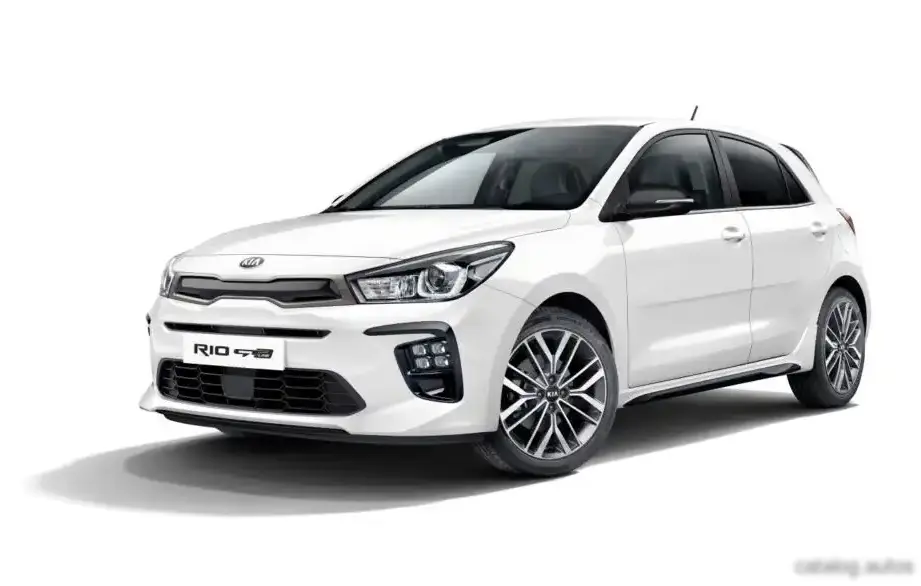
The Kia Rio IV Hatchback, produced from February 2017 to July 2020, represented a significant step forward for Kia’s subcompact offering in the global market. The 1.0 T-GDI (100 hp) variant, powered by Kia’s Kappa II engine, was positioned as a fuel-efficient and relatively affordable entry point into the Rio IV lineup, particularly in European and Asian markets. It aimed to appeal to buyers seeking a modern, well-equipped hatchback with low running costs. This specific configuration utilized a five-speed manual transmission, offering a balance between economy and driver engagement. The YB generation Rio was built on the Hyundai-Kia UB platform, shared with the Hyundai i20.
Technical Specifications
| Brand | Kia |
| Model | Rio |
| Generation | Rio IV Hatchback (YB) |
| Type (Engine) | 1.0 T-GDI (100 Hp) |
| Start of production | February, 2017 |
| End of production | July, 2020 |
| Powertrain Architecture | Internal Combustion engine |
| Body type | Hatchback |
| Seats | 5 |
| Doors | 5 |
| Fuel consumption (combined) | 4.1-4.5 l/100 km (57.4 – 52.3 US mpg, 68.9 – 62.8 UK mpg, 24.4 – 22.2 km/l) |
| CO2 emissions | 94-102 g/km |
| Fuel Type | Petrol (Gasoline) |
| Acceleration 0 – 100 km/h | 10.7 sec |
| Acceleration 0 – 62 mph | 10.7 sec |
| Acceleration 0 – 60 mph | 10.2 sec |
| Maximum speed | 188 km/h (116.82 mph) |
| Emission standard | Euro 6 b |
| Weight-to-power ratio | 11.6 kg/Hp, 86.6 Hp/tonne |
| Weight-to-torque ratio | 6.7 kg/Nm, 148.9 Nm/tonne |
| Power | 100 Hp @ 4500 rpm |
| Power per litre | 100.2 Hp/l |
| Torque | 172 Nm @ 1500-4000 rpm (126.86 lb.-ft. @ 1500-4000 rpm) |
| Engine layout | Front, Transverse |
| Engine Model/Code | Kappa II / G3LC |
| Engine displacement | 998 cm3 (60.9 cu. in.) |
| Number of cylinders | 3 |
| Engine configuration | Inline |
| Cylinder Bore | 71 mm (2.8 in.) |
| Piston Stroke | 84 mm (3.31 in.) |
| Compression ratio | 10:1 |
| Number of valves per cylinder | 4 |
| Fuel injection system | Direct injection |
| Engine aspiration | Turbocharger, Intercooler |
| Engine oil capacity | 3.6 l (3.8 US qt | 3.17 UK qt) |
| Coolant | 5.5 l (5.81 US qt | 4.84 UK qt) |
| Kerb Weight | 1155 kg (2546.34 lbs.) |
| Max. weight | 1600 kg (3527.4 lbs.) |
| Max load | 445 kg (981.06 lbs.) |
| Trunk (boot) space – minimum | 325 l (11.48 cu. ft.) |
| Trunk (boot) space – maximum | 980 l (34.61 cu. ft.) |
| Fuel tank capacity | 45 l (11.89 US gal | 9.9 UK gal) |
| Permitted trailer load with brakes (12%) | 1000 kg (2204.62 lbs.) |
| Permitted trailer load without brakes | 450 kg (992.08 lbs.) |
| Length | 4065 mm (160.04 in.) |
| Width | 1725 mm (67.91 in.) |
| Height | 1450 mm (57.09 in.) |
| Wheelbase | 2580 mm (101.57 in.) |
| Front track | 1518 mm (59.76 in.) |
| Rear (Back) track | 1524 mm (60 in.) |
| Front overhang | 830 mm (32.68 in.) |
| Rear overhang | 655 mm (25.79 in.) |
| Ride height (ground clearance) | 135 mm (5.31 in.) |
| Minimum turning circle (turning diameter) | 10.2 m (33.46 ft.) |
| Drivetrain Architecture | The Internal combustion engine (ICE) drives the front wheels of the vehicle. |
| Drive wheel | Front wheel drive |
| Number of gears and type of gearbox | 5 gears, manual transmission |
| Front suspension | Independent, type McPherson with coil spring and anti-roll bar |
| Rear suspension | Semi-independent, coil spring, Elastic beam |
| Front brakes | Ventilated discs |
| Rear brakes | Drum |
| Assisting systems | ABS (Anti-lock braking system) |
| Steering type | Steering rack and pinion |
| Power steering | Electric Steering |
| Tires size | 185/65 R15; 195/55 R16; 205/45 R17 |
| Wheel rims size | 15; 16; 17 |
Powertrain & Engine Architecture
The heart of this Rio variant is the Kappa II 1.0 T-GDI engine, designated G3LC. This is a three-cylinder, inline gasoline engine featuring direct fuel injection and a single turbocharger with an intercooler. The direct injection system allows for precise fuel delivery, contributing to both efficiency and performance. The engine utilizes a timing chain, reducing maintenance compared to timing belts. The turbocharger provides a boost in power, compensating for the relatively small displacement. The five-speed manual transmission was the standard offering, providing drivers with full control over gear selection. The transmission’s gear ratios were tuned for fuel economy and acceptable acceleration, prioritizing everyday usability over outright performance.
Driving Characteristics
The 1.0 T-GDI Rio offered a surprisingly refined driving experience for its class. While not a performance car, the turbocharger provided adequate power for typical urban and highway driving. Acceleration to 60 mph took around 10.2 seconds, and top speed was rated at 188 km/h (116.82 mph). The manual transmission allowed for engaging driving, but the relatively long throws and light pedal feel weren’t particularly sporty. Compared to higher-output Rio variants, such as those with larger engines, this version felt less powerful, especially when fully loaded or climbing hills. However, the lighter engine weight contributed to nimble handling and reduced body roll. The gear ratios were spaced to maximize fuel efficiency, meaning the engine often needed to be revved to access its full power.
Equipment & Trim Levels
The 1.0 T-GDI Rio typically came with a reasonable level of standard equipment. Base models included air conditioning, power windows, central locking, and a basic audio system with USB connectivity. Higher trim levels added features like alloy wheels, a touchscreen infotainment system with Apple CarPlay and Android Auto compatibility, a rear-view camera, and cruise control. Interior upholstery was typically cloth, with options for upgraded materials on higher trims. Safety features included ABS, ESC (Electronic Stability Control), and multiple airbags. Optional extras included a panoramic sunroof and automatic climate control.
Chassis & Braking
The Rio IV utilized a McPherson strut front suspension and a semi-independent torsion beam rear suspension. This setup provided a good balance between ride comfort and handling. The front brakes were ventilated discs, offering good stopping power, while the rear brakes were drums, a cost-saving measure common in this segment. The steering was electrically assisted, providing light and easy steering feel. Stabilizer bars were fitted to both the front and rear axles to reduce body roll during cornering. The relatively lightweight construction of the vehicle contributed to its agility.
Market Reception & Comparison
The 1.0 T-GDI Rio was generally well-received by critics for its fuel efficiency, modern styling, and value for money. It was often praised as a practical and economical choice for city driving. Compared to other subcompact hatchbacks, such as the Ford Fiesta and Volkswagen Polo, the Rio offered a competitive level of equipment and a longer warranty. However, some reviewers noted that the engine could feel strained at higher speeds and that the interior materials weren’t as premium as those found in some rivals. Fuel economy was a strong point, consistently achieving figures in the range of 4.1-4.5 l/100 km.
Legacy
The Kappa II 1.0 T-GDI engine proved to be a relatively reliable unit, although some owners have reported issues with the turbocharger and fuel injectors. Regular maintenance, including oil changes and air filter replacements, is crucial for ensuring long-term reliability. On the used car market, the 1.0 T-GDI Rio represents a good value proposition, offering a modern and well-equipped hatchback at an affordable price. Its fuel efficiency and relatively low running costs make it an attractive option for budget-conscious buyers. The YB Rio helped solidify Kia’s reputation for producing well-built and reliable vehicles.