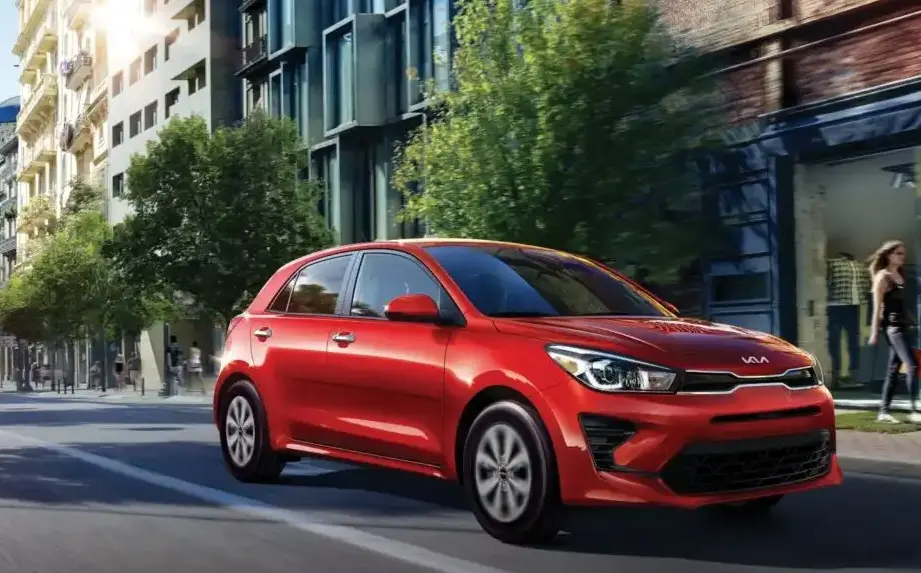
The Kia Rio IV Hatchback, specifically the YB facelift model produced from August 2020 onwards, represents a significant evolution in Kia’s subcompact offering. The 1.0 T-GDI (101 horsepower) variant occupied a key position in the Rio lineup, bridging the gap between the base engine options and the more powerful alternatives. Designed primarily for the European and Asian markets, the Rio IV aimed to deliver a blend of affordability, fuel efficiency, and modern features. This particular engine and transmission combination was targeted towards buyers seeking a balance between running costs and acceptable performance for daily commuting and urban driving.
Technical Specifications
| Brand | Kia |
| Model | Rio |
| Generation | Rio IV Hatchback (YB, facelift 2020) |
| Type (Engine) | 1.0 T-GDI (101 Hp) |
| Start of production | August, 2020 |
| Powertrain Architecture | Internal Combustion engine |
| Body type | Hatchback |
| Seats | 5 |
| Doors | 5 |
| Fuel consumption (urban) | 6.1 l/100 km (38.6 US mpg, 46.3 UK mpg, 16.4 km/l) |
| Fuel consumption (extra urban) | 4.3 l/100 km (54.7 US mpg, 65.7 UK mpg, 23.3 km/l) |
| Fuel consumption (combined) | 5 l/100 km (47 US mpg, 56.5 UK mpg, 20 km/l) |
| CO2 emissions | 114 g/km |
| Fuel Type | Petrol (Gasoline) |
| Acceleration 0 – 100 km/h | 10.4 sec |
| Acceleration 0 – 62 mph | 10.4 sec |
| Acceleration 0 – 60 mph | 9.9 sec |
| Maximum speed | 188 km/h (116.82 mph) |
| Emission standard | Euro 6d-ISC-FCM |
| Weight-to-power ratio | 10.9 kg/Hp, 91.8 Hp/tonne |
| Weight-to-torque ratio | 6.4 kg/Nm, 156.4 Nm/tonne |
| Power | 101 Hp @ 4500-6000 rpm |
| Power per litre | 101.2 Hp/l |
| Torque | 172 Nm @ 1500-4000 rpm (126.86 lb.-ft. @ 1500-4000 rpm) |
| Engine layout | Front, Transverse |
| Engine Model/Code | G3LE |
| Engine displacement | 998 cm3 (60.9 cu. in.) |
| Number of cylinders | 3 |
| Engine configuration | Inline |
| Cylinder Bore | 71 mm (2.8 in.) |
| Piston Stroke | 84 mm (3.31 in.) |
| Compression ratio | 10.5:1 |
| Number of valves per cylinder | 4 |
| Fuel injection system | Direct injection |
| Engine aspiration | Turbocharger, Intercooler |
| Engine oil capacity | 3.6 l (3.8 US qt | 3.17 UK qt) |
| Coolant capacity | 5.9 l (6.23 US qt | 5.19 UK qt) |
| Kerb Weight | 1100-1198 kg (2425.08 – 2641.14 lbs.) |
| Max. weight | 1620 kg (3571.49 lbs.) |
| Max load | 422-520 kg (930.35 – 1146.4 lbs.) |
| Trunk (boot) space – minimum | 325 l (11.48 cu. ft.) |
| Trunk (boot) space – maximum | 1103 l (38.95 cu. ft.) |
| Fuel tank capacity | 45 l (11.89 US gal | 9.9 UK gal) |
| Max. roof load | 70 kg (154.32 lbs.) |
| Permitted trailer load with brakes (12%) | 900 kg (1984.16 lbs.) |
| Permitted trailer load without brakes | 450 kg (992.08 lbs.) |
| Permitted towbar download | 75 kg (165.35 lbs.) |
| Length | 4065-4070 mm (160.04 – 160.24 in.) |
| Width | 1725 mm (67.91 in.) |
| Width including mirrors | 1993 mm (78.46 in.) |
| Height | 1450 mm (57.09 in.) |
| Wheelbase | 2580 mm (101.57 in.) |
| Front track | 1512 mm (59.53 in.) |
| Rear (Back) track | 1518 mm (59.76 in.) |
| Minimum turning circle | 10.2 m (33.46 ft.) |
| Drivetrain Architecture | Front wheel drive |
| Number of gears and type of gearbox | 6 gears, manual transmission |
| Front suspension | Independent, type McPherson with coil spring and anti-roll bar |
| Rear suspension | Coil spring, Elastic beam |
| Front brakes | Ventilated discs, 280 mm |
| Rear brakes | Disc, 262 mm |
| Assisting systems | ABS (Anti-lock braking system) |
| Steering type | Steering rack and pinion |
| Power steering | Electric Steering |
| Tires size | 195/55 R16 87H; 205/45 R17 88V |
| Wheel rims size | 6.0J x 16; 6.5J x 17 |
INTRODUCTION
The Kia Rio IV, launched in 2017 and receiving a significant facelift in 2020, represented Kia’s ambition to compete more effectively in the highly competitive subcompact hatchback segment. The YB facelift brought revised styling, updated technology, and refined powertrains. The 1.0 T-GDI 101 horsepower variant was a key component of this strategy, offering a compelling combination of fuel economy and performance. Positioned as a mid-range option, it sat above the naturally aspirated 1.25-liter engine and below the more potent 1.6-liter options. It was designed to appeal to buyers prioritizing efficiency and value without sacrificing essential features.
Powertrain & Engine Architecture
At the heart of this Rio variant lies the Kia/Hyundai G3LE 1.0-liter turbocharged three-cylinder engine. This engine, part of Kia’s “Kappa” family, utilizes direct fuel injection and a single-scroll turbocharger with an intercooler to deliver a respectable 101 horsepower at 4500-6000 rpm and 172 Nm (126.86 lb-ft) of torque between 1500-4000 rpm. The engine code ‘G3LE’ signifies a specific iteration optimized for efficiency and emissions compliance. The engine features a timing chain, contributing to reduced maintenance compared to timing belts. The 6-speed manual transmission was standard, offering precise shifts and contributing to the car’s overall responsiveness. The transmission’s gear ratios were tuned to maximize fuel efficiency while providing adequate acceleration in everyday driving situations.
Driving Characteristics
The 1.0 T-GDI Rio offers a surprisingly refined driving experience for a subcompact. While not overtly sporty, the turbocharger provides a noticeable boost in power, making overtaking and merging onto highways manageable. The 0-60 mph time of around 9.9 seconds is adequate for most daily driving scenarios. The manual transmission allows for greater driver control, and the relatively short gear ratios keep the engine within its optimal power band. Compared to the naturally aspirated 1.25-liter engine, the 1.0 T-GDI offers significantly more punch, particularly at lower speeds. However, it doesn’t match the outright performance of the 1.6-liter variants. The suspension is tuned for comfort, providing a reasonably smooth ride over most road surfaces, although it can feel slightly unsettled on particularly rough roads.
Equipment & Trim Levels
The 1.0 T-GDI Rio typically came equipped with a decent level of standard features. These generally included air conditioning, a touchscreen infotainment system with Apple CarPlay and Android Auto compatibility, Bluetooth connectivity, and power windows. Safety features such as ABS, ESC (Electronic Stability Control), and multiple airbags were also standard. Higher trim levels added features like alloy wheels, a rear-view camera, parking sensors, and a more sophisticated infotainment system with navigation. Interior upholstery was typically cloth, with options for upgraded materials on higher trims. The dashboard layout was functional and modern, with a focus on ease of use.
Chassis & Braking
The Rio IV utilizes a front-wheel-drive platform with a McPherson strut front suspension and a torsion beam rear suspension. This setup provides a good balance between ride comfort and handling. The front brakes are ventilated discs, while the rear brakes are solid discs, providing adequate stopping power for the vehicle’s weight and performance. The electric power steering offers light and precise steering feel, making it easy to maneuver in urban environments. The chassis was designed to be lightweight, contributing to the car’s overall fuel efficiency and agility.
Market Reception & Comparison
The 1.0 T-GDI Rio received generally positive reviews from automotive critics. It was praised for its fuel efficiency, comfortable ride, and well-equipped interior. However, some critics noted that the engine could feel slightly strained at higher speeds or when fully loaded. Compared to rivals like the Ford Fiesta and Volkswagen Polo, the Rio offered a compelling value proposition, often undercutting them on price while offering a similar level of equipment. In terms of fuel economy, the 1.0 T-GDI Rio consistently outperformed the larger-engined variants, making it an attractive option for budget-conscious buyers. Reliability reports have been generally positive, with few major issues reported with the engine or transmission.
Legacy
The 1.0 T-GDI engine has proven to be a relatively reliable unit, with many examples still on the road today. While preventative maintenance is crucial, the engine is generally known for its durability. The Rio IV, and specifically this 1.0 T-GDI variant, has become a popular choice in the used car market, offering a practical and affordable option for those seeking a fuel-efficient and well-equipped subcompact hatchback. Its combination of modern features, reasonable performance, and competitive pricing has cemented its place as a solid contender in its class.