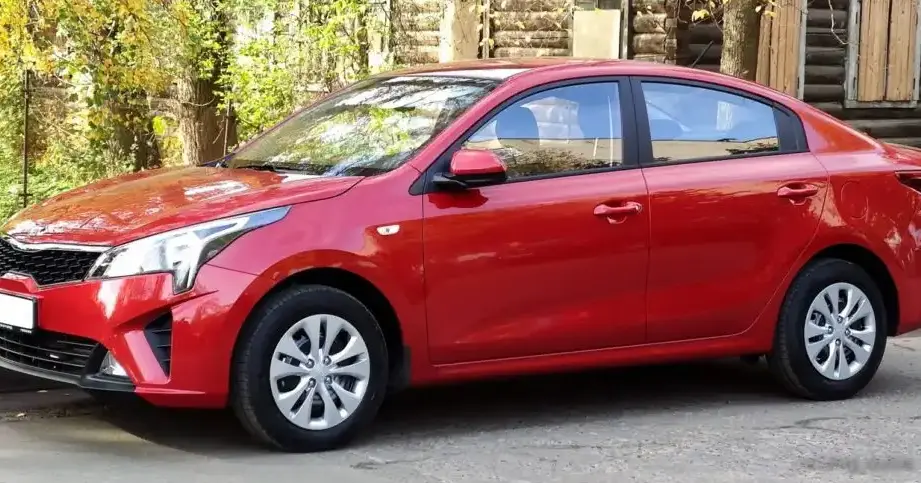
The Kia Rio IV Sedan, specifically the facelifted version introduced in 2020, represented a significant step forward for Kia in the subcompact sedan segment. The 1.4 Kappa engine producing 100 horsepower was a key variant within the Rio IV lineup (FB/UC chassis code), positioned as a balance between affordability and acceptable performance. This model year saw updates to the exterior styling, interior materials, and available technology, aiming to enhance the Rio’s appeal in a competitive market. The Rio IV was primarily targeted at budget-conscious buyers seeking a reliable and fuel-efficient daily driver, particularly in markets where sedans remain popular, like parts of Europe, Latin America, and Asia.
Technical Specifications
| Brand | Kia |
| Model | Rio |
| Generation | Rio IV Sedan (FB/UC, facelift 2020) |
| Type (Engine) | 1.4 Kappa (100 Hp) |
| Start of production | 2020 |
| Powertrain Architecture | Internal Combustion engine |
| Body type | Sedan |
| Seats | 5 |
| Doors | 4 |
| Fuel consumption (urban) | 7.2 l/100 km (32.7 US mpg, 39.2 UK mpg, 13.9 km/l) |
| Fuel consumption (extra urban) | 4.8 l/100 km (49 US mpg, 58.9 UK mpg, 20.8 km/l) |
| Fuel consumption (combined) | 5.7 l/100 km (41.3 US mpg, 49.6 UK mpg, 17.5 km/l) |
| Fuel Type | Petrol (Gasoline) |
| Acceleration 0 – 100 km/h | 12.2 sec |
| Acceleration 0 – 62 mph | 12.2 sec |
| Acceleration 0 – 60 mph | 11.6 sec |
| Maximum speed | 185 km/h (114.95 mph) |
| Emission standard | Euro 5 |
| Weight-to-power ratio | 11.5 kg/Hp, 87 Hp/tonne |
| Weight-to-torque ratio | 8.7 kg/Nm, 114.8 Nm/tonne |
| Power | 100 Hp @ 6000 rpm |
| Power per litre | 73.1 Hp/l |
| Torque | 132 Nm @ 4000 rpm (97.36 lb.-ft. @ 4000 rpm) |
| Engine layout | Front, Transverse |
| Engine Model/Code | Kappa / G4LC |
| Engine displacement | 1368 cm3 (83.48 cu. in.) |
| Number of cylinders | 4 |
| Engine configuration | Inline |
| Cylinder Bore | 72 mm (2.83 in.) |
| Piston Stroke | 84 mm (3.31 in.) |
| Compression ratio | 10.5:1 |
| Number of valves per cylinder | 4 |
| Fuel injection system | Multi-port manifold injection |
| Engine aspiration | Naturally aspirated engine |
| Engine oil capacity | 3.5 l (3.7 US qt | 3.08 UK qt) |
| Coolant capacity | 5.1 l (5.39 US qt | 4.49 UK qt) |
| Kerb Weight | 1150 kg (2535.32 lbs.) |
| Max. weight | 1560 kg (3439.21 lbs.) |
| Max load | 410 kg (903.9 lbs.) |
| Trunk (boot) space – minimum | 480 l (16.95 cu. ft.) |
| Fuel tank capacity | 50 l (13.21 US gal | 11 UK gal) |
| Length | 4420 mm (174.02 in.) |
| Width | 1740 mm (68.5 in.) |
| Height | 1470 mm (57.87 in.) |
| Wheelbase | 2600 mm (102.36 in.) |
| Front track | 1516 mm (59.69 in.) |
| Rear (Back) track | 1524 mm (60 in.) |
| Ride height (ground clearance) | 160 mm (6.3 in.) |
| Drivetrain Architecture | Front wheel drive |
| Number of gears and type of gearbox | 6 gears, manual transmission |
| Front brakes | Ventilated discs |
| Rear brakes | Drum |
| Tires size | 185/65 R15 88H; 195/55 R16 87H; 205/45 R17 88V |
| Wheel rims size | 6J x 15; 6J x 16; 6.5J x 17 |
Powertrain & Engine Architecture
The heart of this Rio variant is the Kia Kappa 1.4-liter inline-four cylinder engine, internally designated as the G4LC. This engine is a naturally aspirated unit featuring multi-point fuel injection and dual continuously variable valve timing (CVVT) on both intake and exhaust camshafts. The CVVT system optimizes valve timing based on engine speed and load, improving both fuel efficiency and power output. The engine utilizes a timing chain, contributing to reduced maintenance compared to timing belts. The 100 horsepower and 132 Nm (97 lb-ft) of torque are modest, but sufficient for everyday driving. Paired with a 6-speed manual transmission, the powertrain aimed for a balance between economy and usability. The transmission’s gear ratios were tuned for fuel efficiency, with a relatively tall final drive.
Driving Characteristics
The 1.4L Kappa engine with the 6-speed manual transmission in the Rio IV Sedan delivers a driving experience best described as adequate. Acceleration is not brisk, taking around 12.2 seconds to reach 60 mph. However, the engine is reasonably responsive in the mid-range, making it suitable for city driving and highway merging with careful planning. The manual transmission provides a more engaging driving experience than an automatic, allowing the driver to keep the engine in its optimal power band. The relatively light weight of the Rio (around 2535 lbs) helps to mitigate the engine’s modest power output. Compared to higher-trim Rio models with more powerful engines, this variant feels noticeably slower, but it offers a more economical and affordable option.
Equipment & Trim Levels
The 1.4 Kappa variant typically served as the entry-level or near-entry-level trim in the Rio IV Sedan range. Standard equipment generally included air conditioning, power windows, power door locks, and a basic audio system with USB connectivity. Safety features such as ABS, airbags, and stability control were also standard. Higher trim levels added features like alloy wheels, a touchscreen infotainment system, a rearview camera, and automatic climate control. Interior upholstery was typically cloth, with a relatively simple dashboard design. Optional extras included a sunroof, upgraded audio systems, and various cosmetic enhancements.
Chassis & Braking
The Rio IV Sedan utilizes a front-wheel-drive platform with a MacPherson strut front suspension and a torsion beam rear suspension. This setup is typical for vehicles in this class, prioritizing cost-effectiveness and simplicity. The front brakes are ventilated discs, providing adequate stopping power, while the rear brakes are drums, a cost-saving measure. Electric power steering is standard, offering light and easy steering feel. The suspension is tuned for comfort rather than sporty handling, providing a reasonably smooth ride over most road surfaces. Stabilizer bars are present on both axles, helping to reduce body roll during cornering.
Market Reception & Comparison
The 1.4L Rio Sedan received generally positive reviews for its fuel efficiency, affordability, and practicality. Critics noted that the engine was somewhat underpowered, particularly when fully loaded or driving uphill. However, the Rio’s competitive pricing and generous warranty helped to offset this drawback. Compared to rivals like the Honda Fit, Toyota Yaris, and Hyundai Accent, the Rio offered a compelling value proposition. The manual transmission version was often praised for providing a more engaging driving experience than the available automatic option. Fuel economy figures were consistently competitive, making it an attractive option for budget-conscious buyers.
Legacy
The Kia Kappa 1.4L engine, in this configuration, has proven to be a relatively reliable powertrain. While not known for exceptional longevity, it generally requires routine maintenance and is not prone to major mechanical failures. On the used car market, the 2020 Rio IV Sedan 1.4L represents a good value for those seeking an affordable and fuel-efficient compact sedan. Its simplicity and relatively low running costs make it an attractive option for first-time car buyers or those on a tight budget. However, potential buyers should be aware of the engine’s modest power output and the basic nature of the interior appointments.