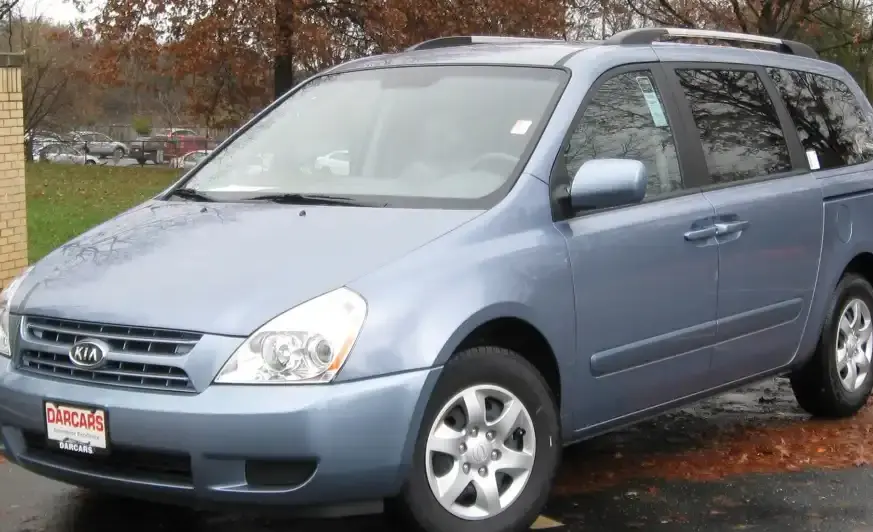
The Kia Sedona, introduced in 2002 for the North American market, represented Kia’s first foray into the highly competitive minivan segment. The first generation, internally designated as the Sedona I, aimed to provide a value-oriented alternative to established players like the Dodge Caravan, Honda Odyssey, and Toyota Sienna. Produced from 2002 through 2005, the Sedona offered seating for seven passengers and a focus on practicality. Among the engine and transmission options available, the 3.5i V6 paired with a four-speed automatic transmission became a popular choice, balancing performance with affordability. This configuration positioned itself as a mid-range offering within the Sedona lineup, appealing to families seeking a comfortable and spacious vehicle without the premium price tag of higher trim levels.
Technical Specifications
| Brand | Kia |
| Model | Sedona |
| Generation | Sedona I |
| Type (Engine) | 3.5i V6 (198 Hp) Automatic |
| Start of production | 2002 |
| End of production | 2005 |
| Powertrain Architecture | Internal Combustion engine |
| Body type | Minivan |
| Seats | 7 |
| Doors | 5 |
| Fuel consumption (urban) | 15.7 l/100 km (15 US mpg, 18 UK mpg, 6.4 km/l) |
| Fuel consumption (extra urban) | 11.8 l/100 km (19.9 US mpg, 23.9 UK mpg, 8.5 km/l) |
| Fuel consumption (combined) | 13.8 l/100 km (17 US mpg, 20.5 UK mpg, 7.2 km/l) |
| Fuel Type | Petrol (Gasoline) |
| Acceleration 0 – 100 km/h | 12.5 sec |
| Acceleration 0 – 62 mph | 12.5 sec |
| Acceleration 0 – 60 mph | 11.9 sec |
| Maximum speed | 176 km/h (109.36 mph) |
| Weight-to-power ratio | 10.8 kg/Hp, 92.7 Hp/tonne |
| Weight-to-torque ratio | 7.2 kg/Nm, 138.6 Nm/tonne |
| Power | 198 Hp @ 5500 rpm |
| Power per litre | 56.6 Hp/l |
| Torque | 296 Nm @ 3500 rpm (218.32 lb.-ft. @ 3500 rpm) |
| Engine layout | Front, Transverse |
| Engine Model/Code | Sigma / G6CU |
| Engine displacement | 3497 cm3 (213.4 cu. in.) |
| Number of cylinders | 6 |
| Engine configuration | V-engine |
| Cylinder Bore | 93 mm (3.66 in.) |
| Piston Stroke | 85.8 mm (3.38 in.) |
| Compression ratio | 10:1 |
| Number of valves per cylinder | 4 |
| Fuel injection system | Multi-port manifold injection |
| Engine aspiration | Naturally aspirated engine |
| Valvetrain | DOHC |
| Engine oil capacity | 4.3 l (4.54 US qt | 3.78 UK qt) |
| Coolant | 8.2 l (8.66 US qt | 7.21 UK qt) |
| Kerb Weight | 2136 kg (4709.07 lbs.) |
| Max. weight | 2674 kg (5895.16 lbs.) |
| Max load | 538 kg (1186.09 lbs.) |
| Trunk (boot) space – minimum | 617 l (21.79 cu. ft.) |
| Trunk (boot) space – maximum | 3610 l (127.49 cu. ft.) |
| Fuel tank capacity | 75 l (19.81 US gal | 16.5 UK gal) |
| Length | 4930 mm (194.09 in.) |
| Width | 1895 mm (74.61 in.) |
| Height | 1760 mm (69.29 in.) |
| Wheelbase | 2910 mm (114.57 in.) |
| Front track | 1635 mm (64.37 in.) |
| Rear (Back) track | 1610 mm (63.39 in.) |
| Ride height (ground clearance) | 170 mm (6.69 in.) |
| Drag coefficient (Cd) | 0.40 |
| Minimum turning circle | 12.6 m (41.34 ft.) |
| Drivetrain Architecture | The Internal combustion engine (ICE) drives the front wheels of the vehicle. |
| Drive wheel | Front wheel drive |
| Number of gears and type of gearbox | 5 gears, automatic transmission |
| Front suspension | Spring Strut |
| Rear suspension | Coil spring |
| Front brakes | Ventilated discs |
| Rear brakes | Disc |
| Assisting systems | ABS (Anti-lock braking system) |
| Steering type | Steering rack and pinion |
| Tires size | 215/70 R15 |
| Wheel rims size | 15 |
Powertrain & Engine Architecture
The heart of this Sedona variant is the Kia Sigma engine, also known as the G6CU. This 3.5-liter, naturally aspirated V6 engine utilizes a 60-degree V-configuration, contributing to a relatively smooth power delivery. The engine employs multi-port fuel injection, delivering fuel directly into the intake ports just before the intake valves. The double overhead camshaft (DOHC) valvetrain, with four valves per cylinder, optimizes airflow for improved volumetric efficiency. The engine produces 198 horsepower at 5500 rpm and 296 Nm (218.32 lb-ft) of torque at 3500 rpm. Paired with this engine is a five-speed automatic transmission. This transmission, while not offering the most advanced shift logic by modern standards, provided smooth and adequate gear changes for everyday driving. The transmission’s gear ratios were tuned for a balance of acceleration and fuel economy, prioritizing usability over outright performance.
Driving Characteristics
The 3.5i V6 with the automatic transmission delivered a comfortable and predictable driving experience. Acceleration from a standstill to 60 mph took approximately 11.9 seconds, which was adequate for merging onto highways and navigating city streets. However, it wasn’t a particularly quick minivan. Compared to the manual transmission versions of the same engine, the automatic resulted in a slight performance decrease due to the inherent power loss within the torque converter. The automatic transmission’s shift points were generally well-placed, but lacked the responsiveness of a manual gearbox. The Sedona’s suspension, tuned for comfort, absorbed bumps and road imperfections reasonably well, providing a pleasant ride for passengers. The steering was light and easy, making maneuvering in tight spaces straightforward.
Equipment & Trim Levels
The 3.5i V6 Automatic trim typically included features such as air conditioning, power windows and locks, a CD player, and cloth upholstery. Safety features included dual front airbags and ABS (Anti-lock Braking System). Optional extras included a sunroof, upgraded audio system, leather upholstery, and power-adjustable front seats. The Sedona’s interior was designed with practicality in mind, offering ample storage compartments and a flexible seating configuration. The third-row seats could be folded flat into the floor, creating a large cargo area. The dashboard layout was straightforward and user-friendly, with clearly labeled controls.
Chassis & Braking
The Sedona I utilized a front-wheel-drive layout with a MacPherson strut suspension in the front and a coil spring suspension in the rear. The front brakes were ventilated discs, providing good stopping power, while the rear brakes were solid discs. The ABS system helped to prevent wheel lockup during hard braking, enhancing stability and control. The chassis was designed to provide a comfortable ride and adequate handling characteristics. The relatively soft suspension tuning prioritized ride comfort over sporty handling. The steering system employed a rack-and-pinion setup, offering precise and responsive steering feel.
Market Reception & Comparison
The Kia Sedona 3.5i V6 Automatic was generally well-received by critics as a solid value proposition in the minivan segment. It offered a spacious interior, comfortable ride, and a reasonable level of features at a competitive price point. However, some reviewers noted that the engine lacked the refinement and power of some of its rivals, such as the Honda Odyssey and Toyota Sienna. Fuel economy was also a point of criticism, with the Sedona’s combined fuel consumption of 17 US mpg being slightly lower than some competitors. Compared to the base 2.4L four-cylinder Sedona, the 3.5i V6 offered significantly more power and a more refined driving experience, justifying the higher price tag. Compared to the later addition of a diesel engine in some markets, the gasoline V6 offered quicker acceleration but lacked the fuel efficiency of the diesel.
Legacy
The Kia Sedona I, particularly the 3.5i V6 Automatic variant, established Kia as a credible player in the minivan market. While not without its flaws, the Sedona offered a compelling combination of value, space, and practicality. The Sigma engine, while not known for exceptional longevity, proved to be reasonably reliable with proper maintenance. Today, well-maintained examples of the Sedona I can still be found on the used car market, offering an affordable and spacious transportation option. However, potential buyers should be aware of the vehicle’s age and potential maintenance needs, such as timing belt replacement and checking for signs of corrosion. The Sedona I laid the groundwork for subsequent generations of the minivan, which have continued to improve in terms of refinement, features, and overall quality.