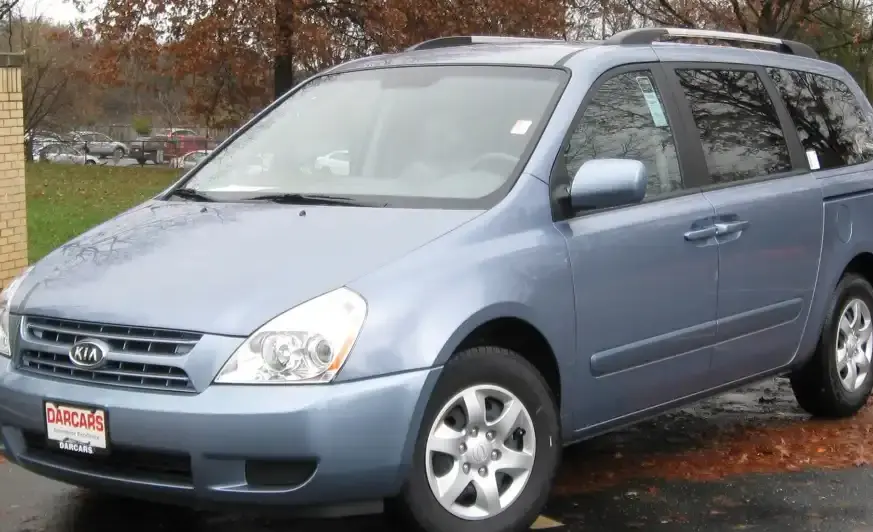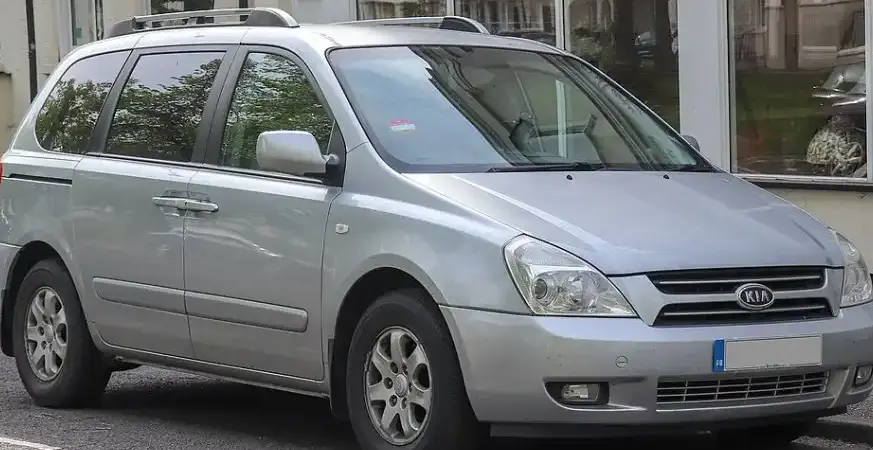
The Kia Sedona III, launched in 2015, represented a significant step forward for Kia’s minivan offering. Positioned as a family-focused vehicle, the Sedona III aimed to compete with established players like the Honda Odyssey and Toyota Sienna. Within the Sedona III lineup, the 3.3-liter V6 engine paired with a six-speed automatic transmission was a popular choice, offering a balance of power and practicality. This configuration was primarily sold in the North American market, where minivans remained a significant segment. Production continued through 2020, with minor updates throughout its lifecycle. The Sedona was later replaced by the Kia Carnival in 2022.
Technical Specifications
| Brand | Kia |
| Model | Sedona |
| Generation | Sedona III |
| Type (Engine) | 3.3 V6 (280 Hp) Automatic |
| Start of production | 2015 |
| Powertrain Architecture | Internal Combustion engine |
| Body type | Minivan |
| Seats | 7-8 |
| Doors | 5 |
| Fuel consumption (economy) – urban | 13.1 l/100 km (18 US mpg, 21.6 UK mpg, 7.6 km/l) |
| Fuel consumption (economy) – extra urban | 9.8 l/100 km (24 US mpg, 28.8 UK mpg, 10.2 km/l) |
| Fuel consumption (economy) – combined | 11.8 l/100 km (19.9 US mpg, 23.9 UK mpg, 8.5 km/l) |
| Fuel Type | Petrol (Gasoline) |
| Acceleration 0 – 100 km/h | 8.2 sec |
| Acceleration 0 – 62 mph | 8.2 sec |
| Acceleration 0 – 60 mph | 7.8 sec |
| Maximum speed | 217 km/h (134.84 mph) |
| Weight-to-power ratio | 7.1 kg/Hp, 139.9 Hp/tonne |
| Weight-to-torque ratio | 6 kg/Nm, 167.9 Nm/tonne |
| Power | 280 Hp @ 6000 rpm |
| Power per litre | 83.8 Hp/l |
| Torque | 336 Nm @ 5200 rpm (247.82 lb.-ft. @ 5200 rpm) |
| Engine layout | Front, Transverse |
| Engine displacement | 3342 cm3 (203.94 cu. in.) |
| Number of cylinders | 6 |
| Engine configuration | V-engine |
| Cylinder Bore | 92 mm (3.62 in.) |
| Piston Stroke | 83.8 mm (3.3 in.) |
| Compression ratio | 11.5:1 |
| Number of valves per cylinder | 4 |
| Fuel injection system | Direct injection |
| Engine aspiration | Naturally aspirated engine |
| Valvetrain | DOHC-CVVT |
| Engine oil capacity | 5.7 l (6.02 US qt | 5.02 UK qt) |
| Coolant | 11.5 l (12.15 US qt | 10.12 UK qt) |
| Kerb Weight | 2001-2059 kg (4411.45 – 4539.32 lbs.) |
| Max. weight | 2760 kg (6084.76 lbs.) |
| Max load | 701-759 kg (1545.44 – 1673.31 lbs.) |
| Trunk (boot) space – minimum | 2220 l (78.4 cu. ft.) |
| Trunk (boot) space – maximum | 4021 l (142 cu. ft.) |
| Fuel tank capacity | 80 l (21.13 US gal | 17.6 UK gal) |
| Permitted trailer load with brakes (12%) | 1588 kg (3500.94 lbs.) |
| Length | 5116 mm (201.42 in.) |
| Width | 1984 mm (78.11 in.) |
| Width including mirrors | 2268 mm (89.29 in.) |
| Height | 1740 mm (68.5 in.) |
| Wheelbase | 3061 mm (120.51 in.) |
| Front track | 1740 mm (68.5 in.) |
| Rear (Back) track | 1747 mm (68.78 in.) |
| Ride height (ground clearance) | 170 mm (6.69 in.) |
| Drag coefficient (Cd) | 0.33 |
| Minimum turning circle (turning diameter) | 11.21 m (36.78 ft.) |
| Drivetrain Architecture | The Internal combustion engine (ICE) drives the front wheels of the vehicle. |
| Drive wheel | Front wheel drive |
| Number of gears and type of gearbox | 6 gears, automatic transmission |
| Front suspension | Independent, type McPherson with coil spring and anti-roll bar |
| Rear suspension | Independent multi-link spring suspension with stabilizer |
| Front brakes | Ventilated discs |
| Rear brakes | Disc |
| Assisting systems | ABS (Anti-lock braking system) |
| Steering type | Steering rack and pinion |
| Power steering | Hydraulic Steering |
| Tires size | 195/65 R15; 205/55 R16; 235/65 R17; 235/60 R18 |
| Wheel rims size | 6.0J x 15; 6.5J x 16; 6.5J x 17; 6.5J x 18 |
Powertrain & Engine Architecture
The heart of this Sedona variant is the 3.3-liter Lambda II V6 engine, designated as the G6DH. This engine utilizes direct injection (GDI) technology, enhancing fuel efficiency and power output. The G6DH features a dual overhead camshaft (DOHC) valvetrain with continuously variable valve timing (CVVT) on both intake and exhaust valves, optimizing engine performance across the rev range. The six-speed automatic transmission, a Hyundai-developed unit, was chosen for its smooth operation and responsiveness. This transmission features a torque converter for smooth launches and gear changes. The engine’s transverse mounting and front-wheel-drive configuration contribute to efficient packaging within the minivan’s chassis.
Driving Characteristics
The 280 horsepower and 247.82 lb-ft of torque provided by the 3.3L V6 and six-speed automatic offered adequate performance for typical minivan duties. Acceleration from 0-60 mph was achieved in around 7.8 seconds, making it reasonably quick for a vehicle of its size and weight. The automatic transmission was tuned for comfort and fuel economy, with gear changes generally smooth and unobtrusive. Compared to the base 3.5L V6 engine, the 3.3L offered a noticeable improvement in power and responsiveness, particularly when fully loaded with passengers and cargo. While not a sporty vehicle, the Sedona III 3.3L Automatic provided sufficient power for highway merging and passing maneuvers. The gear ratios were optimized for everyday driving, prioritizing fuel efficiency at cruising speeds.
Equipment & Trim Levels
The 3.3L V6 Automatic trim typically sat in the mid-range of the Sedona III lineup, often designated as the “SX” or “Limited” trim. Standard features included tri-zone automatic climate control, a touchscreen infotainment system with navigation, rearview camera, and a comprehensive suite of safety features like ABS, electronic stability control, and multiple airbags. Higher trim levels added features such as leather upholstery, heated and ventilated front seats, a panoramic sunroof, and advanced driver-assistance systems like smart cruise control and lane departure warning. Optional extras included a rear-seat entertainment system and premium audio systems.
Chassis & Braking
The Sedona III utilized a McPherson strut front suspension and a multi-link rear suspension, providing a comfortable ride quality. Stabilizer bars were fitted to both axles to reduce body roll during cornering. The braking system consisted of ventilated front discs and solid rear discs, providing adequate stopping power for the vehicle’s weight. ABS (Anti-lock Braking System) was standard, enhancing braking performance in emergency situations. The steering system employed a hydraulic power steering rack and pinion, offering a responsive and predictable steering feel.
Market Reception & Comparison
The Kia Sedona III 3.3L V6 Automatic was generally well-received by automotive critics. It was praised for its spacious interior, comfortable ride, and generous features list. The 3.3L engine was considered a good balance of power and fuel economy, although some reviewers noted that it wasn’t as refined as the engines offered in some of its competitors. Fuel economy figures averaged around 19.9 US mpg combined, which was competitive for its class. Compared to the base 3.5L V6 engine, the 3.3L offered better performance but at a slightly higher price point. Reliability ratings were generally positive, with owners reporting few major issues.
Legacy
The Kia Sedona III 3.3L V6 Automatic has proven to be a relatively reliable and durable powertrain. In the used car market, these models are often sought after for their combination of practicality, features, and value. The Lambda II V6 engine is known for its longevity, provided it receives regular maintenance, including timely oil changes and coolant flushes. While not without its minor quirks, the Sedona III 3.3L Automatic remains a viable option for families seeking a spacious and comfortable minivan at an affordable price.