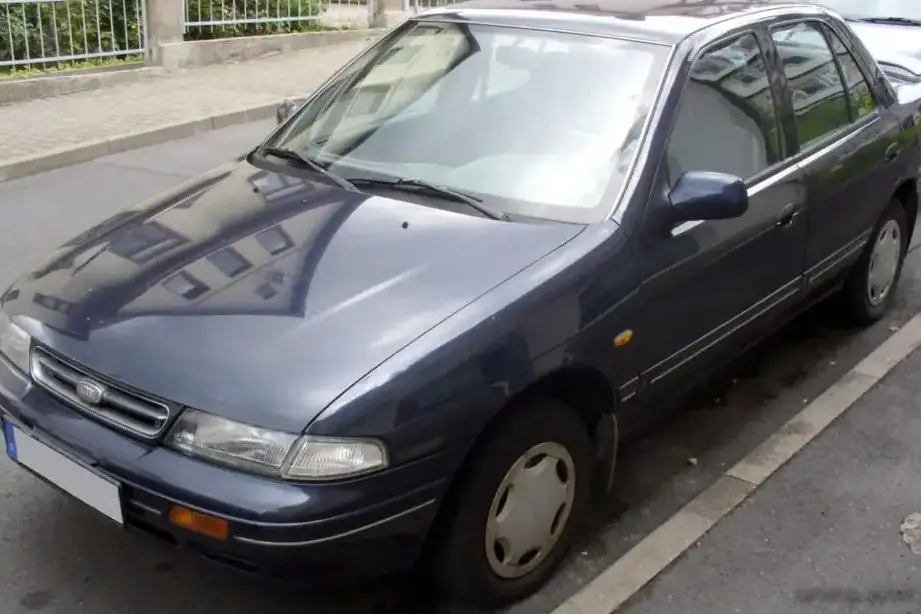
The Kia Sephia II 1.5 i, producing 80 horsepower, was a key model in Kia’s lineup from 1998 through 2003. Representing the second generation of the Sephia, this variant was primarily aimed at the entry-level compact sedan market, particularly in North America and parts of Europe. Built on the Kia AS platform, the Sephia II sought to offer affordable transportation with a focus on practicality and fuel efficiency. The 1.5L engine and 5-speed manual transmission combination positioned it as the most economical option within the Sephia II range, below the more powerful 1.6L and 1.8L engine choices.
Technical Specifications
| Brand | Kia |
| Model | Sephia |
| Generation | Sephia II |
| Type (Engine) | 1.5 i (80 Hp) |
| Start of production | 1998 |
| End of production | 2003 |
| Powertrain Architecture | Internal Combustion engine |
| Body type | Sedan |
| Seats | 5 |
| Doors | 4 |
| Fuel consumption (urban) | 11 l/100 km (21.4 US mpg) |
| Fuel consumption (extra urban) | 6.1 l/100 km (38.6 US mpg) |
| Fuel Type | Petrol (Gasoline) |
| Acceleration 0 – 100 km/h | 13.8 sec |
| Acceleration 0 – 62 mph | 13.8 sec |
| Acceleration 0 – 60 mph | 13.1 sec |
| Maximum speed | 170 km/h (105.63 mph) |
| Weight-to-power ratio | 13.2 kg/Hp |
| Weight-to-torque ratio | 8.8 kg/Nm |
| Power | 80 Hp @ 5500 rpm |
| Power per litre | 53.4 Hp/l |
| Torque | 120 Nm @ 2500 rpm (88.51 lb.-ft. @ 2500 rpm) |
| Engine layout | Front, Transverse |
| Engine displacement | 1498 cm3 (91.41 cu. in.) |
| Number of cylinders | 4 |
| Engine configuration | Inline |
| Cylinder Bore | 78 mm (3.07 in.) |
| Piston Stroke | 78.4 mm (3.09 in.) |
| Compression ratio | 9.3:1 |
| Number of valves per cylinder | 2 |
| Fuel injection system | Multi-port manifold injection |
| Engine aspiration | Naturally aspirated engine |
| Kerb Weight | 1055 kg (2325.88 lbs.) |
| Max. weight | 1590 kg (3505.35 lbs.) |
| Max load | 535 kg (1179.47 lbs.) |
| Trunk (boot) space – minimum | 370 l (13.07 cu. ft.) |
| Trunk (boot) space – maximum | 692 l (24.44 cu. ft.) |
| Fuel tank capacity | 50 l (13.21 US gal | 11 UK gal) |
| Length | 4427 mm (174.29 in.) |
| Width | 1711 mm (67.36 in.) |
| Height | 1415 mm (55.71 in.) |
| Wheelbase | 2560 mm (100.79 in.) |
| Front track | 1465 mm (57.68 in.) |
| Rear (Back) track | 1455 mm (57.28 in.) |
| Drivetrain Architecture | Front wheel drive |
| Number of gears and type of gearbox | 5 gears, manual transmission |
| Front suspension | Spring Strut |
| Rear suspension | Spring Strut |
| Front brakes | Ventilated discs |
| Rear brakes | Drum |
| Assisting systems | ABS (Anti-lock braking system) |
| Steering type | Steering rack and pinion |
| Power steering | Hydraulic Steering |
| Tires size | 175/70 R13 |
Powertrain & Engine Architecture
The heart of the Sephia II 1.5 i was the G4EH engine, a 1.5-liter inline-four cylinder gasoline engine. This engine utilized a single overhead camshaft (SOHC) valvetrain with two valves per cylinder. Fuel delivery was managed by a multi-point fuel injection system, contributing to relatively smooth operation and acceptable fuel economy for its time. The engine’s 9.3:1 compression ratio was a typical value for naturally aspirated engines of this era. The 5-speed manual transmission was the standard offering, providing a reasonably wide range of gear ratios to maximize fuel efficiency and allow for adequate acceleration. The transmission was a conventional design, prioritizing durability and simplicity over advanced features.
Driving Characteristics
The 80 horsepower output of the 1.5L engine translated to modest performance. Acceleration from 0 to 60 mph took approximately 13.1 seconds, making it noticeably slower than the Sephia II models equipped with the 1.6L or 1.8L engines. However, the 1.5L engine offered a more relaxed driving experience, particularly in urban environments. The gear ratios in the 5-speed manual transmission were tuned for fuel economy, meaning the engine needed to be revved relatively high to achieve brisk acceleration. Compared to the automatic transmission options available on other Sephia II trims, the manual version provided more driver control and slightly better fuel economy. The overall driving experience was characterized by its simplicity and predictability, rather than sporty handling or exhilarating acceleration.
Equipment & Trim Levels
The Sephia II 1.5 i typically served as the base model, and as such, came with a relatively limited set of standard features. These generally included power steering, air conditioning, and a basic audio system. Interior upholstery was typically cloth, and the dashboard featured a straightforward design with minimal ornamentation. Optional extras, such as power windows, power locks, and an upgraded audio system, were available, but often added a significant cost to the vehicle. The focus was on providing essential features at an affordable price point.
Chassis & Braking
The Sephia II utilized a conventional front-wheel-drive chassis with a MacPherson strut suspension in the front and a torsion beam suspension in the rear. The front brakes were ventilated discs, providing adequate stopping power for the vehicle’s weight and performance. However, the rear brakes were drums, which were less effective than disc brakes and could be prone to fading under heavy use. The suspension tuning was geared towards comfort rather than sporty handling, resulting in a relatively soft ride quality. The steering was hydraulic power-assisted, making it easy to maneuver at low speeds.
Market Reception & Comparison
The Kia Sephia II 1.5 i was generally well-received as an affordable and practical compact sedan. Critics praised its fuel efficiency and spacious interior, but noted its lack of refinement and modest performance. Compared to other entry-level compacts of the time, such as the Honda Civic and Toyota Corolla, the Sephia II offered a lower price point but lacked the same level of build quality and driving dynamics. Within the Sephia II lineup, the 1.5L model was positioned as the most economical option, appealing to budget-conscious buyers who prioritized fuel efficiency over performance. The 1.6L and 1.8L models offered more power and features, but at a higher price.
Legacy
The Kia Sephia II 1.5 i, while not a performance icon, played a significant role in establishing Kia as a viable competitor in the global automotive market. The G4EH engine proved to be relatively reliable, and many examples of the Sephia II 1.5 i are still on the road today. However, due to its age, finding parts can be increasingly challenging. In the used car market, these vehicles are typically very affordable, making them attractive to buyers seeking a basic and inexpensive means of transportation. While not highly sought after by collectors, the Sephia II 1.5 i represents a significant chapter in Kia’s history, demonstrating the brand’s commitment to providing affordable and reliable vehicles.