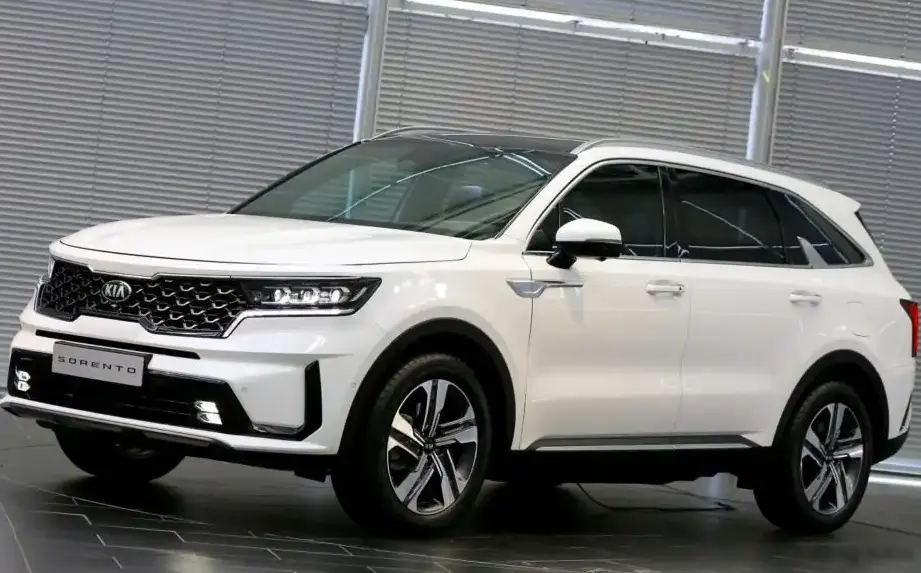
The Kia Sorento IV 1.6 T-GDI Plug-in Hybrid AWD Automatic 7-Seat, produced from January 2021 to March 2024, represents a significant step in Kia’s electrification strategy. Positioned as a premium offering within the fourth-generation Sorento lineup (codenamed MQ4), this variant combined a turbocharged gasoline engine with an electric motor and all-wheel drive, offering a blend of efficiency, performance, and practicality. It was designed to appeal to environmentally conscious families seeking a spacious and well-equipped SUV. The Sorento IV platform marked a substantial upgrade over its predecessor, offering improved interior space, advanced safety features, and a more refined driving experience.
Technical Specifications
| Brand | Kia |
| Model | Sorento |
| Generation | Sorento IV |
| Type (Engine) | 1.6 T-GDI (265 Hp) Plug-in Hybrid AWD Automatic 7 Seat |
| Start of production | January, 2021 |
| End of production | March, 2024 |
| Powertrain Architecture | PHEV (Plug-in Hybrid Electric Vehicle) |
| Body type | SUV |
| Seats | 7 |
| Doors | 5 |
| Fuel consumption (combined) | 1.6 l/100 km (147 US mpg, 176.6 UK mpg, 62.5 km/l) |
| CO2 emissions | 36 g/km |
| Fuel Type | Petrol / electricity |
| Acceleration 0 – 100 km/h | 8.7 sec |
| Acceleration 0 – 62 mph | 8.7 sec |
| Acceleration 0 – 60 mph | 8.3 sec |
| Maximum speed | 193 km/h (119.92 mph) |
| Emission standard | Euro 6d |
| Weight-to-power ratio | 7.5 kg/Hp, 133.7 Hp/tonne |
| Weight-to-torque ratio | 5.7 kg/Nm, 176.6 Nm/tonne |
| Gross battery capacity | 13.8 kWh |
| Battery voltage | 360 V |
| Battery technology | Lithium-polymer (LiPo) |
| Battery weight | 139 kg (306.44 lbs) |
| Battery location | Below the floor |
| All-electric range (WLTP) | 57 km (35.42 mi) |
| All-electric range (NEDC) | 68 km (42.25 mi) |
| Average Energy consumption | 16.1 kWh/100 km (25.91 kWh/100 mi, 130 MPGe, 6.2 km/kWh, 3.9 mi/kWh) |
| Max speed (electric) | 140 km/h (86.99 mph) |
| Electric motor power | 91 Hp @ 2100-3300 rpm |
| Electric motor Torque | 304 Nm @ 0-2100 rpm (224.22 lb.-ft. @ 0-2100 rpm) |
| Electric motor location | Between the combustion engine and the transmission |
| System power | 265 Hp |
| System torque | 350 Nm (258.15 lb.-ft.) |
| Engine Power | 180 Hp @ 5500 rpm |
| Engine Torque | 265 Nm @ 1500-4500 rpm (195.45 lb.-ft. @ 1500-4500 rpm) |
| Engine layout | Front, Transverse |
| Engine Model/Code | G4FT |
| Engine displacement | 1598 cm3 (97.52 cu. in.) |
| Number of cylinders | 4 |
| Engine configuration | Inline |
| Cylinder Bore | 75.6 mm (2.98 in.) |
| Piston Stroke | 89 mm (3.5 in.) |
| Compression ratio | 10.5:1 |
| Number of valves per cylinder | 4 |
| Fuel injection system | Direct injection |
| Engine aspiration | Turbocharger |
| Engine oil capacity | 4.8 l (5.07 US qt | 4.22 UK qt) |
| Coolant capacity | 7.9 l (8.35 US qt | 6.95 UK qt) |
| Kerb Weight | 1982-2099 kg (4369.56 – 4627.5 lbs.) |
| Max. weight | 2680 kg (5908.39 lbs.) |
| Max load | 581-698 kg (1280.89 – 1538.83 lbs.) |
| Trunk (boot) space – minimum | 604-809 l (21.33 – 28.57 cu. ft.) |
| Trunk (boot) space – maximum | 1988 l (70.21 cu. ft.) |
| Fuel tank capacity | 47 l (12.42 US gal | 10.34 UK gal) |
| Max. roof load | 100 kg (220.46 lbs.) |
| Permitted trailer load with brakes (12%) | 1500 kg (3306.93 lbs.) |
| Permitted trailer load without brakes | 750 kg (1653.47 lbs.) |
| Permitted towbar download | 100 kg (220.46 lbs.) |
| Length | 4810 mm (189.37 in.) |
| Width | 1900 mm (74.8 in.) |
| Width including mirrors | 2170 mm (85.43 in.) |
| Height | 1700 mm (66.93 in.) |
| Wheelbase | 2815 mm (110.83 in.) |
| Front track | 1646-1656 mm (64.8 – 65.2 in.) |
| Rear track | 1646-1656 mm (64.8 – 65.2 in.) |
| Front overhang | 930 mm (36.61 in.) |
| Rear overhang | 1065 mm (41.93 in.) |
| Ride height (ground clearance) | 174 mm (6.85 in.) |
| Minimum turning circle | 11.6 m (38.06 ft.) |
| Approach angle | 16.8° |
| Departure angle | 21.3° |
| Ramp-over angle | 15.6° |
| Drivetrain Architecture | ICE and electric motor drive all four wheels in full electric or mixed mode. |
| Drive wheel | All wheel drive (4×4) |
| Number of gears | 6 |
| Gearbox type | Automatic transmission |
| Front suspension | Independent, McPherson with coil spring and anti-roll bar |
| Rear suspension | Double wishbone, Transverse stabilizer, Coil spring |
| Front brakes | Ventilated discs, 325 mm |
| Rear brakes | Disc, 305 mm |
| Assisting systems | ABS (Anti-lock braking system) |
| Steering type | Steering rack and pinion |
| Power steering | Electric |
| Tires size | 235/55 R19 |
| Wheel rims size | 7.5J x 19 ET 49.5 |
INTRODUCTION
The Kia Sorento IV 1.6 T-GDI Plug-in Hybrid AWD Automatic 7-Seat, launched in 2021, represented a significant advancement in Kia’s SUV offerings. Built on the N3 platform, shared with the Hyundai Santa Fe, this variant aimed to provide a compelling alternative to traditional gasoline-powered SUVs, particularly in markets with increasing environmental regulations and incentives for plug-in hybrid vehicles. It was primarily targeted towards European and Asian markets, where demand for fuel-efficient and environmentally friendly vehicles is high. The combination of a relatively small turbocharged engine, an electric motor, and all-wheel drive provided a unique balance of performance and economy.
Powertrain & Engine Architecture
At the heart of the Sorento PHEV lies the G4FT 1.6-liter turbocharged four-cylinder gasoline engine. This engine, part of Kia/Hyundai’s ‘Smartstream’ engine family, utilizes direct injection and a twin-scroll turbocharger to deliver 180 horsepower and 265 Nm of torque. The engine is paired with a 60 kW (91 hp) electric motor integrated between the engine and the six-speed automatic transmission. The electric motor draws power from a 13.8 kWh lithium-polymer battery pack located under the floor of the vehicle. This configuration allows for both all-electric driving and combined operation, where the engine and motor work together to provide a total system output of 265 horsepower and 350 Nm of torque. The automatic transmission is specifically tuned to work seamlessly with the electric motor, optimizing efficiency and providing smooth gear changes. The engine management system intelligently switches between electric, hybrid, and gasoline modes depending on driving conditions and battery charge level.
Driving Characteristics
The Sorento 1.6 T-GDI PHEV offers a surprisingly refined driving experience. In all-electric mode, it provides near-silent operation and instant torque, making it ideal for city driving. The 57 km (35.42 miles) of all-electric range is sufficient for many daily commutes. When the battery is depleted or requires assistance, the gasoline engine seamlessly kicks in, providing ample power for highway cruising and overtaking. While not as overtly sporty as some competitors, the combined output of 265 hp delivers adequate acceleration, with a 0-60 mph time of around 8.3 seconds. The six-speed automatic transmission is well-matched to the engine and motor, providing smooth and predictable shifts. The all-wheel-drive system enhances traction and stability, particularly in adverse weather conditions. Compared to the 2.2-liter diesel versions, the PHEV offers a quieter and more refined driving experience, albeit with slightly less low-end torque.
Equipment & Trim Levels
The Sorento IV 1.6 T-GDI PHEV typically came well-equipped, even in base trim levels. Standard features often included a 10.25-inch touchscreen infotainment system with Apple CarPlay and Android Auto compatibility, a digital instrument cluster, leather upholstery, heated front seats, and a suite of advanced driver-assistance systems (ADAS) such as lane-keeping assist, adaptive cruise control, and automatic emergency braking. Higher trim levels added features like a panoramic sunroof, premium sound system, ventilated front seats, and a 360-degree camera system. Optional extras included a tow hitch and various cosmetic enhancements.
Chassis & Braking
The Sorento IV utilizes a McPherson strut front suspension and a multi-link rear suspension, providing a comfortable and controlled ride. The suspension is tuned to balance ride comfort with handling stability. The PHEV variant, due to the added weight of the battery pack, often featured slightly stiffer spring rates compared to the standard gasoline models. Braking duties are handled by ventilated discs at the front and solid discs at the rear. The ABS system incorporates electronic brakeforce distribution (EBD) and brake assist. The all-wheel-drive system provides enhanced traction and stability, particularly in slippery conditions.
Market Reception & Comparison
The Kia Sorento IV 1.6 T-GDI PHEV was generally well-received by automotive critics. It was praised for its spacious interior, comfortable ride, and impressive fuel efficiency. The plug-in hybrid powertrain was seen as a significant step forward for Kia, offering a viable alternative to traditional gasoline-powered SUVs. Compared to the diesel-powered Sorento models, the PHEV offered a quieter and more refined driving experience, but with slightly less overall range. Against competitors like the Mitsubishi Outlander PHEV and the Volvo XC60 Recharge, the Sorento PHEV offered a compelling combination of value, space, and features. Fuel economy was a strong point, with the ability to travel significant distances on electric power alone.
Legacy
The Kia Sorento IV 1.6 T-GDI Plug-in Hybrid AWD Automatic 7-Seat has established itself as a reliable and practical plug-in hybrid SUV. While relatively new to the used car market, early reports suggest good long-term reliability of the powertrain. The battery pack is expected to maintain a significant portion of its capacity for many years, although regular maintenance and proper charging habits are crucial. The Sorento PHEV represents a key milestone in Kia’s transition towards electrification and continues to be a popular choice for families seeking a spacious, efficient, and environmentally friendly SUV.