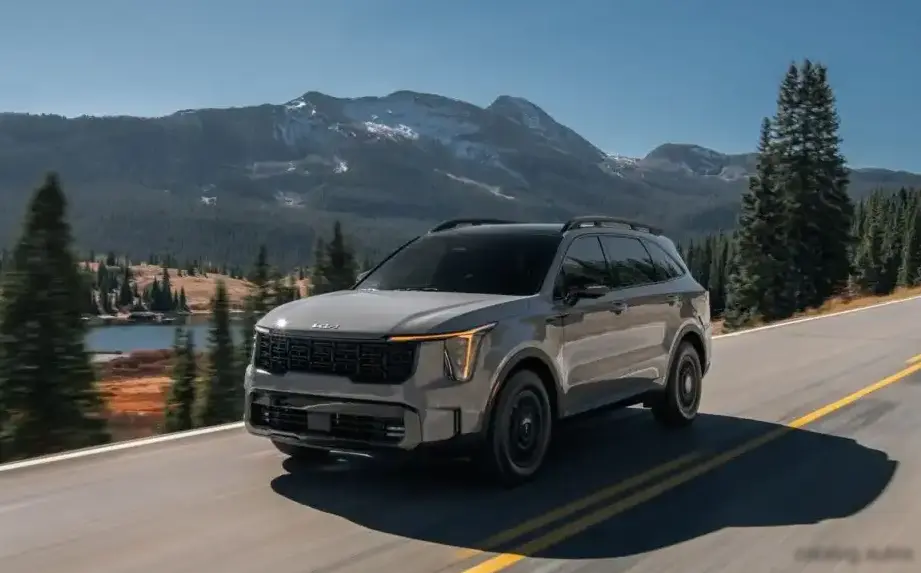
The Kia Sorento IV, specifically the facelifted 2024 model year equipped with the 1.6 T-GDI full hybrid powertrain and automatic transmission, represents a significant offering in the mid-size SUV segment. Introduced in May 2024, this variant builds upon the fourth-generation Sorento (launched in 2020), incorporating styling updates and refining the already popular hybrid technology. Positioned as a mid-range option within the Sorento lineup, it aims to balance fuel efficiency, performance, and affordability, appealing to families and individuals seeking a versatile and technologically advanced vehicle. The Sorento IV utilizes the NQ5 platform, shared with the Hyundai Santa Fe, and is primarily marketed towards North American, European, and Asian markets.
Technical Specifications
| Brand | Kia |
| Model | Sorento |
| Generation | Sorento IV (facelift 2024) |
| Type (Engine) | 1.6 T-GDI (215 Hp) Full Hybrid Automatic |
| Start of production | May, 2024 |
| Powertrain Architecture | FHEV (Full Hybrid Electric Vehicle) |
| Body type | SUV |
| Seats | 5 |
| Doors | 5 |
| Fuel consumption at Low speed (WLTP) | 7.3 l/100 km (32.2 US mpg, 38.7 UK mpg, 13.7 km/l) |
| Fuel consumption at Medium speed (WLTP) | 5.0 l/100 km (47 US mpg, 56.5 UK mpg, 20 km/l) |
| Fuel consumption at high speed (WLTP) | 5.7 l/100 km (41.3 US mpg, 49.6 UK mpg, 17.5 km/l) |
| Fuel consumption at very high speed (WLTP) | 8.5 l/100 km (27.7 US mpg, 33.2 UK mpg, 11.8 km/l) |
| Combined fuel consumption (WLTP) | 6.8 l/100 km (34.6 US mpg, 41.5 UK mpg, 14.7 km/l) |
| CO2 emissions (WLTP) | 153 g/km |
| Fuel Type | Petrol (Gasoline) |
| Acceleration 0 – 100 km/h | 9.4 sec |
| Acceleration 0 – 62 mph | 9.4 sec |
| Acceleration 0 – 60 mph | 8.9 sec |
| Maximum speed | 183 km/h (113.71 mph) |
| Emission standard | Euro 6e |
| Weight-to-power ratio | 8.6 kg/Hp, 116 Hp/tonne |
| Weight-to-torque ratio | 5.1 kg/Nm, 198 Nm/tonne |
| Gross battery capacity | 1.49 kWh |
| Battery voltage | 270 V |
| Battery technology | Lithium-polymer (LiPo) |
| Battery weight | 40 kg (88.18 lbs.) |
| Max speed (electric) | 120 km/h (74.56 mph) |
| Electric motor power | 60 Hp @ 1600-2000 rpm |
| Electric motor Torque | 264 Nm @ 0-1600 rpm (194.72 lb.-ft. @ 0-1600 rpm) |
| Electric motor type | Synchronous |
| System power | 215 Hp |
| System torque | 367 Nm (270.69 lb.-ft.) |
| Power | 160 Hp @ 5500 rpm |
| Power per litre | 100.1 Hp/l |
| Torque | 265 Nm @ 1500-3500 rpm (195.45 lb.-ft. @ 1500-3500 rpm) |
| Engine layout | Front, Transverse |
| Engine Model/Code | G4FT |
| Engine displacement | 1598 cm3 (97.52 cu. in.) |
| Number of cylinders | 4 |
| Engine configuration | Inline |
| Cylinder Bore | 75.6 mm (2.98 in.) |
| Piston Stroke | 89 mm (3.5 in.) |
| Compression ratio | 10.5:1 |
| Number of valves per cylinder | 4 |
| Fuel injection system | Direct injection |
| Engine aspiration | Turbocharger, Intercooler |
| Engine oil capacity | 4.8 l (5.07 US qt | 4.22 UK qt) |
| Coolant | 7.9 l (8.35 US qt | 6.95 UK qt) |
| Kerb Weight | 1854-2007 kg (4087.37 – 4424.68 lbs.) |
| Max. weight | 2510 kg (5533.6 lbs.) |
| Max load | 503-656 kg (1108.93 – 1446.23 lbs.) |
| Trunk (boot) space – minimum | 697-902 l (24.61 – 31.85 cu. ft.) |
| Trunk (boot) space – maximum | 2085 l (73.63 cu. ft.) |
| Fuel tank capacity | 67 l (17.7 US gal | 14.74 UK gal) |
| Max. roof load | 100 kg (220.46 lbs.) |
| Permitted trailer load with brakes (12%) | 1110 kg (2447.13 lbs.) |
| Permitted trailer load without brakes | 750 kg (1653.47 lbs.) |
| Permitted towbar download | 100 kg (220.46 lbs.) |
| Length | 4815 mm (189.57 in.) |
| Width | 1900 mm (74.8 in.) |
| Width including mirrors | 2170 mm (85.43 in.) |
| Height | 1700 mm (66.93 in.) |
| Wheelbase | 2815 mm (110.83 in.) |
| Front track | 1646 mm (64.8 in.) |
| Rear (Back) track | 1656 mm (65.2 in.) |
| Front overhang | 925 mm (36.42 in.) |
| Rear overhang | 1075 mm (42.32 in.) |
| Ride height (ground clearance) | 174 mm (6.85 in.) |
| Minimum turning circle (turning diameter) | 11.6 m (38.06 ft.) |
| Front brakes | Ventilated discs, 325 mm |
| Rear brakes | Disc, 305 mm |
| Number of gears and type of gearbox | 6 gears, automatic transmission |
Powertrain & Engine Architecture
At the heart of this Sorento variant lies the 1.6-liter T-GDI (Turbocharged Gasoline Direct Injection) engine, designated as the G4FT. This engine is part of Kia/Hyundai’s ‘Smartstream’ engine family, known for its focus on efficiency and reduced emissions. The engine produces 160 horsepower and 265 Nm (195 lb-ft) of torque. It utilizes a twin-scroll turbocharger and direct injection to optimize combustion and power delivery. The ‘full hybrid’ aspect comes from the integration of a 60 hp electric motor powered by a 1.49 kWh lithium-polymer battery. The system intelligently switches between the gasoline engine, the electric motor, or a combination of both, maximizing fuel economy. The powertrain is coupled with a 6-speed automatic transmission, specifically tuned for smooth operation and efficient power transfer. The transmission control unit (TCU) is programmed to prioritize fuel efficiency during normal driving conditions and provide quicker downshifts when more power is needed.
Driving Characteristics
The 1.6 T-GDI hybrid powertrain delivers a refined driving experience. Acceleration from 0-60 mph takes approximately 8.9 seconds, which is adequate for everyday driving but doesn’t offer particularly sporty performance. The electric motor provides instant torque, assisting the gasoline engine during acceleration and contributing to a responsive feel. The automatic transmission shifts smoothly, and the hybrid system seamlessly blends power sources. Compared to the higher-output 2.5-liter gasoline engine option, this variant prioritizes fuel economy over outright performance. The 6-speed automatic, while smooth, may feel less responsive than the 8-speed transmissions found in some competitors. The hybrid system allows for short periods of all-electric driving, particularly at lower speeds, further enhancing fuel efficiency.
Equipment & Trim Levels
The 2024 Sorento IV 1.6 T-GDI Hybrid Automatic typically comes well-equipped, even in base trim levels. Standard features generally include automatic climate control, an 8-inch touchscreen infotainment system with Apple CarPlay and Android Auto compatibility, a rearview camera, and a suite of advanced driver-assistance systems (ADAS) such as lane-keeping assist, forward collision avoidance assist, and adaptive cruise control. Higher trim levels add features like a larger touchscreen display (10.25-inch), leather upholstery, a panoramic sunroof, a premium sound system, and ventilated front seats. Interior upholstery is typically cloth in lower trims, upgrading to leather in higher specifications. Dashboard configurations are modern and driver-focused, with a blend of physical buttons and touchscreen controls.
Chassis & Braking
The Sorento IV utilizes a front-wheel-drive (FWD) layout as standard, with all-wheel drive (AWD) available as an option. The front suspension consists of a McPherson strut setup with coil springs and an anti-roll bar, while the rear suspension employs a multi-link design, also with coil springs and an anti-roll bar. Braking duties are handled by ventilated discs at the front and solid discs at the rear. The braking system is augmented by ABS (Anti-lock Braking System), Electronic Stability Control (ESC), and Brake Assist. The suspension tuning is geared towards comfort and ride quality, providing a smooth and controlled driving experience. Stabilizer bar thickness is moderate, balancing body roll with ride comfort.
Market Reception & Comparison
The Kia Sorento IV, and specifically the 1.6 T-GDI Hybrid variant, has been well-received by critics and consumers alike. It’s praised for its spacious interior, comfortable ride, and impressive fuel economy. Compared to other trims in the Sorento lineup, the hybrid model offers a significant advantage in fuel efficiency, making it an attractive option for those prioritizing running costs. However, its acceleration is not as brisk as the higher-powered gasoline engines. Compared to competitors like the Toyota Highlander Hybrid and Honda CR-V Hybrid, the Sorento offers a compelling combination of features, value, and warranty coverage. Reliability reports have been generally positive, although long-term data on the hybrid powertrain is still emerging.
Legacy
The 1.6 T-GDI full hybrid powertrain in the Sorento IV represents Kia’s commitment to electrification and fuel efficiency. While it’s still relatively early to assess its long-term reliability definitively, the Smartstream engine family has proven to be durable in other Kia and Hyundai vehicles. The hybrid system’s components, including the battery and electric motor, are covered by Kia’s comprehensive warranty, providing peace of mind for owners. In the used car market, this variant is expected to hold its value well due to its fuel efficiency and the growing demand for hybrid vehicles. Its blend of practicality, technology, and efficiency positions it as a strong contender in the mid-size SUV segment for years to come.