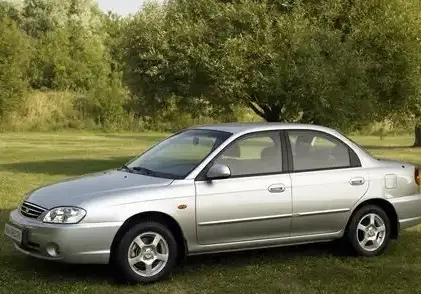
The Kia Spectra 1.6i 16V Automatic, produced from 2005 to 2006, represented an entry-level offering within the second generation (2004-2009) of Kia’s compact sedan. Positioned as a value-oriented choice in the North American market, the Spectra aimed to provide affordable transportation with a focus on practicality and fuel efficiency. This variant, equipped with the 1.6-liter inline-four engine and a four-speed automatic transmission, served as the base model for buyers prioritizing ease of use over outright performance. It was a key component in Kia’s strategy to gain market share by offering a compelling alternative to established Japanese and American competitors.
Technical Specifications
| Brand | Kia |
| Model | Spectra |
| Generation | Spectra |
| Type (Engine) | 1.6i 16V (105 Hp) Automatic |
| Start of production | 2005 |
| End of production | 2006 |
| Powertrain Architecture | Internal Combustion engine |
| Body type | Sedan |
| Seats | 5 |
| Doors | 4 |
| Fuel consumption (urban) | 10.5 l/100 km (22.4 US mpg) |
| Fuel consumption (extra urban) | 6 l/100 km (39.2 US mpg) |
| Fuel Type | Petrol (Gasoline) |
| Acceleration 0 – 100 km/h | 11.6 sec |
| Acceleration 0 – 62 mph | 11.6 sec |
| Acceleration 0 – 60 mph | 11 sec |
| Maximum speed | 186 km/h (115.58 mph) |
| Weight-to-power ratio | 10.7 kg/Hp |
| Weight-to-torque ratio | 7.8 kg/Nm |
| Power | 105 Hp @ 5500 rpm |
| Torque | 144 Nm @ 4500 rpm (106.21 lb.-ft. @ 4500 rpm) |
| Engine layout | Front, Transverse |
| Engine displacement | 1594 cm3 (97.27 cu. in.) |
| Number of cylinders | 4 |
| Engine configuration | Inline |
| Cylinder Bore | 78 mm (3.07 in.) |
| Piston Stroke | 83.4 mm (3.28 in.) |
| Compression ratio | 9.5:1 |
| Number of valves per cylinder | 4 |
| Fuel injection system | Multi-port manifold injection |
| Engine aspiration | Naturally aspirated engine |
| Valvetrain | DOHC |
| Kerb Weight | 1125 kg (2480.2 lbs.) |
| Trunk (boot) space – minimum | 440 l (15.54 cu. ft.) |
| Trunk (boot) space – maximum | 1125 l (39.73 cu. ft.) |
| Fuel tank capacity | 50 l (13.21 US gal | 11 UK gal) |
| Length | 4510 mm (177.56 in.) |
| Width | 1720 mm (67.72 in.) |
| Height | 1415 mm (55.71 in.) |
| Wheelbase | 2560 mm (100.79 in.) |
| Drivetrain Architecture | The Internal combustion engine (ICE) drives the front wheels of the vehicle. |
| Drive wheel | Front wheel drive |
| Number of gears and type of gearbox | 4 gears, automatic transmission |
| Front suspension | Independent, type McPherson with coil spring and anti-roll bar |
| Rear suspension | Independent multi-link spring suspension with stabilizer |
| Front brakes | Disc |
| Rear brakes | Drum |
| Power steering | Hydraulic Steering |
Powertrain & Engine Architecture
The heart of the Spectra 1.6i was the G4FA engine, a 1.6-liter inline-four cylinder gasoline engine. This engine utilized a dual overhead camshaft (DOHC) valvetrain with four valves per cylinder, contributing to its relatively efficient operation. Fuel delivery was managed by a multi-point fuel injection system, a common setup for vehicles of this era. The engine produced 105 horsepower at 5500 rpm and 144 Nm (106 lb-ft) of torque at 4500 rpm. Paired with this engine was a four-speed automatic transmission. This transmission, while providing convenient operation, was a relatively basic design compared to the five or six-speed automatics becoming more prevalent in other vehicles. The transmission’s gear ratios were tuned for fuel economy and smooth cruising rather than aggressive acceleration.
Driving Characteristics
The 1.6-liter engine and four-speed automatic combination resulted in a driving experience focused on practicality. Acceleration was adequate for everyday driving, with a 0-60 mph time of approximately 11 seconds. However, it lacked the punch of the higher-trim Spectra models equipped with the 2.0-liter engine. The automatic transmission’s shift points were noticeable, and downshifting for passing maneuvers required a deliberate push of the accelerator. Compared to the five-speed manual transmission available on other Spectra trims, the automatic version felt less responsive and offered reduced fuel economy. The Spectra’s suspension provided a comfortable ride, absorbing bumps and imperfections in the road reasonably well. Steering was light and easy, making it suitable for urban driving.
Equipment & Trim Levels
The 1.6i Automatic trim typically included standard features such as air conditioning, power windows and locks, and an AM/FM radio with a CD player. Interior upholstery was typically cloth, and the dashboard featured a straightforward design with easy-to-use controls. Optional extras included features like alloy wheels, a sunroof, and an upgraded audio system. The base trim level prioritized affordability, so many features considered standard on higher-end compact cars were either unavailable or offered as optional packages.
Chassis & Braking
The Spectra featured an independent McPherson strut front suspension and an independent multi-link rear suspension, providing a reasonable balance of ride comfort and handling. Front brakes were disc brakes, while rear brakes were drum brakes – a cost-saving measure common in entry-level vehicles. Hydraulic power steering was standard. The chassis was designed for durability and affordability, rather than sporty handling. Stabilizer bars were included both front and rear to reduce body roll during cornering, but the overall handling characteristics were geared towards comfortable cruising.
Market Reception & Comparison
The Kia Spectra 1.6i Automatic was generally well-received as an affordable and practical compact sedan. Critics noted its value for money, spacious interior, and comfortable ride. However, the engine’s lack of power and the automatic transmission’s somewhat dated design were common criticisms. Compared to the 2.0-liter Spectra models, the 1.6i offered significantly less performance but boasted slightly better fuel economy. Against competitors like the Honda Civic, Toyota Corolla, and Mazda3, the Spectra 1.6i offered a lower price point but lacked the refinement and brand reputation of those established models.
Legacy
The Kia Spectra 1.6i Automatic, while not a performance standout, played a significant role in establishing Kia as a viable competitor in the North American market. The G4FA engine proved to be reasonably reliable, and the four-speed automatic transmission, while not cutting-edge, was generally durable. Today, these vehicles are often found as affordable used cars, prized for their low running costs and simple mechanical design. However, potential buyers should be aware of the age-related issues common to older vehicles, such as wear and tear on suspension components and potential for corrosion. The Spectra 1.6i represents a snapshot of early 2000s compact car design, prioritizing affordability and practicality over outright performance and technological innovation.