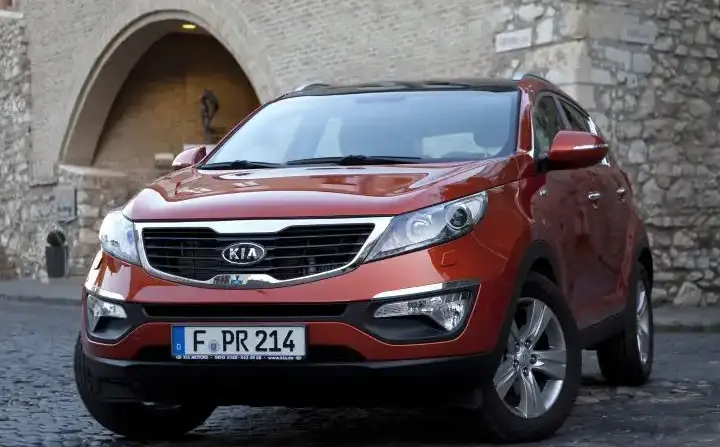
The Kia Sportage III, produced between 2010 and 2016, represented a significant step forward for the South Korean automaker in the competitive compact SUV segment. Introduced as a replacement for the second-generation Sportage, the III generation (internally designated as SL) aimed to offer a more refined and modern vehicle with improved styling, interior quality, and technology. The 2.0 CRDI variant, producing 184 horsepower, was a key offering in many European and international markets, positioned as a balance between fuel efficiency and performance. Production of this specific engine and trim configuration ran from 2011 to 2014.
Technical Specifications
| Brand | Kia |
| Model | Sportage |
| Generation | Sportage III |
| Type (Engine) | 2.0 CRDI (184 Hp) |
| Start of production | 2011 |
| End of production | 2014 |
| Powertrain Architecture | Internal Combustion engine |
| Body type | SUV |
| Seats | 5 |
| Doors | 5 |
| Fuel consumption (urban) | 7.2 l/100 km (32.7 US mpg) |
| Fuel consumption (extra urban) | 5.3 l/100 km (44.4 US mpg) |
| Fuel consumption (combined) | 6 l/100 km (39.2 US mpg) |
| Fuel Type | Diesel |
| Acceleration 0 – 100 km/h | 9.8 sec |
| Acceleration 0 – 62 mph | 9.8 sec |
| Acceleration 0 – 60 mph | 9.3 sec |
| Maximum speed | 194 km/h (120.55 mph) |
| Emission standard | Euro 5 |
| Weight-to-power ratio | 8.3 kg/Hp |
| Weight-to-torque ratio | 4 kg/Nm |
| Power | 184 Hp @ 4000 rpm |
| Torque | 382 Nm @ 1800 rpm (281.75 lb.-ft. @ 1800 rpm) |
| Engine layout | Front, Transverse |
| Engine Model/Code | D4HA |
| Engine displacement | 1995 cm3 (121.74 cu. in.) |
| Number of cylinders | 4 |
| Engine configuration | Inline |
| Number of valves per cylinder | 4 |
| Fuel injection system | Diesel Commonrail |
| Engine aspiration | Turbocharger, Intercooler |
| Valvetrain | DOHC |
| Engine oil capacity | 8 l (8.45 US qt | 7.04 UK qt) |
| Coolant capacity | 8.5 l (8.98 US qt | 7.48 UK qt) |
| Kerb Weight | 1525 kg (3362.05 lbs) |
| Max. weight | 2140 kg (4717.89 lbs) |
| Max load | 615 kg (1355.84 lbs) |
| Trunk (boot) space – minimum | 564 l (19.92 cu. ft.) |
| Trunk (boot) space – maximum | 1353 l (47.78 cu. ft.) |
| Fuel tank capacity | 58 l (15.32 US gal | 12.76 UK gal) |
| Length | 4440 mm (174.8 in) |
| Width | 1855 mm (73.03 in) |
| Height | 1685 mm (66.34 in) |
| Wheelbase | 2640 mm (103.94 in) |
| Minimum turning circle | 10.58 m (34.71 ft) |
| Drivetrain | Front wheel drive |
| Number of gears | 6 |
| Gearbox type | Manual transmission |
| Front brakes | Ventilated discs |
| Rear brakes | Disc |
| Tires size | 225/60 R17 |
| Wheel rims size | 17 |
Powertrain & Engine Architecture
The heart of the Sportage 2.0 CRDI is the D4HA engine, a 1995cc inline-four cylinder diesel. This engine utilizes a second-generation common-rail direct injection system, delivering fuel at extremely high pressure for improved combustion efficiency and reduced emissions. The D4HA features a variable geometry turbocharger (VGT) and an intercooler, enhancing both low-end torque and overall power output. The engine employs a double overhead camshaft (DOHC) valvetrain with four valves per cylinder, optimizing gas flow for increased performance. The 6-speed manual transmission was standard on this variant, offering precise gear changes and contributing to the vehicle’s fuel efficiency. The engine was designed to meet stringent Euro 5 emission standards, incorporating a diesel particulate filter (DPF) to trap soot particles.
Driving Characteristics
The 184 horsepower and 281 lb-ft of torque provided by the 2.0 CRDI engine offered a respectable level of performance for the Sportage. Acceleration from 0-60 mph took approximately 9.3 seconds, making it competitive within its class. The engine’s peak torque, available from 1800 rpm, provided strong pulling power for everyday driving and overtaking maneuvers. While not as sporty as some of its gasoline-powered counterparts, the 2.0 CRDI offered a good balance of power and fuel economy. The 6-speed manual transmission allowed drivers to maintain optimal engine speed for various driving conditions. Compared to the base 1.6 GDI gasoline engine, the 2.0 CRDI provided significantly more torque and better fuel economy, albeit with a slightly heavier engine weight impacting handling.
Equipment & Trim Levels
The 2.0 CRDI variant of the Sportage III typically came equipped with a reasonable level of standard features. These included air conditioning, power windows and mirrors, a CD/MP3 stereo system, and ABS brakes. Higher trim levels, such as the ‘KX-2’ or ‘Titanium’ (depending on the market), added features like alloy wheels, a panoramic sunroof, leather upholstery, automatic climate control, and a rear parking sensor system. Optional extras included a navigation system, Bluetooth connectivity, and a premium sound system. Interior upholstery was typically cloth on base models, with leather options available on higher trims. The dashboard layout was functional and modern, with a focus on ergonomics.
Chassis & Braking
The Sportage III utilized a front-wheel-drive platform with independent MacPherson strut suspension in the front and a multi-link suspension in the rear. This setup provided a comfortable ride quality and decent handling characteristics. The front brakes were ventilated discs, while the rear brakes were solid discs. ABS (Anti-lock Braking System) was standard, enhancing braking performance and stability. The steering system employed a rack and pinion setup, providing precise steering feel. Stabilizer bars were fitted to both the front and rear axles to reduce body roll during cornering.
Market Reception & Comparison
The Kia Sportage III 2.0 CRDI was generally well-received by automotive critics. It was praised for its stylish design, spacious interior, and competitive fuel economy. The diesel engine was noted for its refinement and strong torque output. However, some critics pointed out that the interior materials weren’t quite as premium as those found in some of its rivals, such as the Nissan Qashqai or Volkswagen Tiguan. In terms of fuel economy, the 2.0 CRDI consistently outperformed the gasoline-powered variants of the Sportage. Reliability was generally good, although some owners reported issues with the DPF system, a common concern with modern diesel engines.
Legacy
The Kia Sportage III 2.0 CRDI remains a popular choice in the used car market. The D4HA engine, while requiring regular maintenance (particularly regarding the DPF), is generally considered to be a robust and reliable unit. The combination of fuel efficiency, practicality, and affordability makes it an attractive option for buyers seeking a compact SUV. Parts availability is generally good, and maintenance costs are reasonable. The Sportage III helped to establish Kia as a serious contender in the European and international SUV markets, paving the way for the continued success of the brand.