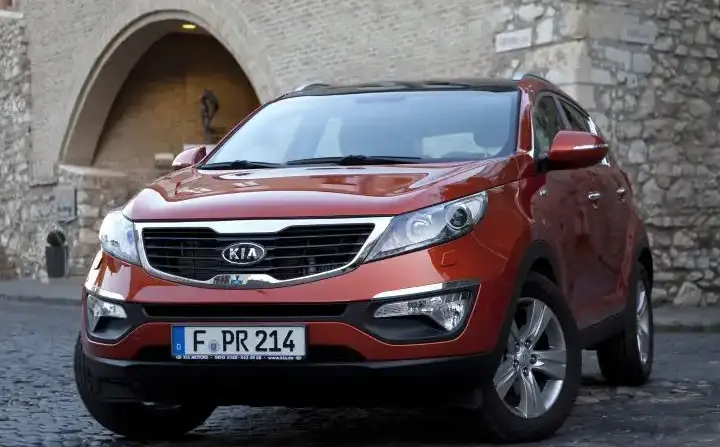
The Kia Sportage III, produced between 2010 and 2016, represented a significant step forward for the South Korean automaker in the competitive compact SUV segment. Introduced as a replacement for the second-generation Sportage, it offered a more refined driving experience, improved interior quality, and a bolder exterior design. The 2.0 CRDI (184 hp) Automatic variant, available from 2011 to 2014, occupied a mid-range position within the Sportage III lineup, appealing to buyers seeking a balance between fuel efficiency, performance, and convenience. This model was particularly important in European and Asian markets where diesel engines were highly favored.
Technical Specifications
| Brand | Kia |
| Model | Sportage |
| Generation | Sportage III |
| Type (Engine) | 2.0 CRDI (184 Hp) Automatic |
| Start of production | 2011 |
| End of production | 2014 |
| Powertrain Architecture | Internal Combustion engine |
| Body type | SUV |
| Seats | 5 |
| Doors | 5 |
| Fuel consumption (urban) | 9.1 l/100 km (25.8 US mpg, 31 UK mpg, 11 km/l) |
| Fuel consumption (extra urban) | 6 l/100 km (39.2 US mpg, 47.1 UK mpg, 16.7 km/l) |
| Fuel consumption (combined) | 7.1 l/100 km (33.1 US mpg, 39.8 UK mpg, 14.1 km/l) |
| Fuel Type | Diesel |
| Acceleration 0 – 100 km/h | 9.8 sec |
| Acceleration 0 – 62 mph | 9.8 sec |
| Acceleration 0 – 60 mph | 9.3 sec |
| Maximum speed | 195 km/h (121.17 mph) |
| Emission standard | Euro 5 |
| Weight-to-power ratio | 8.7 kg/Hp, 114.9 Hp/tonne |
| Weight-to-torque ratio | 4.2 kg/Nm, 238.6 Nm/tonne |
| Power | 184 Hp @ 4000 rpm |
| Power per litre | 92.2 Hp/l |
| Torque | 382 Nm @ 1800 rpm (281.75 lb.-ft. @ 1800 rpm) |
| Engine layout | Front, Transverse |
| Engine Model/Code | D4HA |
| Engine displacement | 1995 cm3 (121.74 cu. in.) |
| Number of cylinders | 4 |
| Engine configuration | Inline |
| Number of valves per cylinder | 4 |
| Fuel injection system | Diesel Commonrail |
| Engine aspiration | Turbocharger, Intercooler |
| Valvetrain | DOHC |
| Engine oil capacity | 8 l (8.45 US qt | 7.04 UK qt) |
| Coolant capacity | 8.5 l (8.98 US qt | 7.48 UK qt) |
| Kerb Weight | 1601 kg (3529.6 lbs.) |
| Max. weight | 2140 kg (4717.89 lbs.) |
| Max load | 539 kg (1188.29 lbs.) |
| Trunk (boot) space – minimum | 564 l (19.92 cu. ft.) |
| Trunk (boot) space – maximum | 1353 l (47.78 cu. ft.) |
| Fuel tank capacity | 58 l (15.32 US gal | 12.76 UK gal) |
| Length | 4440 mm (174.8 in.) |
| Width | 1855 mm (73.03 in.) |
| Height | 1685 mm (66.34 in.) |
| Wheelbase | 2640 mm (103.94 in.) |
| Minimum turning circle | 10.58 m (34.71 ft.) |
| Drivetrain | Front wheel drive |
| Number of gears | 6 |
| Gearbox type | Automatic transmission |
| Front brakes | Ventilated discs |
| Rear brakes | Disc |
| Tire size | 225/60 R17; 235/55 R18 |
| Wheel rims size | 17; 18 |
INTRODUCTION
The Kia Sportage III 2.0 CRDI Automatic, launched in 2011, was a key variant in Kia’s expanding SUV range. Built on the platform shared with the Hyundai ix35 (also known as the Tucson in some markets), the Sportage III aimed to offer a more stylish and practical alternative to established competitors like the Nissan Qashqai and Volkswagen Tiguan. The 2.0 CRDI engine, paired with a six-speed automatic transmission, provided a comfortable and efficient driving experience, making it a popular choice for families and commuters. This configuration represented a middle-ground option, positioned above the base 1.6 GDI petrol engine and below the more powerful 2.2 CRDI diesel.
Powertrain & Engine Architecture
At the heart of the Sportage III 2.0 CRDI Automatic lies the D4HA engine, a 1995cc four-cylinder diesel. This engine utilizes a second-generation common-rail direct injection system, delivering fuel at extremely high pressure for improved combustion efficiency and reduced emissions. The engine features a turbocharger with an intercooler, boosting power output and torque. The DOHC (Double Overhead Camshaft) valvetrain, with four valves per cylinder, further enhances breathing and performance. The six-speed automatic transmission, sourced from Hyundai, was chosen for its smooth shifting and ease of use. While not a dual-clutch transmission, it offered a good balance of responsiveness and comfort. The transmission’s gear ratios were tuned to prioritize fuel economy and drivability, rather than outright performance.
Driving Characteristics
The 2.0 CRDI Automatic Sportage offered a relaxed and comfortable driving experience. With 184 horsepower and 281.75 lb-ft of torque, acceleration was adequate for everyday driving, with a 0-60 mph time of around 9.3 seconds. However, it wasn’t a particularly sporty vehicle. The automatic transmission, while smooth, could sometimes feel hesitant during quick overtaking maneuvers. Compared to the manual transmission version of the same engine, the automatic offered slightly reduced fuel economy and a marginally slower 0-60 mph time. The higher-output 2.2 CRDI models provided significantly more power and torque, but at the expense of fuel efficiency and a higher price point. The suspension was tuned for comfort, absorbing bumps and imperfections in the road well, but this also resulted in some body roll during cornering.
Equipment & Trim Levels
The 2.0 CRDI Automatic trim typically included features such as air conditioning, power windows, central locking, and a basic audio system with USB connectivity. Higher trim levels, such as the ‘3’ or ‘4’ variants, added features like alloy wheels, a panoramic sunroof, leather upholstery, heated front seats, and a more advanced infotainment system with navigation. Safety features included ABS (Anti-lock Braking System), Electronic Stability Control (ESC), and multiple airbags. Optional extras included parking sensors, a rearview camera, and a premium sound system.
Chassis & Braking
The Sportage III utilized a front-wheel-drive layout as standard, with all-wheel drive available as an option. The suspension consisted of MacPherson struts at the front and a multi-link setup at the rear. The front brakes were ventilated discs, providing good stopping power, while the rear brakes were solid discs. The steering was a rack and pinion system, offering reasonable precision and feedback. The chassis was designed to provide a comfortable ride and stable handling, prioritizing practicality over sporty dynamics. Stabilizer bars were fitted to both the front and rear axles to reduce body roll.
Market Reception & Comparison
The Kia Sportage III 2.0 CRDI Automatic was generally well-received by automotive critics. It was praised for its stylish design, spacious interior, and comfortable ride. The diesel engine was noted for its fuel efficiency and reasonable performance. However, some critics found the automatic transmission to be somewhat sluggish and the interior materials to be slightly below par compared to some of its competitors. Compared to the petrol-powered versions, the 2.0 CRDI offered significantly better fuel economy and torque, making it a more practical choice for long-distance driving. Against rivals like the Nissan Qashqai and Volkswagen Tiguan, the Sportage offered a competitive package with a longer warranty and a more affordable price point.
Legacy
The Kia Sportage III 2.0 CRDI Automatic has proven to be a relatively reliable vehicle in the used car market. The D4HA engine is known for its durability, provided it has been properly maintained. Common issues include turbocharger wear and potential problems with the diesel particulate filter (DPF), particularly on vehicles that have primarily been used for short journeys. The automatic transmission is generally reliable, but regular fluid changes are essential. Today, these vehicles represent a good value proposition for buyers seeking a practical and affordable SUV. Their fuel efficiency and relatively low running costs continue to make them an attractive option.