Technical Specifications
| Brand | Kia |
| Model | Sportage |
| Generation | Sportage III (facelift, 2014) |
| Type (Engine) | 2.0 CRDi (136 Hp) 4WD Automatic |
| Start of production | 2014 |
| End of production | 2016 |
| Powertrain Architecture | Internal Combustion engine |
| Body type | SUV |
| Seats | 5 |
| Doors | 5 |
| Fuel consumption (urban) | 8.7 l/100 km (27 US mpg, 32.5 UK mpg, 11.5 km/l) |
| Fuel consumption (extra urban) | 5.8 l/100 km (40.6 US mpg, 48.7 UK mpg, 17.2 km/l) |
| Fuel consumption (combined) | 6.9 l/100 km (34.1 US mpg, 40.9 UK mpg, 14.5 km/l) |
| CO2 emissions | 179 g/km |
| Fuel Type | Diesel |
| Acceleration 0 – 100 km/h | 12.1 sec |
| Acceleration 0 – 62 mph | 12.1 sec |
| Acceleration 0 – 60 mph | 11.5 sec |
| Maximum speed | 181 km/h (112.47 mph) |
| Emission standard | Euro 5 |
| Weight-to-power ratio | 12.3 kg/Hp, 81.1 Hp/tonne |
| Weight-to-torque ratio | 5.3 kg/Nm, 190.3 Nm/tonne |
| Power | 136 Hp @ 4000 rpm |
| Power per litre | 68.2 Hp/l |
| Torque | 319 Nm @ 1800-2500 rpm (235.28 lb.-ft. @ 1800-2500 rpm) |
| Engine layout | Front, Transverse |
| Engine Model/Code | D4HA |
| Engine displacement | 1995 cm3 (121.74 cu. in.) |
| Number of cylinders | 4 |
| Engine configuration | Inline |
| Cylinder Bore | 84 mm (3.31 in.) |
| Piston Stroke | 90 mm (3.54 in.) |
| Compression ratio | 16.5:1 |
| Number of valves per cylinder | 4 |
| Fuel injection system | Diesel Commonrail |
| Engine aspiration | Turbocharger, Intercooler |
| Engine oil capacity | 8 l (8.45 US qt | 7.04 UK qt) |
| Coolant | 8.5 l (8.98 US qt | 7.48 UK qt) |
| Kerb Weight | 1676 kg (3694.95 lbs.) |
| Max. weight | 2140 kg (4717.89 lbs.) |
| Max load | 464 kg (1022.94 lbs.) |
| Trunk (boot) space – minimum | 564 l (19.92 cu. ft.) |
| Trunk (boot) space – maximum | 1353 l (47.78 cu. ft.) |
| Fuel tank capacity | 58 l (15.32 US gal | 12.76 UK gal) |
| Permitted trailer load with brakes (12%) | 1600 kg (3527.4 lbs.) |
| Permitted trailer load without brakes | 750 kg (1653.47 lbs.) |
| Length | 4440 mm (174.8 in.) |
| Width | 1855 mm (73.03 in.) |
| Height | 1635 mm (64.37 in.) |
| Wheelbase | 2640 mm (103.94 in.) |
| Front track | 1611 mm (63.43 in.) |
| Rear (Back) track | 1612 mm (63.46 in.) |
| Ride height (ground clearance) | 172 mm (6.77 in.) |
| Drag coefficient (Cd) | 0.37 |
| Minimum turning circle (turning diameter) | 10.58 m (34.71 ft.) |
| Approach angle | 22.7° |
| Departure angle | 28.2° |
| Ramp-over (brakeover) angle | 17.7° |
| Drive wheel | All wheel drive (4×4) |
| Number of gears and type of gearbox | 6 gears, automatic transmission |
| Front brakes | Ventilated discs |
| Rear brakes | Disc |
| Assisting systems | ABS (Anti-lock braking system) |
| Steering type | Steering rack and pinion |
| Power steering | Electric Steering |
| Tires size | 225/60 R17 |
| Wheel rims size | 17 |
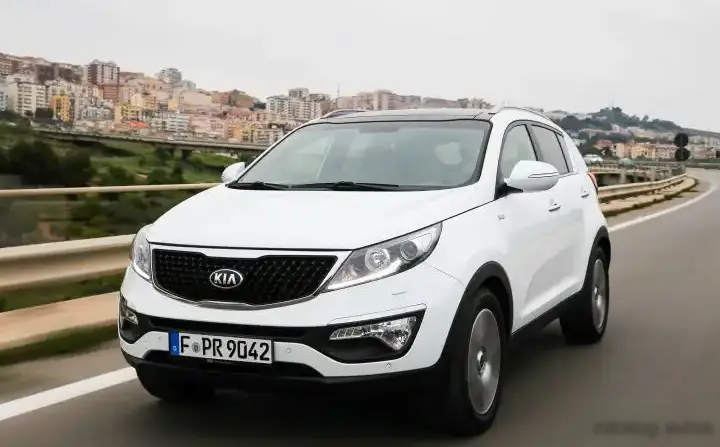
The Kia Sportage III (facelift, introduced in 2014) 2.0 CRDi 136 horsepower (Hp) 4WD Automatic represents a notable evolution of Kia’s popular compact SUV. Produced from 2014 to 2016, this variant occupied a middle ground within the Sportage III range, balancing fuel efficiency, all-weather capability with its four-wheel-drive system, and the convenience of an automatic transmission. It was positioned as a practical choice for families and individuals seeking a versatile vehicle for daily commuting and occasional off-road excursions. While primarily targeted towards the European and Asian markets – where diesel engines and all-wheel drive were highly sought after – it was also available in select other regions.
Powertrain & Engine Architecture
At the heart of the 2014 Sportage 2.0 CRDi Automatic is the D4HA engine, a 1995cc inline-four cylinder diesel. This engine employs a second-generation common-rail direct injection system, delivering fuel at extremely high pressure for optimized combustion. A turbocharger with an intercooler further enhances performance by forcing more air into the cylinders. The engine produces 136 horsepower at 4000 rpm and a substantial 319 Nm (235.28 lb-ft) of torque between 1800 and 2500 rpm. This torque output is a defining characteristic of diesel engines, providing strong pulling power at lower engine speeds. The engine also incorporates a diesel particulate filter (DPF) to reduce harmful emissions, meeting Euro 5 standards. The engine is transversely mounted in the front of the vehicle. The automatic transmission is a conventional six-speed unit, designed to provide smooth gear changes and enhance driving comfort.
Driving Characteristics
The 136 hp 2.0 CRDi Automatic Sportage offers a comfortable and capable driving experience. While not particularly sporty, the engine’s torque provides adequate acceleration for everyday driving situations. The 0-60 mph time of around 11.5 seconds is respectable for a compact SUV. The automatic transmission shifts smoothly, although it can sometimes feel hesitant during quick acceleration. The all-wheel-drive system provides enhanced traction in slippery conditions, making it a suitable vehicle for inclement weather or light off-road use. Compared to the manual transmission version of the same engine, the automatic offers greater convenience, but at the expense of some fuel economy and responsiveness. Higher-output versions of the Sportage, such as those with more powerful diesel engines or the gasoline variants, offer significantly quicker acceleration but typically come with a higher price tag.
Equipment & Trim Levels
The 2014 Sportage 2.0 CRDi Automatic typically came equipped with a range of standard features, including air conditioning, power windows and mirrors, a CD/MP3 stereo system, and alloy wheels. Safety features included ABS, airbags, and electronic stability control. Higher trim levels offered additional features such as leather upholstery, a panoramic sunroof, a navigation system, and parking sensors. Interior upholstery was generally cloth on the base models, with leather options available on higher trims. The dashboard layout was functional and straightforward, with easy-to-read gauges and controls.
Chassis & Braking
The Sportage III utilizes a MacPherson strut front suspension and a multi-link rear suspension, providing a comfortable ride and good handling characteristics. The front brakes are ventilated discs, while the rear brakes are solid discs. The steering is electrically assisted, providing light and precise steering feel. The all-wheel-drive system is typically an on-demand system, automatically engaging the rear wheels when traction is lost. Stabilizer bars are fitted to both the front and rear axles to reduce body roll during cornering.
Market Reception & Comparison
The Kia Sportage III (facelift) 2.0 CRDi Automatic was generally well-received by automotive critics. It was praised for its practicality, fuel efficiency, and comfortable ride. However, some critics noted that the engine could feel underpowered when fully loaded or driving uphill. Compared to competitors such as the Nissan Qashqai and Hyundai ix35, the Sportage offered a competitive level of equipment and value for money. Fuel economy was a strong point, with combined figures around 34.1 US mpg. Reliability was generally good, although some owners reported issues with the DPF system.
Legacy
The Kia Sportage III 2.0 CRDi Automatic has proven to be a relatively reliable vehicle in the used car market. The D4HA engine is known for its durability, although regular maintenance, including DPF regeneration, is essential. The automatic transmission is generally robust, but it’s important to check for smooth gear changes during a pre-purchase inspection. Today, these Sportages represent a good value proposition for buyers seeking a practical and affordable compact SUV with all-wheel drive. They continue to be a common sight on roads throughout Europe and Asia, testament to their enduring popularity and reliability.