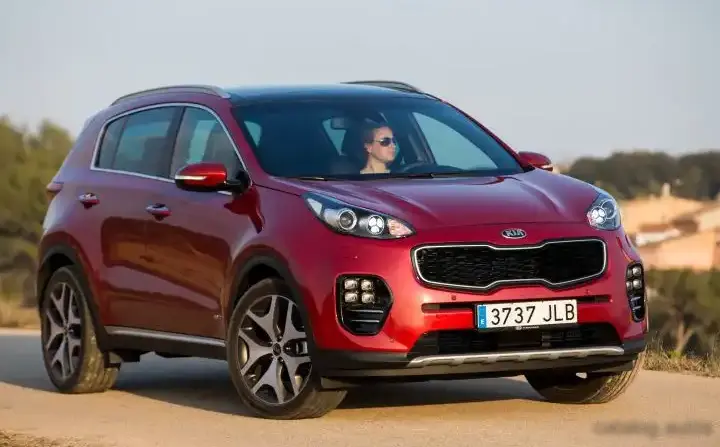
The Kia Sportage IV, produced from 2016 to 2018, represented a significant step forward for the South Korean automaker in the highly competitive compact SUV segment. The 2.0 T-GDI (240 Hp) Sportmatic variant occupied a position as a higher-performance offering within the fourth-generation Sportage (QL) lineup, appealing to buyers seeking a blend of practicality, style, and spirited driving. This model was primarily targeted towards the North American and European markets, where turbocharged engines were gaining popularity. It sat above the base engine options and below any potential range-topping trims, offering a compelling balance of power and efficiency.
Technical Specifications
| Brand | Kia |
| Model | Sportage |
| Generation | Sportage IV |
| Type (Engine) | 2.0 T-GDI (240 Hp) Sportmatic |
| Start of production | 2016 |
| End of production | 2018 |
| Powertrain Architecture | Internal Combustion engine |
| Body type | SUV |
| Seats | 5 |
| Doors | 5 |
| Fuel consumption (economy) – urban (EPA) | 11.2 l/100 km (21 US mpg, 25.2 UK mpg, 8.9 km/l) |
| Fuel consumption (economy) – extra urban (EPA) | 9 l/100 km (26.1 US mpg, 31.4 UK mpg, 11.1 km/l) |
| Fuel consumption (economy) – combined (EPA) | 10.2 l/100 km (23.1 US mpg, 27.7 UK mpg, 9.8 km/l) |
| Fuel Type | Petrol (Gasoline) |
| Emission standard | Euro 6 |
| Weight-to-power ratio | 6.9 kg/Hp, 144.3 Hp/tonne |
| Weight-to-torque ratio | 4.7 kg/Nm, 212.3 Nm/tonne |
| Power | 240 Hp @ 6000 rpm |
| Power per litre | 120.1 Hp/l |
| Torque | 353 Nm @ 1450-3500 rpm (260.36 lb.-ft. @ 1450-3500 rpm) |
| Engine layout | Front, Transverse |
| Engine Model/Code | Theta II / G4KH |
| Engine displacement | 1998 cm3 (121.93 cu. in.) |
| Number of cylinders | 4 |
| Engine configuration | Inline |
| Cylinder Bore | 86 mm (3.39 in.) |
| Piston Stroke | 86 mm (3.39 in.) |
| Compression ratio | 10:1 |
| Number of valves per cylinder | 4 |
| Fuel injection system | Direct injection |
| Engine aspiration | Twin-scroll turbo, Intercooler |
| Valvetrain | DOHC, CVVT |
| Engine oil capacity | 4.8 l (5.07 US qt | 4.22 UK qt) |
| Coolant | 7.2 l (7.61 US qt | 6.34 UK qt) |
| Kerb Weight | 1663-1768 kg (3666.29 – 3897.77 lbs.) |
| Trunk (boot) space – minimum | 491 l (17.34 cu. ft.) |
| Trunk (boot) space – maximum | 1492 l (52.69 cu. ft.) |
| Fuel tank capacity | 62 l (16.38 US gal | 13.64 UK gal) |
| Max. roof load | 100 kg (220.46 lbs.) |
| Permitted trailer load with brakes (12%) | 907 kg (1999.59 lbs.) |
| Permitted trailer load without brakes | 748 kg (1649.06 lbs.) |
| Length | 4480 mm (176.38 in.) |
| Width | 1855 mm (73.03 in.) |
| Height | 1645 mm (64.76 in.) |
| Wheelbase | 2670 mm (105.12 in.) |
| Front track | 1609 mm (63.35 in.) |
| Rear (Back) track | 1620 mm (63.78 in.) |
| Front overhang | 910 mm (35.83 in.) |
| Rear overhang | 900 mm (35.43 in.) |
| Ride height (ground clearance) | 163 mm (6.42 in.) |
| Minimum turning circle (turning diameter) | 10.6 m (34.78 ft.) |
| Approach angle | 16.7° |
| Departure angle | 23.9° |
| Ramp-over (brakeover) angle | 18.6° |
| Drivetrain Architecture | The Internal combustion engine (ICE) drives the front wheels of the vehicle. |
| Drive wheel | Front wheel drive |
| Number of gears and type of gearbox | 6 gears, automatic transmission Sportmatic |
| Front suspension | Independent, type McPherson with coil spring and anti-roll bar |
| Rear suspension | Independent multi-link spring suspension with stabilizer |
| Front brakes | Ventilated discs, 320 mm |
| Rear brakes | Disc, 302 mm |
| Assisting systems | ABS (Anti-lock braking system) |
| Steering type | Steering rack and pinion |
| Power steering | Electric Steering |
| Tires size | 245/45 R19 |
| Wheel rims size | 7.5J x 19 |
Powertrain & Engine Architecture
At the heart of the Sportage 2.0 T-GDI Sportmatic lies the Theta II engine family, specifically the G4KH code. This 1.998-liter inline-four cylinder engine utilizes direct fuel injection and a twin-scroll turbocharger with an intercooler to deliver a robust 240 horsepower at 6,000 rpm and 353 Nm (260.36 lb-ft) of torque between 1,450 and 3,500 rpm. The twin-scroll turbo design minimizes turbo lag, providing a more responsive driving experience. The engine also features a Double Overhead Camshaft (DOHC) valvetrain with Continuously Variable Valve Timing (CVVT) on both intake and exhaust valves, optimizing engine efficiency and performance across the rev range. The “Sportmatic” transmission refers to Kia’s six-speed automatic transmission, offering a degree of driver control with selectable shift points. While not a dual-clutch system, it provided smoother shifts than earlier Kia automatics.
Driving Characteristics
The 2.0 T-GDI Sportmatic offered a noticeable performance upgrade compared to the base engine options available on the Sportage IV. Acceleration was brisk, making highway merging and overtaking maneuvers effortless. The automatic transmission, while smooth, wasn’t particularly sporty, prioritizing comfort over aggressive shifting. The gear ratios were tuned for fuel efficiency and everyday drivability rather than outright performance. Compared to a manual transmission equipped Sportage, the automatic offered convenience but sacrificed some driver engagement. The weight of the vehicle, ranging from 1663 to 1768 kg (3666.29 – 3897.77 lbs.), did impact overall agility, but the turbocharger helped to mitigate the effects of the weight.
Equipment & Trim Levels
The 2.0 T-GDI Sportmatic trim typically included a generous array of standard features. These often included automatic climate control, a touchscreen infotainment system with Apple CarPlay and Android Auto compatibility, rear parking sensors, and a rearview camera. Higher trim levels added features like leather upholstery, a panoramic sunroof, heated and ventilated front seats, and advanced driver-assistance systems such as lane departure warning and automatic emergency braking. Interior upholstery was typically cloth on lower trims, with leather options available. Dashboard configurations were consistent across the range, with a focus on user-friendliness and modern design.
Chassis & Braking
The Sportage IV utilized a front-wheel-drive platform with independent suspension at all four corners. The front suspension employed a McPherson strut design with coil springs and an anti-roll bar, while the rear featured a multi-link setup with a stabilizer bar. This configuration provided a comfortable ride quality while maintaining reasonable handling characteristics. Braking duties were handled by ventilated discs at the front and solid discs at the rear. ABS (Anti-lock Braking System) was standard. The suspension tuning was geared towards comfort, prioritizing ride quality over sharp handling.
Market Reception & Comparison
The Kia Sportage IV 2.0 T-GDI Sportmatic was generally well-received by automotive critics. It was praised for its stylish design, spacious interior, and strong engine performance. Fuel economy, however, was a common point of criticism, falling slightly behind some of its competitors. Compared to other trims in the Sportage lineup, the 2.0 T-GDI offered a significant power boost but came at a higher price point. The 1.6L turbo and diesel options offered better fuel economy, while the base engine provided a more affordable entry point. Reliability reports were generally positive, although some owners reported minor issues with the infotainment system.
Legacy
The Kia Sportage IV 2.0 T-GDI Sportmatic has proven to be a relatively reliable vehicle in the used car market. The Theta II engine, while not without its potential issues (such as occasional oil consumption), has generally demonstrated good durability. The automatic transmission has also proven to be dependable. Today, these Sportages represent a good value proposition for buyers seeking a well-equipped and reasonably powerful compact SUV. The model helped solidify Kia’s reputation for producing vehicles that offer a compelling blend of features, performance, and value.