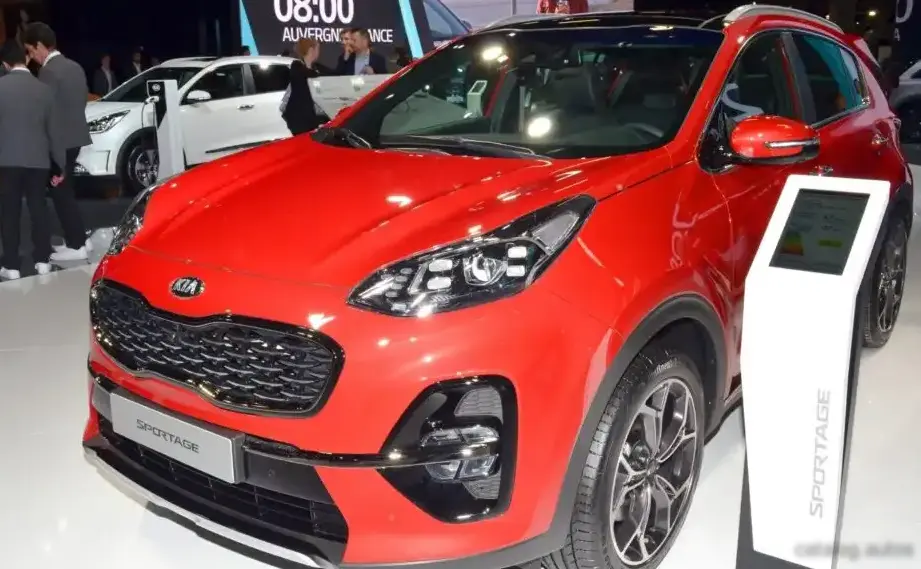
The Kia Sportage IV, specifically the facelifted version introduced in 2018, represented a significant step forward for the South Korean automaker in the highly competitive compact SUV segment. This iteration, produced through July 2021, offered a range of engine and transmission options, with the 2.0 MPI (Multi-Point Injection) producing 150 horsepower being a popular choice, particularly in markets where fuel efficiency and affordability were key considerations. This variant occupied a mid-range position within the Sportage IV lineup, slotting below the more powerful turbocharged engines and above the base-level engine options. It was designed to appeal to families and individuals seeking a practical, reliable, and well-equipped SUV.
Technical Specifications
| Brand | Kia |
| Model | Sportage |
| Generation | Sportage IV (facelift 2018) |
| Type (Engine) | 2.0 MPI (150 Hp) |
| Start of production | 2018 |
| End of production | July, 2021 |
| Powertrain Architecture | Internal Combustion engine |
| Body type | SUV |
| Seats | 5 |
| Doors | 5 |
| Fuel consumption (urban) | 10.7 l/100 km (22 US mpg, 26.4 UK mpg, 9.3 km/l) |
| Fuel consumption (extra urban) | 6.3 l/100 km (37.3 US mpg, 44.8 UK mpg, 15.9 km/l) |
| Fuel consumption (combined) | 7.9 l/100 km (29.8 US mpg, 35.8 UK mpg, 12.7 km/l) |
| Fuel Type | Petrol (Gasoline) |
| Acceleration 0 – 100 km/h | 10.5 sec |
| Acceleration 0 – 62 mph | 10.5 sec |
| Acceleration 0 – 60 mph | 10 sec |
| Maximum speed | 186 km/h (115.58 mph) |
| Weight-to-power ratio | 9.9 kg/Hp, 101 Hp/tonne |
| Weight-to-torque ratio | 7.7 kg/Nm, 129.3 Nm/tonne |
| Power | 150 Hp @ 6200 rpm |
| Power per litre | 75 Hp/l |
| Torque | 192 Nm @ 4000 rpm (141.61 lb.-ft. @ 4000 rpm) |
| Engine layout | Front, Transverse |
| Engine Model/Code | Nu / G4NA |
| Engine displacement | 1999 cm3 (121.99 cu. in.) |
| Number of cylinders | 4 |
| Engine configuration | Inline |
| Cylinder Bore | 81 mm (3.19 in.) |
| Piston Stroke | 97 mm (3.82 in.) |
| Compression ratio | 10.3:1 |
| Number of valves per cylinder | 4 |
| Fuel injection system | Multi-port manifold injection |
| Engine aspiration | Naturally aspirated engine |
| Engine oil capacity | 4 l (4.23 US qt | 3.52 UK qt) |
| Coolant capacity | 7.1 l (7.5 US qt | 6.25 UK qt) |
| Kerb Weight | 1485 kg (3273.86 lbs.) |
| Max. weight | 2050 kg (4519.48 lbs.) |
| Max load | 565 kg (1245.61 lbs.) |
| Trunk (boot) space – minimum | 466 l (16.46 cu. ft.) |
| Fuel tank capacity | 62 l (16.38 US gal | 13.64 UK gal) |
| Length | 4485 mm (176.57 in.) |
| Width | 1855 mm (73.03 in.) |
| Height | 1645-1655 mm (64.76 – 65.16 in.) |
| Wheelbase | 2670 mm (105.12 in.) |
| Front track | 1609-1625 mm (63.35 – 63.98 in.) |
| Rear (Back) track | 1620-1636 mm (63.78 – 64.41 in.) |
| Front overhang | 905 mm (35.63 in.) |
| Rear overhang | 910 mm (35.83 in.) |
| Ride height (ground clearance) | 182 mm (7.17 in.) |
| Minimum turning circle | 10.6 m (34.78 ft.) |
| Drivetrain Architecture | Front wheel drive |
| Drive wheel | Front wheel drive |
| Number of gears and type of gearbox | 6 gears, manual transmission |
| Front suspension | Independent type McPherson |
| Rear suspension | Independent multi-link suspension |
| Front brakes | Ventilated discs |
| Rear brakes | Disc |
| Assisting systems | ABS (Anti-lock braking system) |
| Steering type | Steering rack and pinion |
| Power steering | Electric Steering |
INTRODUCTION
The Kia Sportage IV, launched in 2016 and receiving a significant facelift in 2018, quickly became a cornerstone of Kia’s global sales success. The facelift brought revised styling, updated technology, and refined engine options. The 2.0 MPI variant, producing 150 horsepower, was a key offering, particularly in European and Asian markets. It was positioned as a practical and affordable option for buyers who didn’t require the performance of the turbocharged engines but still desired a comfortable and well-equipped SUV. Built on the platform shared with the Hyundai Tucson, the Sportage IV aimed to deliver a compelling blend of style, practicality, and value.
Powertrain & Engine Architecture
At the heart of the 2.0 MPI Sportage is the Kia/Hyundai Nu family of engines, specifically the G4NA code. This naturally aspirated, 1.999-liter inline-four cylinder engine utilizes multi-point fuel injection. The engine features a dual continuously variable valve timing (CVVT) system, optimizing valve timing for improved fuel efficiency and power delivery across the rev range. The 150 horsepower peak is achieved at 6,200 rpm, while the 192 Nm (141.61 lb.-ft.) of torque is available at 4,000 rpm. The engine is known for its relative simplicity and reliability. The 6-speed manual transmission was standard, offering precise shifts and a direct connection to the engine. While an automatic transmission was available in some markets, this article focuses on the manual configuration.
Driving Characteristics
The 2.0 MPI Sportage with the 6-speed manual transmission provides a reasonably engaging driving experience. Acceleration from 0-60 mph takes around 10 seconds, which is adequate for everyday driving but doesn’t offer particularly sporty performance. The engine feels responsive enough in the mid-range, making overtaking maneuvers manageable. The manual gearbox is well-matched to the engine’s characteristics, with gear ratios designed to maximize fuel efficiency and provide sufficient power for most driving situations. Compared to the turbocharged versions, the 2.0 MPI feels less powerful, but it offers a smoother and more predictable power delivery. The manual transmission also gives the driver more control, which some buyers prefer.
Equipment & Trim Levels
The 2.0 MPI Sportage typically came equipped with a respectable level of standard features. These generally included air conditioning, power windows and locks, a touchscreen infotainment system with Bluetooth connectivity, and a suite of safety features such as ABS, ESC (Electronic Stability Control), and multiple airbags. Higher trim levels added features like leather upholstery, heated seats, a panoramic sunroof, and advanced driver-assistance systems (ADAS) such as lane departure warning and automatic emergency braking. Interior upholstery was typically cloth on the base models, with leather options available on higher trims. Dashboard configurations were generally consistent across the range, with a focus on user-friendliness and practicality.
Chassis & Braking
The Sportage IV utilizes a front-wheel-drive platform with independent suspension at all four corners. The front suspension employs a McPherson strut design, while the rear features a multi-link setup. This configuration provides a comfortable ride quality and decent handling characteristics. The front brakes are ventilated discs, providing ample stopping power, while the rear brakes are solid discs. ABS (Anti-lock Braking System) is standard, enhancing safety during emergency braking situations. Stabilizer bars are fitted front and rear to reduce body roll during cornering.
Market Reception & Comparison
The 2.0 MPI Sportage was generally well-received by automotive critics as a practical and affordable option within the compact SUV segment. It was praised for its comfortable ride, spacious interior, and generous equipment levels. However, some reviewers noted that the engine lacked the punch of the turbocharged alternatives. Compared to the 1.6 T-GDI (turbocharged gasoline direct injection) and diesel variants, the 2.0 MPI offered lower running costs and potentially greater long-term reliability due to its simpler engine design. Fuel economy was competitive within its class, averaging around 29.8 US mpg in combined driving.
Legacy
The Kia Sportage IV, including the 2.0 MPI variant, has proven to be a reliable and durable vehicle. The Nu engine family has a generally good reputation for longevity, and the 6-speed manual transmission is known for its robustness. On the used car market, these Sportages represent a good value proposition, offering a lot of features and practicality for the price. Maintenance costs are relatively low, and parts availability is generally good. The 2.0 MPI Sportage remains a popular choice for buyers seeking a dependable and affordable compact SUV.