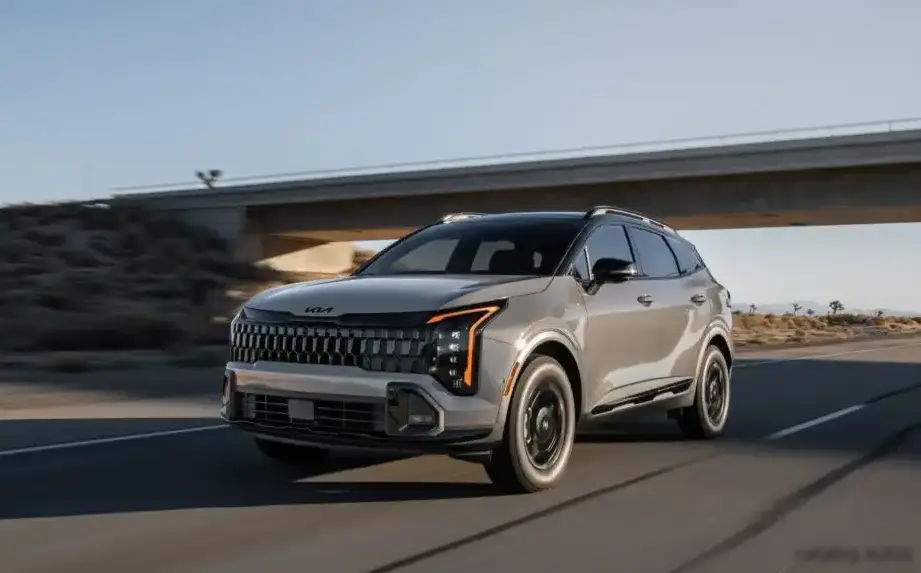
The Kia Sportage V (facelift, introduced in 2024) 1.6 CRDi (136 Hp) Mild Hybrid DCT represents a significant iteration within the fifth generation (NQ5) of Kia’s popular compact SUV. Production commenced in July 2025, positioning this variant as a key offering in the European and increasingly, North American markets. This model blends diesel efficiency with mild-hybrid technology and a dual-clutch transmission (DCT) to appeal to buyers seeking a balance between fuel economy, practicality, and modern driving experience. It slots into the mid-range of the Sportage V lineup, offering a more economical and refined alternative to the higher-powered gasoline and more expensive plug-in hybrid options.
Technical Specifications
| Brand | Kia |
| Model | Sportage |
| Generation | Sportage V (facelift 2024) |
| Type (Engine) | 1.6 CRDi (136 Hp) Mild Hybrid DCT |
| Start of production | July, 2025 |
| Powertrain Architecture | MHEV (Mild Hybrid Electric Vehicle) |
| Body type | SUV |
| Seats | 5 |
| Doors | 5 |
| Fuel consumption at Low speed (WLTP) | 6.2 l/100 km (37.9 US mpg, 45.6 UK mpg, 16.1 km/l) |
| Fuel consumption at Medium speed (WLTP) | 5.3 l/100 km (44.4 US mpg, 53.3 UK mpg, 18.9 km/l) |
| Fuel consumption at high speed (WLTP) | 4.8 l/100 km (49 US mpg, 58.9 UK mpg, 20.8 km/l) |
| Fuel consumption at very high speed (WLTP) | 6.2 l/100 km (37.9 US mpg, 45.6 UK mpg, 16.1 km/l) |
| Combined fuel consumption (WLTP) | 5.6 l/100 km (42 US mpg, 50.4 UK mpg, 17.9 km/l) |
| CO2 emissions (WLTP) | 147 g/km |
| Fuel Type | Diesel |
| Acceleration 0 – 100 km/h | 11.4 sec |
| Acceleration 0 – 62 mph | 11.4 sec |
| Acceleration 0 – 60 mph | 10.8 sec |
| Maximum speed | 180 km/h (111.85 mph) |
| Emission standard | Euro 6e |
| Weight-to-power ratio | 11.6 kg/Hp, 85.9 Hp/tonne |
| Weight-to-torque ratio | 4.9 kg/Nm, 202.1 Nm/tonne |
| Battery voltage | 48 V |
| Electric motor | 1 (Integrated into the transmission, Synchronous) |
| Power | 136 Hp @ 4000 rpm |
| Torque | 320 Nm @ 2000-2250 rpm (236.02 lb.-ft. @ 2000-2250 rpm) |
| Engine layout | Front, Transverse |
| Engine Model/Code | D4FE |
| Engine displacement | 1598 cm3 (97.52 cu. in.) |
| Number of cylinders | 4 |
| Engine configuration | Inline |
| Cylinder Bore | 77 mm (3.03 in.) |
| Piston Stroke | 85.8 mm (3.38 in.) |
| Compression ratio | 15.9:1 |
| Number of valves per cylinder | 4 |
| Fuel injection system | Diesel Commonrail |
| Engine aspiration | Turbocharger, Intercooler |
| Engine oil capacity | 4.4 l (4.65 US qt | 3.87 UK qt) |
| Coolant capacity | 7.3 l (7.71 US qt | 6.42 UK qt) |
| Kerb Weight | 1583-1730 kg (3489.92 – 3814 lbs.) |
| Max. weight | 2225 kg (4905.29 lbs.) |
| Max load | 495-642 kg (1091.29 – 1415.37 lbs.) |
| Trunk (boot) space – minimum | 526 l (18.58 cu. ft.) |
| Trunk (boot) space – maximum | 1715 l (60.56 cu. ft.) |
| Fuel tank capacity | 54 l (14.27 US gal | 11.88 UK gal) |
| Max. roof load | 100 kg (220.46 lbs.) |
| Permitted trailer load with brakes (12%) | 1650 kg (3637.63 lbs.) |
| Permitted trailer load without brakes | 750 kg (1653.47 lbs.) |
| Permitted towbar download | 100 kg (220.46 lbs.) |
| Length | 4540 mm (178.74 in.) |
| Width | 1865 mm (73.43 in.) |
| Height | 1645 mm (64.76 in.) |
| Wheelbase | 2680 mm (105.51 in.) |
| Front track | 1615-1630 mm (63.58 – 64.17 in.) |
| Rear (Back) track | 1622-1637 mm (63.86 – 64.45 in.) |
| Front overhang | 930 mm (36.61 in.) |
| Rear overhang | 930 mm (36.61 in.) |
| Ride height (ground clearance) | 170 mm (6.69 in.) |
| Minimum turning circle | 10.92 m (35.83 ft.) |
| Front brakes | Ventilated discs, 320 mm |
| Rear brakes | Disc, 300 mm |
| Number of gears and type of gearbox | 7 gears, automatic transmission DCT |
Powertrain & Engine Architecture
At the heart of this Sportage variant lies the 1.6-liter D4FE diesel engine. This four-cylinder, inline engine utilizes a turbocharger and intercooler to produce 136 horsepower at 4,000 rpm and 320 Nm (236 lb-ft) of torque between 2,000 and 2,250 rpm. The engine employs a diesel commonrail fuel injection system for precise fuel delivery and optimized combustion. The mild-hybrid system incorporates a 48V electric motor integrated with the 7-speed dual-clutch transmission (DCT). This system provides a small power boost during acceleration and allows for extended engine-off coasting, improving fuel efficiency. The DCT offers quicker and smoother gear changes compared to a traditional automatic transmission, contributing to a more engaging driving experience.
Driving Characteristics
The 1.6 CRDi with the DCT delivers a comfortable and refined driving experience. While not exceptionally quick – achieving 0-60 mph in approximately 10.8 seconds – it provides adequate power for everyday driving and highway cruising. The DCT transmission is responsive, and the mild-hybrid system helps to smooth out gear changes. Compared to the more powerful gasoline engines in the Sportage lineup, this diesel variant prioritizes fuel economy over outright performance. The gear ratios are tuned for efficiency, meaning the engine may feel slightly strained when accelerating hard, particularly when fully loaded. Compared to a manual transmission version (if offered in the same market), the DCT provides convenience and ease of use, but may slightly diminish driver engagement.
Equipment & Trim Levels
The 1.6 CRDi Mild Hybrid DCT typically comes well-equipped, often positioned as a mid-range trim level. Standard features generally include air conditioning, a touchscreen infotainment system with Apple CarPlay and Android Auto compatibility, a rearview camera, and a suite of safety features such as lane-keeping assist, forward collision avoidance assist, and automatic emergency braking. Interior upholstery is typically cloth, with options for leather upgrades. Higher trim levels add features like heated seats, a panoramic sunroof, and a premium sound system. Exterior features often include alloy wheels, LED headlights, and roof rails.
Chassis & Braking
The Sportage V utilizes a McPherson strut front suspension and a multi-link rear suspension, providing a comfortable ride and predictable handling. Stabilizer bars are fitted to both axles to reduce body roll during cornering. Braking duties are handled by ventilated discs at the front and solid discs at the rear. The braking system is assisted by ABS (Anti-lock Braking System) and electronic stability control. The suspension tuning is geared towards comfort, making it well-suited for everyday driving conditions.
Market Reception & Comparison
The 1.6 CRDi Mild Hybrid DCT Sportage has been generally well-received by automotive critics, praised for its fuel efficiency and comfortable ride. It offers a compelling alternative to gasoline-powered rivals, particularly for drivers who cover long distances. Compared to the higher-output gasoline engines, the diesel variant delivers significantly better fuel economy, but at the expense of some performance. The mild-hybrid system adds a layer of refinement and contributes to lower emissions. Reliability reports suggest that the D4FE engine is generally robust, but regular maintenance is crucial for optimal performance and longevity.
Legacy
The Kia Sportage V 1.6 CRDi Mild Hybrid DCT represents a step towards greater fuel efficiency and reduced emissions in the compact SUV segment. The combination of diesel power, mild-hybrid technology, and a DCT transmission offers a practical and refined driving experience. In the used car market, these models are expected to hold their value reasonably well, particularly those with a full service history. The longevity of the powertrain will depend on regular maintenance, including oil changes and filter replacements. As Kia continues to expand its hybrid and electric offerings, this variant serves as a transitional model, bridging the gap between traditional internal combustion engines and a more sustainable future.