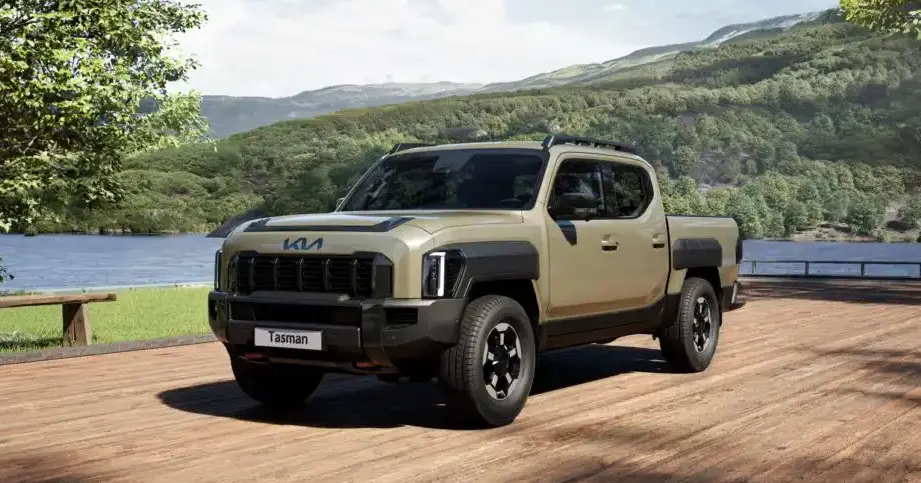
The Kia Tasman Double Cab 2.5 T-GDI 4WD Automatic represents Kia’s entry into the mid-size pickup truck segment, launched in February 2025. Designed primarily for markets outside of North America initially, the Tasman aims to provide a versatile and capable vehicle blending passenger comfort with utility. This specific configuration, featuring the 2.5-liter turbocharged gasoline engine paired with an eight-speed automatic transmission and four-wheel drive, is positioned as a well-rounded option within the Tasman lineup, balancing performance, fuel efficiency, and capability. It’s built on a dedicated body-on-frame chassis, intended to compete with established players like the Toyota Hilux and Ford Ranger in regions where such vehicles are highly popular.
Technical Specifications
| Brand | Kia |
| Model | Tasman |
| Generation | Tasman Double Cab |
| Type (Engine) | 2.5 T-GDI (281 Hp) 4WD Automatic |
| Start of production | February, 2025 |
| Powertrain Architecture | Internal Combustion engine |
| Body type | Pick-up |
| Seats | 5 |
| Doors | 4 |
| Fuel consumption (urban) | 13.7-14.9 l/100 km (17.2 – 15.8 US mpg) |
| Fuel consumption (extra urban) | 10.9-12 l/100 km (21.6 – 19.6 US mpg) |
| Fuel consumption (combined) | 12.3-13.5 l/100 km (19.1 – 17.4 US mpg) |
| CO2 emissions | 210-231 g/km |
| Fuel Type | Petrol (Gasoline) |
| Weight-to-power ratio | 7.7 kg/Hp |
| Weight-to-torque ratio | 5.1 kg/Nm |
| Power | 281 Hp @ 5800 rpm |
| Torque | 421 Nm @ 1750-4000 rpm (310.51 lb.-ft. @ 1750-4000 rpm) |
| Engine layout | Front, Longitudinal |
| Engine Model/Code | Theta 3 |
| Engine displacement | 2497 cm3 (152.38 cu. in.) |
| Number of cylinders | 4 |
| Engine configuration | Inline |
| Cylinder Bore | 88.5 mm (3.48 in.) |
| Piston Stroke | 101.5 mm (4 in.) |
| Number of valves per cylinder | 4 |
| Fuel injection system | Direct injection and Multi-port manifold injection |
| Engine aspiration | Turbocharger, Intercooler |
| Valvetrain | DOHC |
| Engine systems | Start & Stop System |
| Kerb Weight | 2165-2345 kg (4773.01 – 5169.84 lbs.) |
| Max. weight | 2765-2945 kg (6095.78 – 6492.61 lbs.) |
| Max load | 600 kg (1322.77 lbs.) |
| Trunk (boot) space – minimum | 1173 l (41.42 cu. ft.) |
| Fuel tank capacity | 80 l (21.13 US gal | 17.6 UK gal) |
| Permitted trailer load with brakes (12%) | 3500 kg (7716.18 lbs.) |
| Length | 5410 mm (212.99 in.) |
| Width | 1930 mm (75.98 in.) |
| Height | 1870-1890 mm (73.62 – 74.41 in.) |
| Wheelbase | 3270 mm (128.74 in.) |
| Front track | 1636 mm (64.41 in.) |
| Rear (Back) track | 1624 mm (63.94 in.) |
| Ride height (ground clearance) | 224 mm (8.82 in.) |
| Wading depth | 800 mm (31.5 in.) |
| Drivetrain Architecture | The Internal combustion engine (ICE) drives the rear wheels permanently, and the front wheels are driven through an electrically or mechanically operated clutch if necessary. |
| Drive wheel | All wheel drive (4×4) |
| Number of gears and type of gearbox | 8 gears, automatic transmission |
| Front suspension | Coil spring, Double wishbone |
| Rear suspension | Rigid axle suspension, Leaf spring |
| Front brakes | Ventilated discs |
| Rear brakes | Disc |
| Assisting systems | ABS (Anti-lock braking system) |
| Steering type | Steering rack and pinion |
| Power steering | Electric Steering |
| Tires size | 265/65 R17; 265/60 R18 |
| Wheel rims size | 17; 18 |
Powertrain & Engine Architecture
At the heart of the Tasman Double Cab 2.5 T-GDI is Kia’s Theta 3 engine, a 2.5-liter inline-four cylinder gasoline engine. This engine utilizes a combination of direct injection and multi-port fuel injection to optimize combustion efficiency and power delivery. The engine is turbocharged and intercooled, allowing it to produce 281 horsepower at 5800 rpm and 421 Nm (310.51 lb.-ft.) of torque between 1750 and 4000 rpm. The eight-speed automatic transmission is a crucial component, designed to efficiently manage the engine’s power and provide smooth shifts. While specific details regarding the transmission’s internal construction haven’t been fully disclosed, it’s expected to feature electronically controlled shifting and adaptive learning algorithms to optimize performance based on driving conditions. The powertrain is longitudinally mounted, contributing to a balanced weight distribution.
Driving Characteristics
The 2.5 T-GDI engine, coupled with the eight-speed automatic, delivers a responsive driving experience. The readily available torque from 1750 rpm provides ample pulling power for hauling and towing, while the higher horsepower output allows for confident acceleration. The automatic transmission is well-tuned, offering smooth gear changes and minimizing hunting for the optimal gear. Compared to potential diesel variants (not currently available), this gasoline engine offers a more refined and quieter driving experience, albeit with potentially higher fuel consumption. The 4WD system provides enhanced traction in off-road conditions and inclement weather, making the Tasman a capable all-weather vehicle. The gear ratios are optimized for a balance between on-road cruising and off-road capability.
Equipment & Trim Levels
The Tasman Double Cab 2.5 T-GDI 4WD Automatic typically comes standard with features such as air conditioning, power windows and locks, a touchscreen infotainment system with smartphone integration (Apple CarPlay and Android Auto), and a suite of safety features including ABS, stability control, and multiple airbags. Higher trim levels add features like leather upholstery, heated and ventilated front seats, a premium audio system, and advanced driver-assistance systems (ADAS) such as adaptive cruise control and lane-keeping assist. Exterior features include alloy wheels, automatic headlights, and a bed liner.
Chassis & Braking
The Tasman utilizes a traditional body-on-frame construction, providing a robust and durable platform for demanding applications. The front suspension consists of a coil spring and double wishbone setup, while the rear suspension employs a rigid axle with leaf springs. This configuration prioritizes load-carrying capacity and durability. The braking system features ventilated discs at the front and solid discs at the rear, providing adequate stopping power. The electric power steering offers a responsive and precise steering feel.
Market Reception & Comparison
Initial reviews of the Kia Tasman have been positive, with critics praising its blend of practicality, comfort, and capability. The 2.5 T-GDI engine has been noted for its strong performance and refinement. Fuel economy, however, is a point of concern, with combined figures ranging from 12.3-13.5 l/100 km. Compared to competitors like the Toyota Hilux and Ford Ranger, the Tasman offers a competitive level of equipment and performance at a potentially more attractive price point. The gasoline engine may appeal to buyers who prioritize refinement over the fuel efficiency of a diesel.
Legacy
The long-term reliability of the Theta 3 engine and the eight-speed automatic transmission remains to be seen, as the Tasman is a relatively new model. However, Kia has a growing reputation for building reliable vehicles, and the company offers a comprehensive warranty program. In the used car market, the Tasman Double Cab 2.5 T-GDI 4WD Automatic is expected to hold its value well, particularly among buyers seeking a versatile and capable pickup truck with a comfortable driving experience.