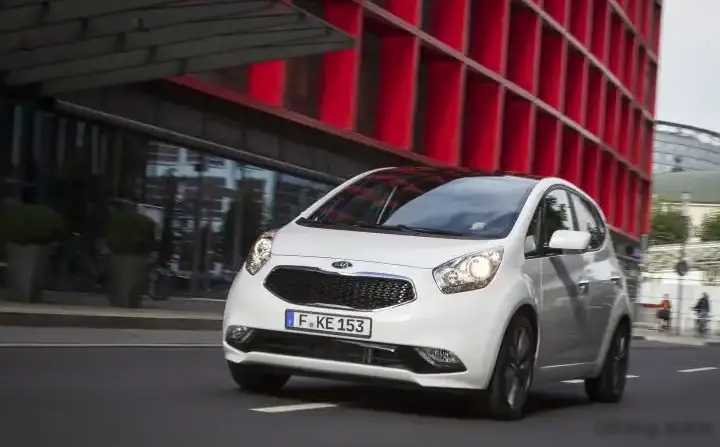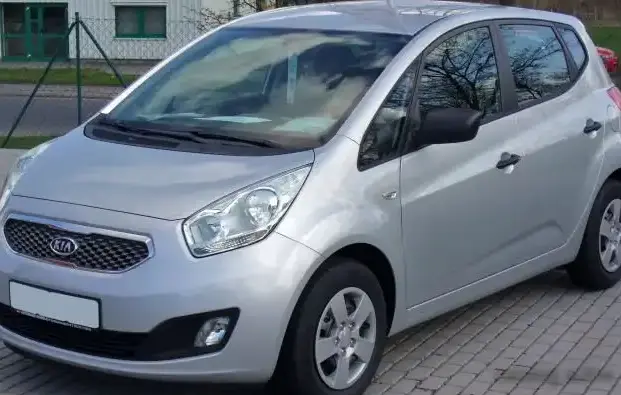
The Kia Venga (YN) 1.4 16V, producing 90 horsepower, was a key variant in Kia’s European small MPV lineup from 2010 to 2014. Positioned as an entry-level offering, it aimed to provide affordable and practical transportation for families and urban drivers. The Venga, itself a relatively new model for Kia at the time, represented the brand’s increasing focus on European market preferences, offering a more stylish and feature-rich alternative to traditional budget-oriented small cars. This particular 1.4-liter engine and five-speed manual transmission combination was designed to balance fuel efficiency with acceptable performance for everyday driving.
Technical Specifications
| Brand | Kia |
| Model | Venga |
| Generation | Venga (YN) |
| Type (Engine) | 1.4 16V (90 Hp) |
| Start of production | 2010 |
| End of production | 2014 |
| Powertrain Architecture | Internal Combustion engine |
| Body type | Hatchback |
| Seats | 5 |
| Doors | 5 |
| Fuel consumption (urban) | 7.5 l/100 km (31.4 US mpg) |
| Fuel consumption (extra urban) | 5.5 l/100 km (42.8 US mpg) |
| Fuel consumption (combined) | 6.2 l/100 km (37.9 US mpg) |
| Fuel Type | Petrol (Gasoline) |
| Acceleration 0 – 100 km/h | 12.9 sec |
| Acceleration 0 – 62 mph | 12.9 sec |
| Acceleration 0 – 60 mph | 12.3 sec |
| Maximum speed | 167 km/h (103.77 mph) |
| Emission standard | Euro 5 |
| Weight-to-power ratio | 14.1 kg/Hp |
| Weight-to-torque ratio | 9.3 kg/Nm |
| Power | 90 Hp |
| Torque | 137 Nm @ 4000 rpm (101.05 lb.-ft. @ 4000 rpm) |
| Engine layout | Front, Transverse |
| Engine Model/Code | G4FA |
| Engine displacement | 1396 cm3 (85.19 cu. in.) |
| Number of cylinders | 4 |
| Engine configuration | Inline |
| Number of valves per cylinder | 4 |
| Fuel injection system | Multi-port manifold injection |
| Engine aspiration | Naturally aspirated engine |
| Valvetrain | DOHC |
| Engine oil capacity | 3.3 l (3.49 US qt | 2.9 UK qt) |
| Coolant capacity | 5.3 l (5.6 US qt | 4.66 UK qt) |
| Kerb Weight | 1268 kg (2795.46 lbs.) |
| Max. weight | 1710 kg (3769.9 lbs.) |
| Max load | 442 kg (974.44 lbs.) |
| Trunk (boot) space – minimum | 440 l (15.54 cu. ft.) |
| Fuel tank capacity | 48 l (12.68 US gal | 10.56 UK gal) |
| Length | 4068 mm (160.16 in.) |
| Width | 1765 mm (69.49 in.) |
| Height | 1600 mm (62.99 in.) |
| Wheelbase | 2615 mm (102.95 in.) |
| Minimum turning circle | 10.4 m (34.12 ft.) |
| Drivetrain | Front wheel drive |
| Number of gears | 5 |
| Gearbox type | Manual transmission |
| Assisting systems | ABS (Anti-lock braking system) |
| Steering type | Steering rack and pinion |
| Tires size | 205/55 R16 |
| Wheel rims size | 16 |
Powertrain & Engine Architecture
The Kia Venga 1.4 16V utilizes the G4FA engine, a 1.4-liter inline-four cylinder gasoline engine. This engine is a naturally aspirated design, meaning it doesn’t employ turbocharging or supercharging. It features a multi-point fuel injection system, delivering fuel directly into the intake ports. The engine’s double overhead camshaft (DOHC) valvetrain, with four valves per cylinder, contributes to improved breathing and efficiency. The 90 horsepower output is achieved at 6,000 rpm, while peak torque of 137 Nm (101 lb-ft) arrives at 4,000 rpm. The engine is transversely mounted in the front of the vehicle, driving the front wheels. The five-speed manual transmission was the standard offering for this variant, providing a relatively direct connection between the engine and the wheels. The gear ratios were tuned for fuel economy and everyday drivability rather than outright performance.
Driving Characteristics
The 1.4-liter Venga with a manual transmission offered a predictable, if not particularly exciting, driving experience. Acceleration from 0-60 mph took around 12.3 seconds, making it suitable for urban and suburban commuting but less ideal for frequent highway overtaking. The engine felt somewhat strained at higher speeds, and the five-speed gearbox, while adequate, didn’t offer the flexibility of a six-speed unit. Compared to the more powerful 1.6-liter engine option, the 1.4 felt noticeably slower, especially when fully loaded with passengers and cargo. However, the lighter engine weight contributed to slightly better handling and fuel economy. The steering was light and easy, making it maneuverable in tight spaces.
Equipment & Trim Levels
The 1.4 16V Venga typically came with a reasonable level of standard equipment, reflecting its position as an entry-level model. This included air conditioning, power steering, electric front windows, and a basic audio system with USB connectivity. Safety features such as ABS brakes, front airbags, and seatbelt pretensioners were also standard. Higher trim levels offered upgrades like alloy wheels, rear electric windows, a more sophisticated audio system, and optional features like parking sensors and a panoramic sunroof. Interior upholstery was typically cloth, with a functional and durable design. The dashboard layout was straightforward and user-friendly.
Chassis & Braking
The Kia Venga utilized a front-wheel-drive chassis with a MacPherson strut front suspension and a torsion beam rear suspension. This setup provided a comfortable ride quality, absorbing bumps and imperfections in the road reasonably well. The front brakes were ventilated discs, while the rear brakes were drums. This configuration was typical for vehicles in this weight class and price range. The steering was a rack-and-pinion system, providing precise and responsive control. Stabilizer bars were fitted to both the front and rear axles to reduce body roll during cornering.
Market Reception & Comparison
The Kia Venga 1.4 16V was generally well-received by automotive critics as a practical and affordable small MPV. It was praised for its spacious interior, comfortable ride, and good value for money. However, the engine was often criticized for being underpowered, particularly when the vehicle was fully loaded. Fuel economy was considered good, averaging around 37.9 US mpg in combined driving. Compared to other small MPVs like the Renault Modus or the Fiat Qubo, the Venga offered a more modern design and a longer warranty, which were key selling points. The 1.6-liter Venga offered significantly better performance, but at a higher price point. The diesel variants, such as the 1.6 CRDi, provided superior fuel economy but came with a higher initial cost.
Legacy
The Kia Venga 1.4 16V has proven to be a relatively reliable vehicle in the used car market. The G4FA engine is known for its durability, and routine maintenance is relatively inexpensive. While not known for its blistering performance, the 1.4-liter engine has a good track record for longevity. Common issues are typically related to wear and tear, such as suspension components and brake pads. Today, these vehicles represent an affordable and practical option for budget-conscious buyers seeking a spacious and reliable small MPV. The Venga helped establish Kia as a serious contender in the European market, demonstrating the brand’s commitment to building well-equipped and reliable vehicles.