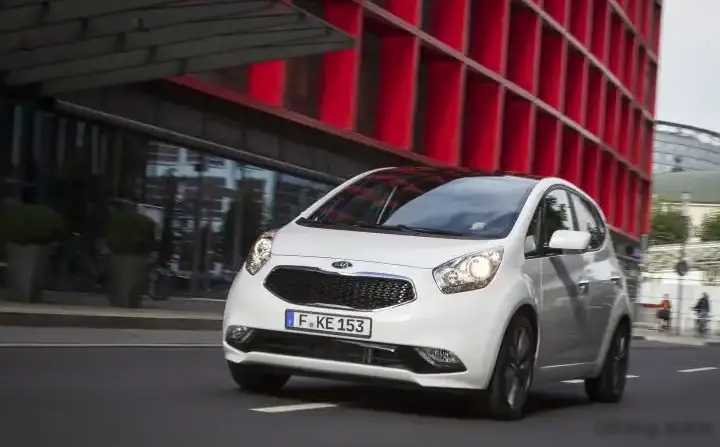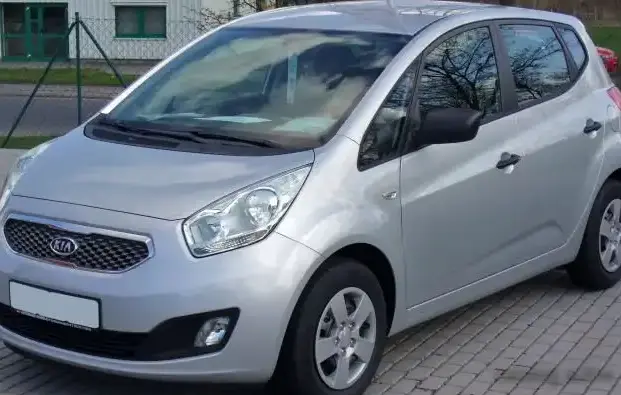
The Kia Venga (YN) 1.6 16V, producing 125 horsepower, was a key variant in Kia’s European small MPV lineup from 2010 to 2014. Positioned as a mid-range offering, it aimed to bridge the gap between the more basic 1.4-liter models and the higher-specification diesel options. The Venga, designed specifically for the European market, represented Kia’s increasing focus on offering practical and well-equipped vehicles to compete with established European brands. This particular engine and transmission combination offered a balance of performance and fuel efficiency, making it a popular choice for families and urban commuters.
Technical Specifications
| Brand | Kia |
| Model | Venga |
| Generation | Venga (YN) |
| Type (Engine) | 1.6 16V (125 Hp) |
| Start of production | 2010 |
| End of production | 2014 |
| Powertrain Architecture | Internal Combustion engine |
| Body type | Hatchback |
| Seats | 5 |
| Doors | 5 |
| Fuel consumption (urban) | 8.4 l/100 km (28 US mpg, 33.6 UK mpg, 11.9 km/l) |
| Fuel consumption (extra urban) | 5.8 l/100 km (40.6 US mpg, 48.7 UK mpg, 17.2 km/l) |
| Fuel consumption (combined) | 6.7 l/100 km (35.1 US mpg, 42.2 UK mpg, 14.9 km/l) |
| Fuel Type | Petrol (Gasoline) |
| Acceleration 0 – 100 km/h | 10.9 sec |
| Acceleration 0 – 62 mph | 10.9 sec |
| Acceleration 0 – 60 mph | 10.4 sec |
| Maximum speed | 182 km/h (113.09 mph) |
| Emission standard | Euro 5 |
| Weight-to-power ratio | 10.2 kg/Hp, 97.7 Hp/tonne |
| Weight-to-torque ratio | 8.2 kg/Nm, 121.9 Nm/tonne |
| Power | 125 Hp |
| Power per litre | 78.6 Hp/l |
| Torque | 156 Nm @ 4200 rpm (115.06 lb.-ft. @ 4200 rpm) |
| Engine layout | Front, Transverse |
| Engine Model/Code | G4FC |
| Engine displacement | 1591 cm3 (97.09 cu. in.) |
| Number of cylinders | 4 |
| Engine configuration | Inline |
| Number of valves per cylinder | 4 |
| Fuel injection system | Multi-port manifold injection |
| Engine aspiration | Naturally aspirated engine |
| Valvetrain | DOHC |
| Engine oil capacity | 3.3 l (3.49 US qt | 2.9 UK qt) |
| Coolant capacity | 5.3 l (5.6 US qt | 4.66 UK qt) |
| Kerb Weight | 1280 kg (2821.92 lbs.) |
| Max. weight | 1710 kg (3769.9 lbs.) |
| Max load | 430 kg (947.99 lbs.) |
| Trunk (boot) space – minimum | 440 l (15.54 cu. ft.) |
| Fuel tank capacity | 48 l (12.68 US gal | 10.56 UK gal) |
| Length | 4068 mm (160.16 in.) |
| Width | 1765 mm (69.49 in.) |
| Height | 1600 mm (62.99 in.) |
| Wheelbase | 2615 mm (102.95 in.) |
| Minimum turning circle | 10.4 m (34.12 ft.) |
| Drivetrain | Front wheel drive |
| Number of gears | 5 gears, manual transmission |
| Assisting systems | ABS (Anti-lock braking system) |
| Steering type | Steering rack and pinion |
| Tires size | 195/65 R15 |
| Wheel rims size | 15 |
INTRODUCTION
The Kia Venga 1.6 16V (YN) was introduced in 2010 as part of the first generation Venga lineup. Designed as a compact multi-purpose vehicle (MPV), the Venga aimed to provide a spacious and practical alternative to traditional hatchback offerings in the European B-segment. The YN series Venga was never officially sold in the United States, being specifically tailored for the European market. The 1.6-liter engine variant, producing 125 hp, was a popular choice, offering a balance between performance, fuel economy, and affordability. It sat in the middle of the range, above the 1.4-liter engine and below the diesel options.
Powertrain & Engine Architecture
The heart of the Venga 1.6 16V is the Kia G4FC engine, a 1.6-liter inline-four cylinder gasoline engine. This engine utilizes a multi-point fuel injection system, delivering fuel directly into the intake ports. The engine features a double overhead camshaft (DOHC) valvetrain, operating 16 valves (four per cylinder) to optimize airflow and combustion efficiency. The G4FC engine is a naturally aspirated design, meaning it doesn’t employ turbocharging or supercharging. The 125 hp output is achieved at 6300 rpm, while peak torque of 156 Nm (115 lb-ft) is delivered at 4200 rpm. The engine is transversely mounted in the front of the vehicle, driving the front wheels. The standard transmission for this variant was a five-speed manual gearbox, providing a relatively direct driving experience. While an automatic transmission was available in some markets, it wasn’t as commonly paired with this engine as the manual.
Driving Characteristics
The Venga 1.6 16V offered a comfortable and predictable driving experience. With 125 hp, acceleration was adequate for everyday driving, with a 0-60 mph time of around 10.4 seconds. The five-speed manual transmission allowed for reasonable control over the engine’s power band. Compared to the lower-powered 1.4-liter Venga, the 1.6-liter engine provided noticeably more punch, especially when fully loaded or tackling inclines. However, it didn’t offer the same level of performance as the diesel variants. The gear ratios were tuned for fuel efficiency and everyday usability rather than outright speed. The steering was light and easy, making it well-suited for urban environments. The suspension provided a comfortable ride, absorbing bumps and imperfections in the road surface effectively.
Equipment & Trim Levels
The Venga 1.6 16V was typically offered in several trim levels, with standard equipment including air conditioning, electric front windows, central locking, and a basic audio system. Higher trim levels added features such as alloy wheels, a more advanced audio system with Bluetooth connectivity, rear parking sensors, and climate control. Interior upholstery was typically cloth, with options for different colors and patterns. The dashboard layout was functional and straightforward, with easy-to-read instrumentation. Optional extras included a panoramic sunroof, leather upholstery, and a navigation system.
Chassis & Braking
The Venga utilized a front-wheel-drive chassis with a MacPherson strut suspension at the front and a torsion beam suspension at the rear. The torsion beam setup was a cost-effective solution for the rear suspension, providing adequate ride comfort and handling characteristics for the vehicle’s intended purpose. Braking was typically accomplished with disc brakes at the front and drum brakes at the rear. Anti-lock Braking System (ABS) was standard, enhancing safety by preventing wheel lockup during hard braking. The steering system employed a rack and pinion setup, providing precise and responsive steering feel.
Market Reception & Comparison
The Kia Venga 1.6 16V was generally well-received by automotive critics as a practical and affordable MPV. It was praised for its spacious interior, comfortable ride, and generous equipment levels for its price point. Compared to the 1.4-liter Venga, the 1.6-liter engine offered a significant improvement in performance, making it a more appealing option for drivers who frequently carried passengers or cargo. However, the diesel variants offered superior fuel economy and torque, making them a popular choice for long-distance drivers. The Venga competed with other small MPVs such as the Renault Modus, Opel Meriva, and Ford Fusion.
Legacy
The Kia Venga 1.6 16V has proven to be a relatively reliable vehicle in the used car market. The G4FC engine is known for its durability and relatively low maintenance costs. Common issues are typically related to wear and tear items such as brakes, suspension components, and exhaust systems. The Venga’s simple and straightforward design makes it relatively easy and affordable to repair. Today, the Venga 1.6 16V remains a popular choice for budget-conscious buyers seeking a practical and spacious small MPV. Its blend of affordability, reliability, and practicality has ensured its continued presence on European roads.