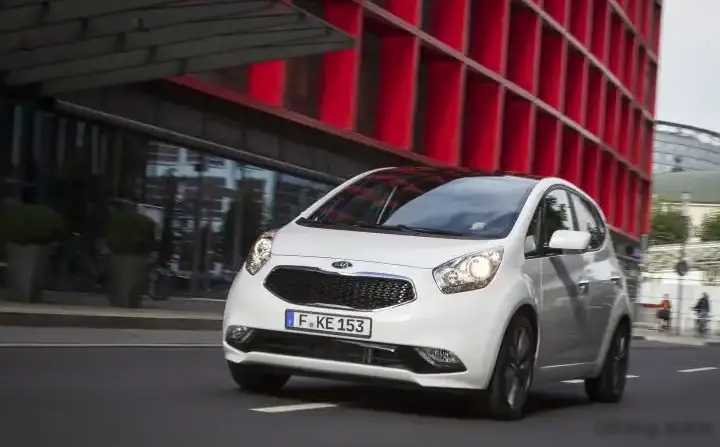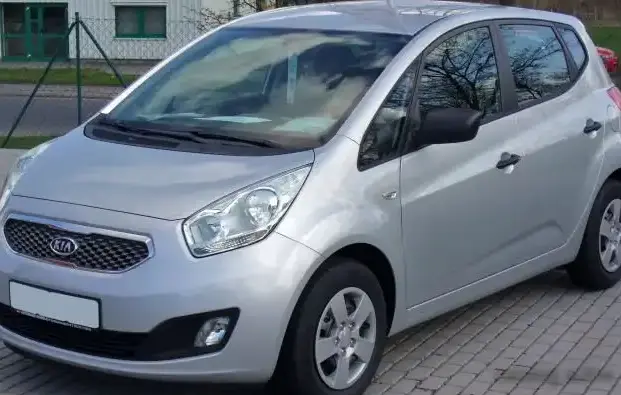
The Kia Venga, produced between 2010 and 2014, was a subcompact multi-purpose vehicle (MPV) designed and marketed primarily for the European market. Kia aimed to provide a practical and affordable vehicle in a segment dominated by established European manufacturers. The 1.6 CRDI 16V variant, generating 115 horsepower, represented a mid-range offering within the Venga lineup, positioned between the lower-powered 1.4 gasoline engine and the more potent 1.6 gasoline direct injection (GDI) models. This diesel version was particularly popular in Europe due to its fuel efficiency and suitability for long-distance driving. The Venga (YN) is built on Kia’s platform.
Technical Specifications
| Brand | Kia |
| Model | Venga |
| Generation | Venga (YN) |
| Type (Engine) | 1.6 CRDI 16V (115 Hp) |
| Start of production | 2010 |
| End of production | 2014 |
| Powertrain Architecture | Internal Combustion engine |
| Body type | Hatchback |
| Seats | 5 |
| Doors | 5 |
| Fuel consumption (urban) | 5.8 l/100 km (40.6 US mpg, 48.7 UK mpg, 17.2 km/l) |
| Fuel consumption (extra urban) | 4.4 l/100 km (53.5 US mpg, 64.2 UK mpg, 22.7 km/l) |
| Fuel consumption (combined) | 4.9 l/100 km (48 US mpg, 57.6 UK mpg, 20.4 km/l) |
| Fuel Type | Diesel |
| Acceleration 0 – 100 km/h | 11.5 sec |
| Acceleration 0 – 62 mph | 11.5 sec |
| Acceleration 0 – 60 mph | 10.9 sec |
| Maximum speed | 182 km/h (113.09 mph) |
| Emission standard | Euro 5 |
| Weight-to-power ratio | 12 kg/Hp, 83.3 Hp/tonne |
| Weight-to-torque ratio | 5.3 kg/Nm, 188.4 Nm/tonne |
| Power | 115 Hp |
| Power per litre | 72.7 Hp/l |
| Torque | 260 Nm @ 1900 rpm (191.77 lb.-ft. @ 1900 rpm) |
| Engine layout | Front, Transverse |
| Engine Model/Code | D4FB |
| Engine displacement | 1582 cm3 (96.54 cu. in.) |
| Number of cylinders | 4 |
| Engine configuration | Inline |
| Number of valves per cylinder | 4 |
| Fuel injection system | Diesel Commonrail |
| Engine aspiration | Turbocharger, Intercooler |
| Valvetrain | DOHC |
| Engine oil capacity | 5.3 l (5.6 US qt | 4.66 UK qt) |
| Coolant capacity | 6.4 l (6.76 US qt | 5.63 UK qt) |
| Kerb Weight | 1380 kg (3042.38 lbs.) |
| Max. weight | 1810 kg (3990.37 lbs.) |
| Max load | 430 kg (947.99 lbs.) |
| Trunk (boot) space – minimum | 440 l (15.54 cu. ft.) |
| Fuel tank capacity | 48 l (12.68 US gal | 10.56 UK gal) |
| Length | 4068 mm (160.16 in.) |
| Width | 1765 mm (69.49 in.) |
| Height | 1600 mm (62.99 in.) |
| Wheelbase | 2615 mm (102.95 in.) |
| Minimum turning circle | 10.4 m (34.12 ft.) |
| Drivetrain | Front wheel drive |
| Number of gears | 6 gears, manual transmission |
| Assisting systems | ABS (Anti-lock braking system) |
| Steering type | Steering rack and pinion |
| Tires size | 195/65 R15 |
| Wheel rims size | 15 |
Introduction
The Kia Venga 1.6 CRDI 16V (115 hp) was introduced in 2010 as part of the first generation (YN) Venga lineup. Designed as a compact MPV, the Venga aimed to offer a spacious and versatile interior within a relatively small footprint. The 1.6 CRDI variant was a key component of the Venga’s success, particularly in European markets where diesel engines were – and continue to be – highly favored for their fuel economy. The Venga sought to challenge established competitors like the Renault Modus, Opel Meriva, and Ford Fusion by offering a compelling combination of practicality, value, and Kia’s growing reputation for reliability. Production continued until 2014, with minor updates throughout its lifespan.
Powertrain & Engine Architecture
At the heart of the Venga 1.6 CRDI is Kia’s D4FB engine, a 1.6-liter inline-four cylinder diesel engine. This engine utilizes a second-generation common rail direct injection system, delivering fuel at extremely high pressure for optimized combustion. The 16-valve DOHC (Double Overhead Camshaft) configuration, coupled with a turbocharger and intercooler, helps to maximize power output and efficiency. The engine produces 115 horsepower and a respectable 260 Nm (192 lb-ft) of torque at 1900 rpm. This torque output, available at relatively low engine speeds, contributes to the Venga’s usable performance in everyday driving situations. The engine is transversely mounted in the front of the vehicle. The Venga 1.6 CRDI was typically paired with a six-speed manual transmission, although a four-speed automatic transmission was also available, albeit less common. The automatic transmission, while offering convenience, generally resulted in slightly reduced fuel economy and acceleration compared to the manual version.
Driving Characteristics
The Venga 1.6 CRDI with the manual transmission provides adequate performance for typical urban and highway driving. Acceleration from 0-60 mph takes around 10.9 seconds, and the top speed is approximately 113 mph. The engine’s strong low-end torque makes it feel more responsive than its horsepower figure might suggest, particularly when overtaking or climbing hills. The six-speed gearbox is well-matched to the engine, allowing for comfortable cruising at highway speeds. The automatic transmission, while smooth, feels less engaging and can sometimes hunt for gears, especially under heavy load. Compared to the higher-output 1.6 GDI gasoline engine, the CRDI offers significantly better fuel economy but lacks the GDI’s immediate throttle response and overall refinement. The Venga’s suspension is tuned for comfort, providing a reasonably smooth ride over most road surfaces, although it can feel slightly unsettled on particularly rough roads.
Equipment & Trim Levels
The Venga 1.6 CRDI was available in several trim levels, typically designated as ‘1’, ‘2’, and ‘3’ (or equivalent designations depending on the market). The base ‘1’ trim included standard features such as air conditioning, electric front windows, central locking, and a basic audio system. The mid-range ‘2’ trim added features like alloy wheels, fog lights, a trip computer, and upgraded interior trim. The top-of-the-line ‘3’ trim included luxuries such as automatic climate control, parking sensors, a panoramic sunroof, and a more sophisticated audio system with Bluetooth connectivity. Interior upholstery was typically cloth, with higher trims offering partial leather options. Optional extras included navigation systems and various styling enhancements.
Chassis & Braking
The Kia Venga utilizes a front-wheel-drive platform with a MacPherson strut front suspension and a torsion beam rear suspension. This setup provides a good balance between ride comfort and handling. The Venga 1.6 CRDI typically featured disc brakes on the front wheels and drum brakes on the rear wheels. ABS (Anti-lock Braking System) was standard across all trim levels. The steering is rack and pinion, providing reasonably precise control. Stabilizer bars were fitted to both the front and rear axles to reduce body roll during cornering.
Market Reception & Comparison
The Kia Venga 1.6 CRDI was generally well-received by automotive critics, who praised its spacious interior, practical design, and competitive pricing. The diesel engine was lauded for its fuel efficiency and strong torque output. However, some critics noted that the interior materials felt somewhat low-rent compared to some of its European rivals. Compared to the gasoline-powered Venga models, the 1.6 CRDI offered significantly better fuel economy, making it a more attractive option for drivers who covered long distances. The Venga’s fuel economy figures of around 48 US mpg combined were competitive with other subcompact MPVs in its class. Reliability proved to be a strong point, with the D4FB engine generally considered to be robust and dependable.
Legacy
The Kia Venga 1.6 CRDI has proven to be a reliable and economical used car. The D4FB engine, while not without its potential issues (such as diesel particulate filter clogging if not properly maintained), is generally considered durable. The Venga’s spacious interior and practical design continue to appeal to buyers looking for a versatile and affordable vehicle. Today, well-maintained examples of the Venga 1.6 CRDI can be found at reasonable prices, making them a good value proposition for budget-conscious buyers. The Venga helped establish Kia as a serious contender in the European small car market, paving the way for the brand’s continued success.