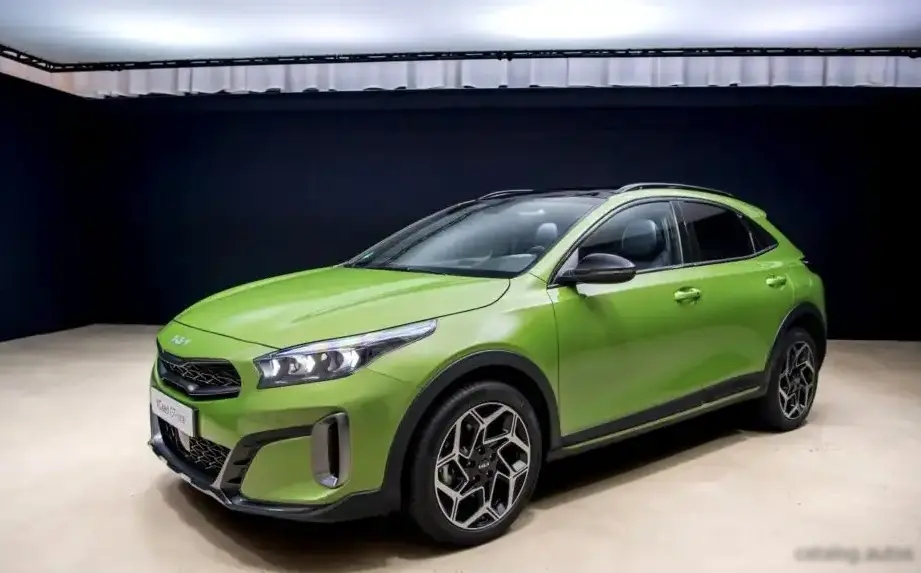
The Kia XCeed (facelift, introduced in 2022) 1.0 T-GDI 115 hp represents an entry-level powertrain option within the XCeed range. Production began in July 2022, positioning it as a fuel-efficient and accessible variant of Kia’s European-market C-segment crossover. The XCeed itself is a model unique to the European market, designed to bridge the gap between traditional hatchbacks and larger SUVs, offering a more coupe-like silhouette than the standard Ceed hatchback. This specific 1.0 T-GDI engine and six-speed manual transmission combination aimed to attract buyers prioritizing economy and affordability, while still providing a reasonably practical and stylish vehicle.
Technical Specifications
| Brand | Kia |
| Model | XCeed |
| Generation | Xceed (facelift 2022) |
| Type (Engine) | 1.0 T-GDI (115 Hp) |
| Start of production | July, 2022 |
| Powertrain Architecture | Internal Combustion engine |
| Body type | SUV, Crossover |
| Seats | 5 |
| Doors | 5 |
| Fuel consumption at Low speed (WLTP) | 8.0 l/100 km (29.4 US mpg, 35.3 UK mpg, 12.5 km/l) |
| Fuel consumption at Medium speed (WLTP) | 6.2 l/100 km (37.9 US mpg, 45.6 UK mpg, 16.1 km/l) |
| Fuel consumption at high speed (WLTP) | 5.4 l/100 km (43.6 US mpg, 52.3 UK mpg, 18.5 km/l) |
| Fuel consumption at very high speed (WLTP) | 6.6 l/100 km (35.6 US mpg, 42.8 UK mpg, 15.2 km/l) |
| Combined fuel consumption (WLTP) | 6.4 l/100 km (36.8 US mpg, 44.1 UK mpg, 15.6 km/l) |
| CO2 emissions (WLTP) | 144 g/km |
| Fuel Type | Petrol (Gasoline) |
| Acceleration 0 – 100 km/h | 11.7 sec |
| Acceleration 0 – 62 mph | 11.7 sec |
| Acceleration 0 – 60 mph | 11.1 sec |
| Maximum speed | 182 km/h (113.09 mph) |
| Emission standard | Euro 6e bis |
| Weight-to-power ratio | 11.1 kg/Hp, 90.1 Hp/tonne |
| Weight-to-torque ratio | 6.4 kg/Nm, 156.7 Nm/tonne |
| Power | 115 Hp @ 6000 rpm |
| Power per litre | 115.2 Hp/l |
| Torque | 200 Nm @ 2000-3000 rpm (147.51 lb.-ft. @ 2000-3000 rpm) |
| Engine layout | Front, Transverse |
| Engine Model/Code | G3LE |
| Engine displacement | 998 cm3 (60.9 cu. in.) |
| Number of cylinders | 3 |
| Engine configuration | Inline |
| Cylinder Bore | 71 mm (2.8 in.) |
| Piston Stroke | 84 mm (3.31 in.) |
| Compression ratio | 11.5:1 |
| Number of valves per cylinder | 4 |
| Fuel injection system | Direct injection |
| Engine aspiration | Turbocharger, Intercooler |
| Valvetrain | Dual VVT |
| Engine oil capacity | 3.6 l (3.8 US qt | 3.17 UK qt) |
| Coolant | 5.5 l (5.81 US qt | 4.84 UK qt) |
| Kerb Weight | 1276-1406 kg (2813.1 – 3099.7 lbs.) |
| Max. weight | 1830 kg (4034.46 lbs.) |
| Max load | 424-554 kg (934.76 – 1221.36 lbs.) |
| Trunk (boot) space – minimum | 426 l (15.04 cu. ft.) |
| Trunk (boot) space – maximum | 1378 l (48.66 cu. ft.) |
| Fuel tank capacity | 50 l (13.21 US gal | 11 UK gal) |
| Max. roof load | 80 kg (176.37 lbs.) |
| Permitted trailer load with brakes (12%) | 1010 kg (2226.67 lbs.) |
| Permitted trailer load without brakes | 500 kg (1102.31 lbs.) |
| Permitted towbar download | 75 kg (165.35 lbs.) |
| Length | 4395 mm (173.03 in.) |
| Width | 1826 mm (71.89 in.) |
| Height | 1483-1495 mm (58.39 – 58.86 in.) |
| Wheelbase | 2650 mm (104.33 in.) |
| Front track | 1575-1585 mm (62.01 – 62.4 in.) |
| Rear (Back) track | 1573-1583 mm (61.93 – 62.32 in.) |
| Front overhang | 905 mm (35.63 in.) |
| Rear overhang | 840 mm (33.07 in.) |
| Minimum turning circle (turning diameter) | 10.4 m (34.12 ft.) |
| Drivetrain Architecture | The Internal combustion engine (ICE) drives the front wheels of the vehicle. |
| Drive wheel | Front wheel drive |
| Number of gears and type of gearbox | 6 gears, manual transmission |
| Front suspension | Independent type McPherson |
| Rear suspension | Independent multi-link spring suspension with stabilizer |
| Front brakes | Ventilated discs, 305×25 mm |
| Rear brakes | Disc, 284×10 mm |
| Assisting systems | ABS (Anti-lock braking system) |
| Steering type | Steering rack and pinion |
| Power steering | Electric Steering |
| Tires size | 205/60 R16 92H; 235/45 R18 94V |
| Wheel rims size | 6.5J x 16 ET40; 7.5J x 18 ET45 |
Powertrain & Engine Architecture
The heart of this XCeed variant is the Kia/Hyundai G3LE 1.0-liter turbocharged three-cylinder engine. This engine is part of Kia’s ‘Kappa’ family of engines, known for its compact size and efficiency. The G3LE utilizes direct fuel injection and a single-scroll turbocharger with an intercooler to deliver 115 horsepower at 6000 rpm and 200 Nm (147.51 lb-ft) of torque between 2000 and 3000 rpm. The engine features Dual Variable Valve Timing (DVVT) to optimize performance and fuel economy across the rev range. The engine’s relatively small displacement and turbocharging contribute to its fuel efficiency. The engine is transversely mounted at the front of the vehicle. The six-speed manual transmission provides a balance between fuel economy and driver engagement. Gear ratios are tuned for everyday drivability, prioritizing acceleration in lower gears and comfortable cruising at highway speeds.
Driving Characteristics
The 1.0 T-GDI 115 hp XCeed offers a comfortable and economical driving experience. Acceleration from 0-100 km/h (0-62 mph) takes approximately 11.7 seconds, which is adequate for everyday driving but doesn’t offer particularly sporty performance. The turbocharger provides a noticeable boost in power, but the engine can feel somewhat strained when pushed hard, especially when fully loaded. The six-speed manual transmission is light and precise, allowing for smooth gear changes. Compared to higher-powered XCeed variants (like those with the 1.6 T-GDI engine), this version prioritizes fuel efficiency over outright performance. The lighter engine weight contributes to nimble handling, but the suspension is tuned for comfort rather than sporty dynamics.
Equipment & Trim Levels
The 1.0 T-GDI 115 hp XCeed typically came equipped as a base or mid-range trim level, depending on the specific market. Standard features generally included air conditioning, a touchscreen infotainment system with Apple CarPlay and Android Auto compatibility, Bluetooth connectivity, and a suite of safety features such as ABS, ESC (Electronic Stability Control), and multiple airbags. Higher trim levels added features like automatic climate control, a larger touchscreen display, a reversing camera, parking sensors, and alloy wheels. Interior upholstery was typically cloth, with options for leather upgrades on higher trims. Optional extras included a panoramic sunroof, a premium sound system, and advanced driver-assistance systems (ADAS) like lane keeping assist and adaptive cruise control.
Chassis & Braking
The XCeed utilizes a front-wheel-drive platform with independent suspension all around. The front suspension employs a McPherson strut setup, while the rear features a multi-link system with a stabilizer bar. This configuration provides a good balance between ride comfort and handling. Braking duties are handled by ventilated discs at the front and solid discs at the rear. ABS (Anti-lock Braking System) is standard, ensuring safe and controlled braking in various conditions. The steering is electrically assisted, providing light and precise steering feel.
Market Reception & Comparison
The 1.0 T-GDI XCeed was generally well-received by critics as a practical and economical crossover. It was praised for its fuel efficiency, comfortable ride, and stylish design. However, some reviewers noted that the engine could feel underpowered, especially when carrying passengers or luggage. Compared to other trims in the XCeed lineup, this variant offered the most affordable entry point, making it attractive to budget-conscious buyers. Its fuel economy was competitive with other small crossovers in its class, and its reliability proved to be generally good.
Legacy
The 1.0 T-GDI engine has become a mainstay in Kia and Hyundai models, known for its reliability and fuel efficiency. While not a performance powerhouse, the G3LE engine has proven to be durable and relatively inexpensive to maintain. In the used car market, the 1.0 T-GDI XCeed represents a good value proposition, offering a practical and economical crossover with a reasonable level of equipment. Regular maintenance, including oil changes and timing belt replacements (where applicable), is crucial for ensuring the long-term reliability of this powertrain.