
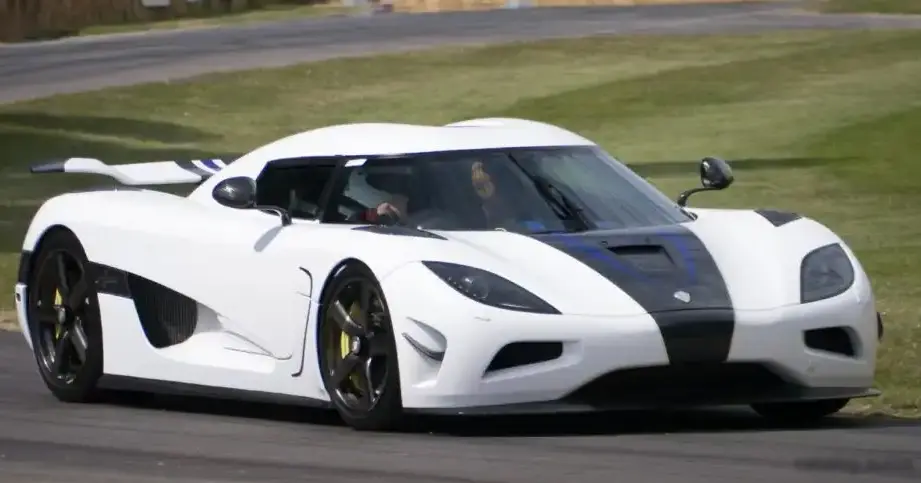
The Koenigsegg Agera 5.0 V8 (960 Hp) Automatic, produced from 2010 to 2018, represents a pinnacle of Swedish hypercar engineering. Positioned as a high-performance variant within the broader Agera lineage, it showcased Koenigsegg’s commitment to pushing the boundaries of speed, power, and exclusivity. The Agera, meaning “to act” in Swedish, was designed as a more track-focused and lighter successor to the CCR, and the 5.0 V8 variant with the automatic transmission offered a unique blend of raw performance and relative ease of use for its limited clientele. Built around a carbon fiber chassis and boasting a twin-turbocharged V8 engine, the Agera 5.0 Automatic was a statement of intent – a car designed to dominate both the road and the racetrack.
Technical Specifications
| Brand | Koenigsegg |
| Model | Agera |
| Generation | Agera |
| Type (Engine) | 5.0 V8 (960 Hp) Automatic |
| Start of production | 2010 |
| End of production | 2018 |
| Powertrain Architecture | Internal Combustion engine |
| Body type | Targa |
| Seats | 2 |
| Doors | 2 |
| Fuel consumption (economy) – extra urban | 12.5 l/100 km (18.8 US mpg, 22.6 UK mpg, 8 km/l) |
| Fuel consumption (economy) – combined | 14.7 l/100 km (16 US mpg, 19.2 UK mpg, 6.8 km/l) |
| Fuel Type | Petrol (Gasoline) |
| Acceleration 0 – 100 km/h | 3 sec |
| Acceleration 0 – 62 mph | 3 sec |
| Acceleration 0 – 60 mph | 3 sec |
| Acceleration 0 – 200 km/h | 8.0 sec |
| Maximum speed | 420 km/h (260.98 mph) |
| 100 km/h – 0 | 30.5 m |
| Emission standard | Euro 5 |
| Weight-to-power ratio | 1.5 kg/Hp, 669 Hp/tonne |
| Weight-to-torque ratio | 1.3 kg/Nm, 766.6 Nm/tonne |
| Power | 960 Hp @ 7100 rpm |
| Power per litre | 190.8 Hp/l |
| Torque | 1100 Nm @ 4000 rpm (811.32 lb.-ft. @ 4000 rpm) |
| Maximum engine speed | 7500 rpm |
| Engine layout | Middle, Longitudinal |
| Engine displacement | 5032 cm3 (307.07 cu. in.) |
| Number of cylinders | 8 |
| Engine configuration | V-engine |
| Cylinder Bore | 91.7 mm (3.61 in.) |
| Piston Stroke | 95.25 mm (3.75 in.) |
| Compression ratio | 9:1 |
| Number of valves per cylinder | 4 |
| Fuel injection system | Multi-port manifold injection |
| Engine aspiration | Twin-Turbo, Intercooler |
| Valvetrain | DOHC |
| Kerb Weight | 1435 kg (3163.63 lbs.) |
| Max. weight | 1650 kg (3637.63 lbs.) |
| Max load | 215 kg (473.99 lbs.) |
| Trunk (boot) space – minimum | 120 l (4.24 cu. ft.) |
| Fuel tank capacity | 80 l (21.13 US gal | 17.6 UK gal) |
| Length | 4293 mm (169.02 in.) |
| Width including mirrors | 1996 mm (78.58 in.) |
| Height | 1120 mm (44.09 in.) |
| Wheelbase | 2662 mm (104.8 in.) |
| Front track | 1700 mm (66.93 in.) |
| Rear (Back) track | 1650 mm (64.96 in.) |
| Front overhang | 885 mm (34.84 in.) |
| Rear overhang | 752 mm (29.61 in.) |
| Ride height (ground clearance) | 100 mm (3.94 in.) |
| Drag coefficient (Cd) | 0.33-0.37 |
| Minimum turning circle (turning diameter) | 11 m (36.09 ft.) |
| Drivetrain Architecture | The Internal combustion engine (ICE) drives the rear wheels of the vehicle. |
| Drive wheel | Rear wheel drive |
| Number of gears and type of gearbox | 7 gears, automatic transmission |
| Front suspension | Double wishbone |
| Rear suspension | Double wishbone |
| Front brakes | Ventilated discs |
| Rear brakes | Ventilated discs |
| Assisting systems | ABS (Anti-lock braking system) |
| Steering type | Steering rack and pinion |
| Power steering | Electric Steering |
| Tires size | 265/35 R19; 345/30 R20 |
| Wheel rims size | 9.5J x 19; 12.5J x 20 |
Powertrain & Engine Architecture
At the heart of the Agera 5.0 Automatic lies Koenigsegg’s proprietary 5.0-liter V8 engine, designated as the KA08DR. This engine is a marvel of engineering, featuring a dry-sump lubrication system, twin-turbochargers with anti-lag technology, and a flat-plane crankshaft. The engine produces a staggering 960 horsepower at 7,100 rpm and 1100 Nm (811 lb-ft) of torque at 4,000 rpm. The fuel system utilizes multi-port fuel injection, optimized for both performance and efficiency. The engine’s architecture is designed for minimal internal friction and maximum responsiveness. The automatic transmission is a 7-speed dual-clutch unit, specifically tuned to handle the immense power output. Unlike traditional automatics, this transmission offers incredibly fast and precise shifts, contributing to the car’s blistering acceleration.
Driving Characteristics
The Agera 5.0 Automatic delivers a driving experience that is both exhilarating and surprisingly manageable. While the manual transmission Agera variants are often favored by purists for their direct connection, the automatic version offers a level of accessibility that broadens the car’s appeal. The 7-speed dual-clutch transmission provides near-instantaneous gear changes, minimizing power interruption during acceleration. The car’s lightweight construction (1435 kg / 3163.63 lbs) and advanced aerodynamics contribute to its phenomenal grip and stability, even at extreme speeds. The power delivery is immense, with the twin-turbochargers providing a surge of torque that pins the driver back into their seat. While the automatic transmission simplifies the driving process, it doesn’t diminish the Agera’s inherent intensity. The car remains a demanding machine that requires respect and skill to fully exploit its capabilities.
Equipment & Trim Levels
Given the Agera’s exclusivity, customization options were extensive. However, the standard equipment level was already exceptionally high. The interior featured a carbon fiber monocoque chassis, leather upholstery, and a bespoke infotainment system. Standard features included adjustable bucket seats, a leather-wrapped steering wheel, and climate control. Optional extras included a range of carbon fiber trim pieces, bespoke paint finishes, and advanced telemetry systems. The Agera 5.0 Automatic was typically specified with a focus on performance and luxury, with many owners opting for lightweight materials and aerodynamic enhancements.
Chassis & Braking
The Agera’s chassis is a lightweight carbon fiber monocoque, providing exceptional rigidity and crash protection. The suspension utilizes double wishbones at both the front and rear, with adjustable dampers and stabilizers. The braking system features ventilated discs on all four wheels, with multi-piston calipers providing immense stopping power. An advanced ABS system ensures optimal braking performance in all conditions. The car’s aerodynamic package includes active rear wing and front flaps, which adjust automatically to optimize downforce and reduce drag.
Market Reception & Comparison
The Koenigsegg Agera 5.0 Automatic was widely praised by automotive journalists for its incredible performance, advanced technology, and luxurious interior. Critics noted the seamless operation of the automatic transmission and its ability to deliver blistering acceleration without sacrificing drivability. Compared to the manual transmission Agera variants, the automatic version was seen as more accessible and user-friendly, making it a more appealing option for drivers who prioritize ease of use. However, some purists argued that the automatic transmission diminished the car’s overall engagement. Fuel economy, while not a primary concern for Agera owners, was surprisingly reasonable for a hypercar, with a combined fuel consumption of 14.7 l/100 km (16 US mpg).
Legacy
The Koenigsegg Agera 5.0 V8 (960 Hp) Automatic remains a highly sought-after hypercar in the used car market. Its combination of extreme performance, advanced technology, and exclusivity ensures its continued desirability. The KA08DR engine has proven to be remarkably reliable, with many examples exceeding six-figure mileages without major issues. The Agera’s impact on the automotive industry is significant, demonstrating Koenigsegg’s ability to create truly groundbreaking hypercars that push the boundaries of what’s possible. It solidified Koenigsegg’s position as one of the world’s leading manufacturers of high-performance automobiles.
