
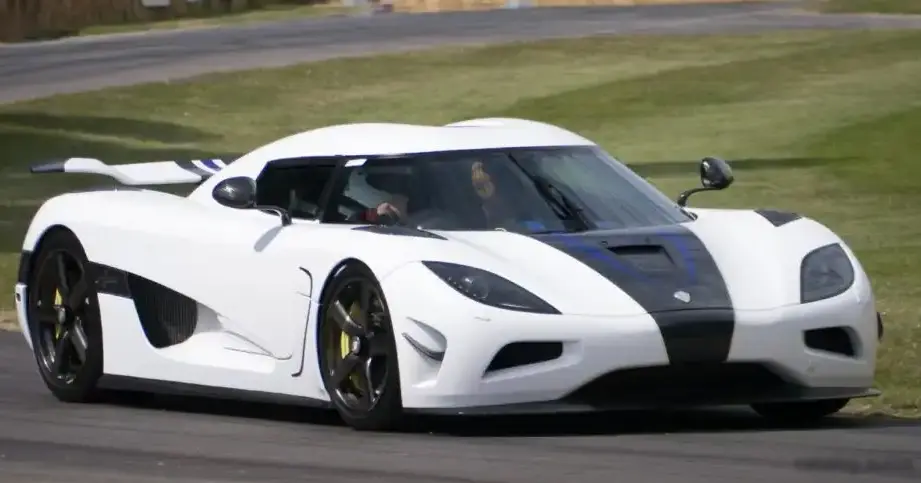
The Koenigsegg Agera RS 5.0 V8 (1160 Hp) Automatic, produced between 2015 and 2016, represents a pinnacle of hypercar engineering. Positioned as the highest-performance variant within the Agera lineage, the RS was designed to break speed records and showcase Koenigsegg’s technological prowess. Built on the Agera platform (1HX0), the RS distinguished itself through extensive use of lightweight materials, a more powerful engine, and aerodynamic enhancements. The inclusion of an automatic transmission, while unconventional for a car of this caliber, broadened its appeal to a wider range of drivers seeking extreme performance with relative ease of use. This specific configuration, combining the 5.0-liter twin-turbo V8 with an automatic gearbox, was a limited-production offering, further enhancing its exclusivity.
Technical Specifications
| Brand | Koenigsegg |
| Model | Agera |
| Generation | Agera |
| Type (Engine) | RS 5.0 V8 (1160 Hp) Automatic |
| Start of production | 2015 |
| End of production | 2016 |
| Powertrain Architecture | Internal Combustion engine |
| Body type | Targa |
| Seats | 2 |
| Doors | 2 |
| Fuel Type | Petrol (Gasoline) |
| Maximum speed | 443 km/h (275.27 mph) |
| Weight-to-power ratio | 1.2 kg/Hp, 831.5 Hp/tonne |
| Weight-to-torque ratio | 1.1 kg/Nm, 917.6 Nm/tonne |
| Power | 1160 Hp @ 7800 rpm |
| Power per litre | 229 Hp/l |
| Torque | 1280 Nm @ 4100 rpm (944.08 lb.-ft. @ 4100 rpm) |
| Maximum engine speed | 8250 rpm |
| Engine layout | Middle, Longitudinal |
| Engine displacement | 5065 cm3 (309.09 cu. in.) |
| Number of cylinders | 8 |
| Engine configuration | V-engine |
| Cylinder Bore | 92 mm (3.62 in.) |
| Piston Stroke | 95.25 mm (3.75 in.) |
| Compression ratio | 9.3:1 |
| Number of valves per cylinder | 4 |
| Fuel injection system | Multi-port manifold injection |
| Engine aspiration | Twin-Turbo, Intercooler |
| Valvetrain | DOHC |
| Kerb Weight | 1395 kg (3075.45 lbs.) |
| Trunk (boot) space – minimum | 150 l (5.3 cu. ft.) |
| Fuel tank capacity | 82 l (21.66 US gal | 18.04 UK gal) |
| Length | 4293 mm (169.02 in.) |
| Width including mirrors | 2050 mm (80.71 in.) |
| Height | 1120 mm (44.09 in.) |
| Wheelbase | 2662 mm (104.8 in.) |
| Ride height (ground clearance) | 85 mm (3.35 in.) |
| Minimum turning circle (turning diameter) | 11 m (36.09 ft.) |
| Drivetrain Architecture | The Internal combustion engine (ICE) drives the rear wheels of the vehicle. |
| Drive wheel | Rear wheel drive |
| Number of gears and type of gearbox | 7 gears, automatic transmission |
| Front suspension | Double wishbone |
| Rear suspension | Double wishbone |
| Front brakes | Ventilated discs |
| Rear brakes | Ventilated discs |
| Assisting systems | ABS (Anti-lock braking system) |
| Steering type | Steering rack and pinion |
| Power steering | Electric Steering |
| Tires size | 265/35 R19; 345/30 R20 |
| Wheel rims size | 9.5J x 19; 12.5J x 20 |
Powertrain & Engine Architecture
At the heart of the Agera RS lies Koenigsegg’s 5.0-liter V8 engine, designated as the R50. This engine is a marvel of engineering, featuring a dry-sump lubrication system, titanium connecting rods, and a lightweight crankshaft. The twin-turbocharger setup, utilizing low-inertia turbochargers, minimizes turbo lag and delivers instant power. The engine employs multi-port fuel injection, optimized for both efficiency and performance. The 7-speed automatic transmission, a custom-built unit, was designed to handle the immense power output. While details are proprietary, it’s understood to feature rapid shift times and a sophisticated control system. The engine produces 1160 horsepower at 7800 rpm and a staggering 1280 Nm (944 lb-ft) of torque at 4100 rpm. This power is delivered to the rear wheels, making the Agera RS a challenging but rewarding driving experience.
Driving Characteristics
The Agera RS 5.0 V8 Automatic delivers a driving experience unlike almost any other car on the road. The automatic transmission, while offering convenience, doesn’t detract from the raw, visceral feel of the car. Gear changes are incredibly quick, allowing the engine to remain in its optimal power band. The power delivery is explosive, with minimal turbo lag. Compared to the manual-transmission Agera RS, the automatic version offers slightly reduced driver involvement but provides a more accessible experience for those less comfortable with a traditional manual gearbox. The car’s lightweight construction and advanced aerodynamics contribute to exceptional handling and cornering ability. The RS is capable of accelerating from 0 to 60 mph in under 3 seconds and achieving a top speed exceeding 275 mph.
Equipment & Trim Levels
The Agera RS was largely bespoke, with customers able to personalize nearly every aspect of the car. Standard features included a carbon fiber body, adjustable Öhlins dampers, and a fully digital instrument cluster. Interior appointments were luxurious, with leather and Alcantara upholstery, and carbon fiber trim. Optional extras included a lifting hydraulic suspension system, a bespoke exhaust system, and a range of personalized interior finishes. The Targa top, a defining feature of the Agera RS, is removable for open-air driving. Given the limited production run and high price point, most Agera RS models were highly customized to the owner’s specifications.
Chassis & Braking
The Agera RS utilizes a lightweight chassis constructed primarily from carbon fiber. This provides exceptional rigidity and contributes to the car’s low weight. The suspension system features fully adjustable Öhlins dampers, allowing drivers to fine-tune the ride and handling characteristics. Braking is provided by ventilated discs on all four wheels, with ABS (Anti-lock Braking System) as standard. The braking system is designed to withstand the extreme stresses of high-speed driving and provides exceptional stopping power. The car’s aerodynamic package, including a large rear wing and front splitter, generates significant downforce, enhancing stability at high speeds.
Market Reception & Comparison
The Koenigsegg Agera RS was universally praised by automotive critics for its performance, technology, and exclusivity. It was lauded as one of the fastest and most capable hypercars ever produced. Compared to other hypercars of the time, such as the Bugatti Veyron and McLaren P1, the Agera RS offered a unique combination of raw power, lightweight construction, and advanced aerodynamics. While the automatic transmission was initially met with some skepticism, it proved to be a capable and reliable component. The Agera RS’s fuel economy, while not a primary concern for its owners, was surprisingly reasonable given its performance capabilities. Reliability has been generally good, although maintenance costs are exceptionally high due to the car’s complex engineering and exotic components.
Legacy
The Koenigsegg Agera RS cemented Koenigsegg’s reputation as a leading manufacturer of hypercars. Its record-breaking speed runs and innovative technology pushed the boundaries of automotive engineering. Today, the Agera RS remains a highly sought-after collector’s item, with values continuing to appreciate. The powertrain, while complex, has proven to be relatively reliable when properly maintained. The Agera RS serves as a benchmark for future hypercar development, and its legacy will continue to inspire automotive engineers for years to come. The combination of extreme performance and a usable automatic transmission made it a unique and desirable machine, even within the exclusive hypercar segment.
