
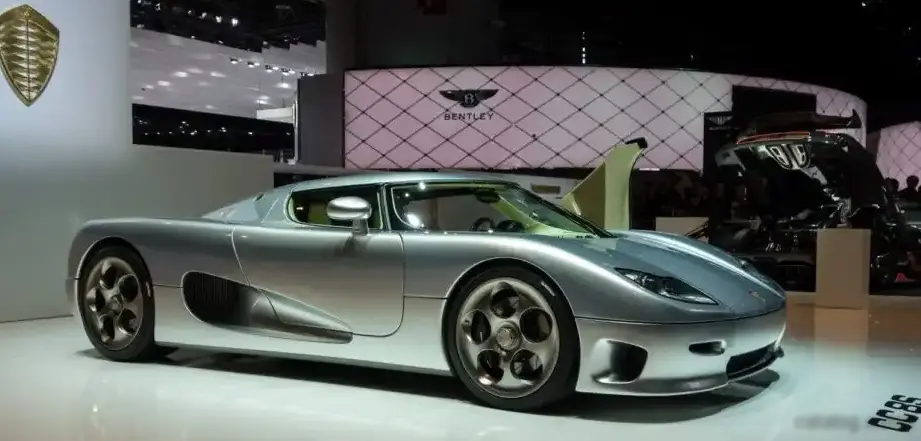
The Koenigsegg CC8S, produced from 2002 to 2003, represents a pivotal moment in the history of the Swedish hypercar manufacturer. It was the first production model from Koenigsegg Automotive AB, establishing the company as a serious contender in the high-performance automotive world. The CC8S, named for Christian von Koenigsegg and the engine’s 8-cylinder configuration, was designed to be a direct competitor to established exotic car brands like Ferrari and Lamborghini. A total of just 39 examples were built, making it a highly exclusive and sought-after vehicle today. The CC8S was built on a space frame chassis, a design choice prioritizing lightweight construction and exceptional rigidity. It laid the foundation for all subsequent Koenigsegg models.
Technical Specifications
| Brand | Koenigsegg |
| Model | CC |
| Generation | CC8S |
| Type (Engine) | 4.7 i V8 32V (655 Hp) |
| Start of production | 2002 |
| End of production | 2003 |
| Powertrain Architecture | Internal Combustion engine |
| Body type | Coupe |
| Seats | 2 |
| Doors | 2 |
| Fuel Type | Petrol (Gasoline) |
| Acceleration 0 – 100 km/h | 3.5 sec |
| Acceleration 0 – 62 mph | 3.5 sec |
| Acceleration 0 – 60 mph | 3.3 sec |
| Maximum speed | 390 km/h / 242.33 mph |
| Weight-to-power ratio | 1.8 kg/Hp, 557.4 Hp/tonne |
| Weight-to-torque ratio | 1.6 kg/Nm, 638.3 Nm/tonne |
| Power | 655 Hp @ 6800 rpm |
| Power per litre | 139.4 Hp/l |
| Torque | 750 Nm @ 5000 rpm / 553.17 lb.-ft. @ 5000 rpm |
| Engine layout | Middle, Longitudinal |
| Engine displacement | 4700 cm3 / 286.81 cu. in. |
| Number of cylinders | 8 |
| Engine configuration | V-engine |
| Compression ratio | 8.6:1 |
| Number of valves per cylinder | 4 |
| Fuel injection system | Multi-port manifold injection |
| Engine aspiration | Turbocharger, Intercooler |
| Kerb Weight | 1175 kg / 2590.43 lbs |
| Trunk (boot) space – maximum | 120 l / 4.24 cu. ft |
| Fuel tank capacity | 80 l / 21.13 US gal | 17.6 UK gal |
| Length | 4190 mm / 164.96 in |
| Width | 1990 mm / 78.35 in |
| Height | 1070 mm / 42.13 in |
| Wheelbase | 2660 mm / 104.72 in |
| Drivetrain Architecture | Rear wheel drive |
| Number of gears and type of gearbox | 6 gears, manual transmission |
| Front suspension | Double wishbone |
| Rear suspension | Double wishbone |
| Front brakes | Ventilated discs |
| Rear brakes | Ventilated discs |
| Assisting systems | ABS (Anti-lock braking system) |
| Steering type | Steering rack and pinion |
| Tires size | 255/40 ZR18; 335/30 ZR20 |
| Wheel rims size | 9J x 18; 12.5J x 20 |
Powertrain & Engine Architecture
The heart of the CC8S is its 4.7-liter V8 engine, designated as a Koenigsegg-designed and built unit. This engine is notable for its relatively small displacement for the performance it delivers. It features a 90-degree V-angle, contributing to a smoother power delivery and reduced vibrations. The engine utilizes a cast iron block with aluminum cylinder heads, a combination chosen for strength and weight reduction. Crucially, the CC8S employs twin superchargers – a unique design choice for the time – providing instant boost and eliminating turbo lag. The superchargers are roots-type blowers, delivering a significant amount of air into the engine. Fuel delivery is managed by a multi-port fuel injection system. The engine produces 655 horsepower at 6,800 rpm and 750 Nm (553 lb-ft) of torque at 5,000 rpm. The engine is longitudinally mounted in the rear-mid engine position. The sole transmission option was a 6-speed manual gearbox, designed for quick and precise shifts.
Driving Characteristics
The Koenigsegg CC8S delivers a visceral and exhilarating driving experience. The combination of the supercharged V8 and the lightweight chassis results in astonishing acceleration. The 0-60 mph sprint is dispatched in approximately 3.3 seconds, and the car can reach a top speed of 242 mph. The manual transmission requires a skilled driver to extract the most performance, but it provides a direct connection to the powertrain. The car’s relatively short wheelbase and responsive steering contribute to its agile handling. While not designed for comfort, the CC8S offers a surprisingly compliant ride for a high-performance vehicle, thanks to its sophisticated double-wishbone suspension. The lack of electronic driver aids means the driver is fully engaged in the driving process, requiring a high level of skill and concentration.
Equipment & Trim Levels
Given the limited production run and the CC8S’s positioning as a hypercar, the level of customization was relatively high. However, the base specification included a minimalist interior focused on functionality and weight reduction. Seats were typically upholstered in leather, and the dashboard featured aluminum trim. Air conditioning and a basic audio system were standard. Optional extras included upgraded leather upholstery, carbon fiber interior trim, and bespoke paint finishes. The CC8S did not offer many of the convenience features found in more mainstream vehicles; the emphasis was entirely on performance. The car featured dihedral synchro-helix actuation doors, a Koenigsegg signature, which added to its dramatic appearance.
Chassis & Braking
The CC8S utilizes a lightweight space frame chassis constructed from aluminum and carbon fiber. This construction method provides exceptional rigidity while minimizing weight. The suspension consists of independent double wishbones at both the front and rear, with adjustable dampers and springs. Braking is provided by ventilated disc brakes at all four corners, offering substantial stopping power. An Anti-lock Braking System (ABS) is included as a standard safety feature. The car’s low weight and balanced chassis contribute to its exceptional handling characteristics. The tires are high-performance ZR-rated tires, specifically sized 255/40 ZR18 at the front and 335/30 ZR20 at the rear, maximizing grip.
Market Reception & Comparison
Upon its release, the Koenigsegg CC8S was met with widespread acclaim from automotive journalists and enthusiasts. It was praised for its incredible performance, innovative engineering, and striking design. Critics noted that the CC8S was a genuine rival to established hypercar manufacturers like Ferrari and Lamborghini. Compared to other cars in its class, the CC8S offered a unique combination of power, lightweight construction, and a raw, unfiltered driving experience. Its twin-supercharger setup was a notable differentiator. Reliability was generally good for a low-volume, high-performance vehicle, although maintenance costs were substantial. The CC8S’s exclusivity and limited production run ensured that it quickly became a collector’s item.
Legacy
The Koenigsegg CC8S holds a significant place in automotive history as the first production model from a now-renowned hypercar manufacturer. It established Koenigsegg’s reputation for pushing the boundaries of performance and innovation. The technologies and design principles pioneered in the CC8S – such as the space frame chassis, twin-supercharger setup, and dihedral synchro-helix doors – have been carried forward in subsequent Koenigsegg models. Today, the CC8S is a highly sought-after collector’s car, with values continuing to appreciate. The powertrain, while requiring specialized maintenance, has proven to be relatively durable when properly cared for. The CC8S remains a testament to Christian von Koenigsegg’s vision and engineering prowess, and a landmark achievement in the world of high-performance automobiles.
