
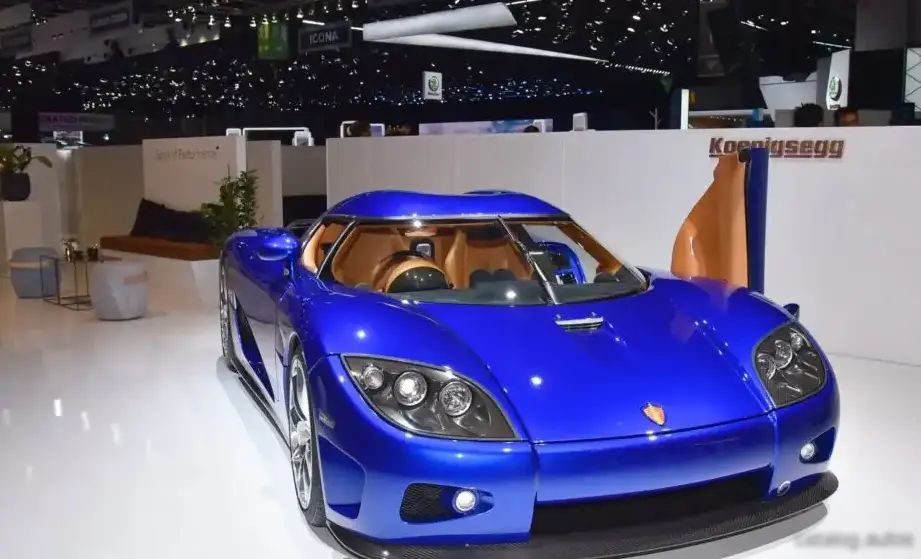
The Koenigsegg CCX, introduced in 2006 and produced through 2010, represents a pivotal moment in the Swedish automaker’s history. Positioned as a more accessible (though still extraordinarily expensive) entry point into the Koenigsegg lineup compared to earlier models like the CCR, the CCX was designed to meet evolving global homologation standards, particularly those in the United States. The “CCX” designation stands for “Competition Coupe X,” signifying its focus on track performance and its position as the tenth model produced by Koenigsegg. This variant, equipped with the 4.7-liter V8 engine producing 806 horsepower, became the cornerstone of the CCX range, offering a blend of extreme performance and relative usability for a hypercar.
Technical Specifications
| Brand | Koenigsegg |
| Model | CC |
| Generation | CCX |
| Type (Engine) | 4.7 V8 (806 Hp) |
| Start of production | 2006 |
| End of production | 2010 |
| Powertrain Architecture | Internal Combustion engine |
| Body type | Targa |
| Seats | 2 |
| Doors | 2 |
| Fuel consumption (economy) – extra urban | 13 l/100 km (18.1 US mpg, 21.7 UK mpg, 7.7 km/l) |
| Fuel consumption (economy) – combined | 17 l/100 km (13.8 US mpg, 16.6 UK mpg, 5.9 km/l) |
| Fuel Type | Petrol (Gasoline) |
| Acceleration 0 – 100 km/h | 3.2 sec |
| Acceleration 0 – 62 mph | 3.2 sec |
| Acceleration 0 – 60 mph | 3 sec |
| Acceleration 0 – 200 km/h | 9.8 sec |
| Maximum speed | 395 km/h (245.44 mph) |
| Power | 806 Hp @ 7000 rpm |
| Power per litre | 171.5 Hp/l |
| Torque | 920 Nm @ 5500 rpm (678.56 lb.-ft. @ 5500 rpm) |
| Engine layout | Rear, Longitudinal |
| Engine displacement | 4700 cm3 (286.81 cu. in.) |
| Number of cylinders | 8 |
| Engine configuration | V-engine |
| Compression ratio | 8.2:1 |
| Number of valves per cylinder | 4 |
| Fuel injection system | Multi-port manifold injection |
| Engine aspiration | Supercharger, Intercooler |
| Valvetrain | DOHC |
| Kerb Weight | 1280 kg (2821.92 lbs) |
| Trunk (boot) space – minimum | 120 l (4.24 cu. ft.) |
| Fuel tank capacity | 70 l (18.49 US gal, 15.4 UK gal) |
| Length | 4293 mm (169.02 in) |
| Width | 1996 mm (78.58 in) |
| Height | 1120 mm (44.09 in) |
| Wheelbase | 2660 mm (104.72 in) |
| Ride height (ground clearance) | 100 mm (3.94 in) |
| Drag coefficient (Cd) | 0.32 |
| Minimum turning circle | 11 m (36.09 ft) |
| Drivetrain Architecture | The Internal combustion engine (ICE) drives the rear wheels of the vehicle. |
| Drive wheel | Rear wheel drive |
| Number of gears and type of gearbox | 6 gears, manual transmission |
| Front suspension | Double wishbone, Transverse stabilizer |
| Rear suspension | Double wishbone, Transverse stabilizer |
| Front brakes | Ventilated discs, 380×34 mm |
| Rear brakes | Ventilated discs, 262×32 mm |
| Assisting systems | ABS (Anti-lock braking system) |
| Steering type | Steering rack and pinion |
| Power steering | Electric Steering |
| Tires size | Front wheel tires: 255/35 R19, Rear wheel tires: 335/30 R20 |
| Wheel rims size | Front wheel rims: 9.5J x 19, Rear wheel rims: 12.5J x 20 |
Powertrain & Engine Architecture
At the heart of the CCX lies Koenigsegg’s in-house developed 4.7-liter V8 engine. This engine, designated as the ‘KB8’ internally, is a dry-sump design, allowing for a lower center of gravity and improved oil scavenging during high-G maneuvers. The engine utilizes a cast aluminum block and heads, and features a flat-plane crankshaft for reduced rotating mass and increased responsiveness. Crucially, the CCX engine was specifically designed to run on 91 octane gasoline, making it compliant with North American fuel standards – a key factor in its US market introduction. The engine employs multi-port fuel injection and is force-fed by a Roots-type supercharger, along with an intercooler to manage intake temperatures. The DOHC valvetrain, with four valves per cylinder, contributes to the engine’s high-revving nature and impressive power output. The standard transmission for the CCX was a 6-speed manual gearbox, providing direct control for the driver.
Driving Characteristics
The 806 horsepower and 678 lb-ft of torque delivered by the CCX’s V8 engine translate into breathtaking acceleration. The 0-60 mph sprint is dispatched in around 3 seconds, and the car can reach 200 km/h (124 mph) in under 10 seconds. The supercharger provides instant throttle response, delivering a surge of power across the entire rev range. While the manual transmission offers a highly engaging driving experience, it demands skill and precision to manage the immense power. The relatively lightweight construction (around 2822 lbs) contributes to the car’s agility and responsiveness. The CCX feels incredibly planted at high speeds, thanks to its aerodynamic design and sophisticated suspension. Compared to potential future models with dual-clutch transmissions, the manual gearbox provides a more raw and visceral connection to the car.
Equipment & Trim Levels
The CCX was offered with a relatively high level of standard equipment, reflecting its price point. The interior featured leather upholstery, carbon fiber trim, and a bespoke instrument cluster. Air conditioning, power windows, and a premium audio system were also standard. Koenigsegg offered a significant degree of customization, allowing customers to specify unique paint colors, interior materials, and optional extras. These options included upgraded audio systems, navigation, and various carbon fiber components. The Targa top, a removable hardtop, was a defining feature of the CCX, providing an open-air driving experience.
Chassis & Braking
The CCX utilizes a lightweight chassis constructed from aluminum and carbon fiber. The suspension consists of double wishbones at both the front and rear, with adjustable dampers and stabilizer bars. This setup provides a balance between ride comfort and handling precision. The braking system features ventilated discs at all four corners, with powerful calipers to provide exceptional stopping power. ABS (Anti-lock Braking System) is standard. The CCX’s relatively low weight and advanced suspension contribute to its exceptional handling characteristics.
Market Reception & Comparison
The Koenigsegg CCX was widely praised by automotive journalists for its incredible performance, stunning design, and overall engineering excellence. Critics noted its accessibility compared to earlier Koenigsegg models, making it a more viable option for a wider range of potential buyers. However, its high price tag (over $1 million) limited its appeal to an extremely exclusive clientele. Compared to other hypercars of the era, such as the Bugatti Veyron and the Pagani Zonda, the CCX offered a more focused driving experience, prioritizing agility and responsiveness over sheer brute force. Fuel economy, while not a primary concern for CCX owners, was relatively poor at around 13.8 US mpg in combined driving.
Legacy
The Koenigsegg CCX played a crucial role in establishing the brand as a serious contender in the hypercar market. Its success paved the way for future models, such as the Agera and the Regera. The CCX’s engine, while no longer in production, remains a testament to Koenigsegg’s engineering prowess. Today, the CCX is a highly sought-after collector’s item, with values continuing to appreciate. The powertrain, while demanding in terms of maintenance, has proven to be relatively reliable when properly cared for. The CCX represents a unique chapter in the history of hypercars, combining Scandinavian design, Swedish engineering, and American market accessibility.
