
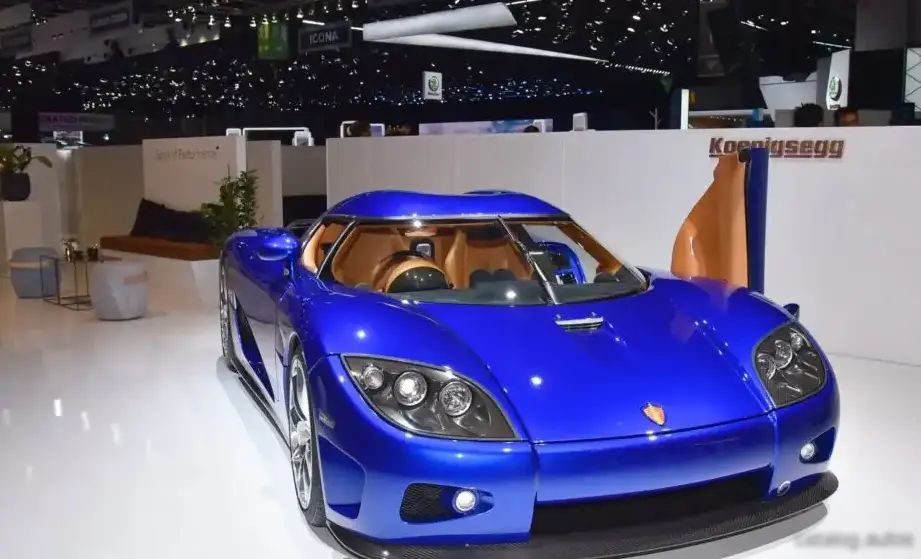
The Koenigsegg CCX R 4.8 V8 (1032 Hp) Special Edition Ethanol was a limited-production, high-performance supercar manufactured by the Swedish automaker Koenigsegg between 2007 and 2010. Positioned as an extreme variant of the CCX model, the “R” designation signified a focus on track performance and the ability to run on E85 ethanol fuel, significantly boosting power output. It represented a pinnacle of Koenigsegg’s engineering prowess during that period, offering blistering acceleration and a top speed exceeding 248 mph. The CCX itself was designed as a more accessible (though still exceptionally expensive) alternative to the earlier, more exclusive Koenigsegg models, aiming to broaden the brand’s reach within the hypercar segment.
Technical Specifications
| Brand | Koenigsegg |
| Model | CC |
| Generation | CCX |
| Type (Engine) | R 4.8 V8 (1032 Hp) Special Edition Ethanol |
| Start of production | 2007 |
| End of production | 2010 |
| Powertrain Architecture | Internal Combustion engine |
| Body type | Targa |
| Seats | 2 |
| Doors | 2 |
| Fuel consumption (economy) – extra urban | 18 l/100 km (13.1 US mpg, 15.7 UK mpg, 5.6 km/l) |
| Fuel consumption (economy) – combined | 22 l/100 km (10.7 US mpg, 12.8 UK mpg, 4.5 km/l) |
| Fuel Type | Petrol / Ethanol – E85 |
| Acceleration 0 – 100 km/h | 2.9 sec |
| Acceleration 0 – 62 mph | 2.9 sec |
| Acceleration 0 – 60 mph | 2.8 sec |
| Acceleration 0 – 200 km/h | 8.75 sec |
| Maximum speed | 400 km/h (248.55 mph) |
| Emission standard | Euro 4 |
| Weight-to-power ratio | 1.3 kg/Hp, 775.9 Hp/tonne |
| Weight-to-torque ratio | 1.2 kg/Nm, 812 Nm/tonne |
| Power | 1032 Hp @ 7000 rpm |
| Power per litre | 215 Hp/l |
| Torque | 1080 Nm @ 5600 rpm (796.57 lb.-ft. @ 5600 rpm) |
| Engine layout | Rear, Longitudinal |
| Engine displacement | 4800 cm3 (292.91 cu. in.) |
| Number of cylinders | 8 |
| Engine configuration | V-engine |
| Compression ratio | 9.2:1 |
| Number of valves per cylinder | 4 |
| Fuel injection system | Multi-port manifold injection |
| Engine aspiration | Twin-Turbo, Intercooler |
| Valvetrain | DOHC |
| Kerb Weight | 1330 kg (2932.15 lbs) |
| Trunk (boot) space – minimum | 120 l (4.24 cu. ft.) |
| Fuel tank capacity | 70 l (18.49 US gal | 15.4 UK gal) |
| Length | 4293 mm (169.02 in) |
| Width including mirrors | 1996 mm (78.58 in) |
| Height | 1114 mm (43.86 in) |
| Ride height (ground clearance) | 100 mm (3.94 in) |
| Drag coefficient (Cd) | 0.36 |
| Minimum turning circle (turning diameter) | 11 m (36.09 ft) |
| Drivetrain Architecture | The Internal combustion engine (ICE) drives the rear wheels of the vehicle. |
| Drive wheel | Rear wheel drive |
| Number of gears and type of gearbox | 6 gears, manual transmission |
| Front suspension | Double wishbone |
| Rear suspension | Double wishbone |
| Front brakes | Ventilated discs |
| Rear brakes | Ventilated discs |
| Assisting systems | ABS (Anti-lock braking system) |
| Steering type | Steering rack and pinion |
| Power steering | Electric Steering |
| Tires size | 255/35 R19; 335/30 R20 |
| Wheel rims size | 9.5J x 19; 12.5J x 20 |
Powertrain & Engine Architecture
At the heart of the CCX R lay a 4.8-liter V8 engine, designated as a Koenigsegg-designed and built unit. Unlike many manufacturers who rely on external suppliers, Koenigsegg maintained complete control over the engine’s development and production. The engine featured a 90-degree V-angle, contributing to a balanced and smooth power delivery. Crucially, the “R” variant was specifically engineered to run on E85 ethanol, a biofuel with a higher octane rating than conventional gasoline. This allowed for significantly increased turbocharger boost and a corresponding jump in power output to 1032 horsepower and 1080 Nm (796.57 lb-ft) of torque. The engine employed twin superchargers, a configuration chosen for its immediate response and linear power delivery, avoiding the turbo lag often associated with traditional turbocharging systems. Fuel delivery was managed by a multi-port fuel injection system, optimized for both gasoline and E85. The engine utilized a double overhead camshaft (DOHC) valvetrain with four valves per cylinder, ensuring efficient cylinder filling and exhaust scavenging. The CCX R was exclusively offered with a 6-speed manual transmission, prioritizing driver engagement and control.
Driving Characteristics
The Koenigsegg CCX R delivered a truly visceral driving experience. The combination of the powerful V8 engine and the lightweight chassis resulted in astonishing acceleration. The 0-60 mph sprint was dispatched in around 2.8 seconds, and the car could reach 200 km/h (124 mph) in just 8.75 seconds. The manual transmission, while demanding, provided precise control over the immense power. The chassis, featuring double wishbone suspension at both the front and rear, was tuned for both road and track use, offering a surprisingly compliant ride for a car of its performance capabilities. However, the CCX R was not a car for the faint of heart. The steering was direct and responsive, but required significant driver input to manage at high speeds. The brakes, equipped with ventilated discs all around, provided ample stopping power, but demanded a firm pedal application. Compared to the standard CCX, the “R” variant offered a noticeably more aggressive power delivery and a sharper focus on track performance. The E85 fuel also contributed to a slightly different engine sound, characterized by a more pronounced exhaust note.
Equipment & Trim Levels
Given its exclusivity, the CCX R offered a relatively limited range of options. Koenigsegg focused on providing a highly personalized experience for each customer. The interior was characterized by a minimalist design, emphasizing functionality and lightweight materials. Standard features included leather upholstery, air conditioning, and a basic audio system. Customers could specify custom leather colors, stitching patterns, and carbon fiber trim. Optional extras included a GPS navigation system, upgraded audio system, and various aerodynamic enhancements. The CCX R’s targa top, constructed from lightweight carbon fiber, could be removed for open-air driving. The overall emphasis was on creating a driver-focused environment, free from unnecessary distractions.
Chassis & Braking
The CCX R’s chassis was constructed from a lightweight carbon fiber monocoque, providing exceptional rigidity and strength. This minimized weight and maximized structural integrity. The suspension system utilized adjustable dampers, allowing drivers to fine-tune the ride characteristics to suit their preferences. The braking system featured ventilated discs at all four corners, providing ample stopping power. An anti-lock braking system (ABS) was standard, enhancing safety and control. The steering system employed a rack and pinion setup with electric power assistance, offering precise and responsive steering feel. The car rode on staggered tires – 255/35 R19 at the front and 335/30 R20 at the rear – mounted on lightweight alloy wheels.
Market Reception & Comparison
The Koenigsegg CCX R was widely praised by automotive journalists for its exceptional performance, innovative engineering, and exclusivity. Critics lauded the car’s blistering acceleration, responsive handling, and impressive build quality. However, the CCX R’s high price tag and limited availability meant that it remained out of reach for most enthusiasts. Compared to other supercars of the era, such as the Ferrari Enzo and the Porsche Carrera GT, the CCX R offered a unique combination of raw power, advanced technology, and Scandinavian design. Its ability to run on E85 fuel was also seen as a forward-thinking feature, demonstrating Koenigsegg’s commitment to sustainability. Fuel economy, while not a primary concern for buyers of this caliber, was rated at 22 l/100 km combined, which was relatively reasonable given the car’s performance.
Legacy
The Koenigsegg CCX R remains a highly sought-after collector’s item. Its limited production run and exceptional performance have ensured its place in automotive history. The engine, while complex, has proven to be relatively reliable when properly maintained. The carbon fiber chassis has also demonstrated excellent durability. Today, CCX R models command significant prices on the used car market, reflecting their rarity and desirability. The CCX R served as a crucial stepping stone for Koenigsegg, solidifying its reputation as a manufacturer of world-class hypercars and paving the way for future models like the Agera and Regera.
