
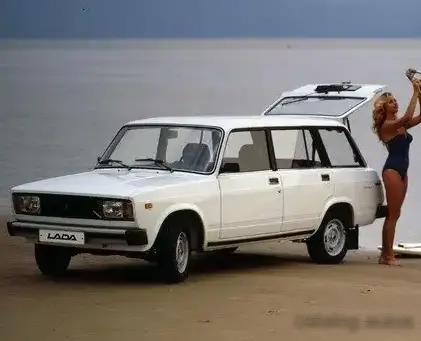
The Lada 2104, produced between 1984 and 1992, represents a significant evolution of the classic Lada 2101 series, itself based on the Fiat 124. The 2104 specifically denotes the station wagon (estate) body style within the broader 2104-2107 family. This variant was primarily aimed at the Soviet domestic market and export to countries within the Eastern Bloc, offering a practical and affordable vehicle for families and commercial use. The 1.3-liter, 64 horsepower engine configuration was a mainstay of the lineup, representing an entry-level option focused on fuel economy and durability rather than outright performance. It served as a workhorse vehicle, prized for its simplicity and ease of maintenance.
Technical Specifications
| Brand | Lada |
| Model | 2104 |
| Generation | 2104 |
| Type (Engine) | 1.3 (64 Hp) |
| Start of production | 1984 |
| End of production | 1992 |
| Powertrain Architecture | Internal Combustion engine |
| Body type | Station wagon (estate) |
| Seats | 5 |
| Doors | 5 |
| Fuel consumption (urban) | 10.1 l/100 km (23.3 US mpg / 28 UK mpg / 9.9 km/l) |
| Fuel Type | Petrol (Gasoline) |
| Acceleration 0 – 100 km/h | 18.5 sec |
| Acceleration 0 – 62 mph | 18.5 sec |
| Acceleration 0 – 60 mph | 17.6 sec |
| Maximum speed | 137 km/h (85.13 mph) |
| Weight-to-power ratio | 15.9 kg/Hp (62.7 Hp/tonne) |
| Weight-to-torque ratio | 11.1 kg/Nm (90.2 Nm/tonne) |
| Power | 64 Hp @ 5600 rpm |
| Power per litre | 49.5 Hp/l |
| Torque | 92 Nm @ 3400 rpm (67.86 lb.-ft. @ 3400 rpm) |
| Engine layout | Front, Longitudinal |
| Engine displacement | 1294 cm3 (78.96 cu. in.) |
| Number of cylinders | 4 |
| Engine configuration | Inline |
| Piston Stroke | 66.8 mm (2.63 in.) |
| Compression ratio | 8.5:1 |
| Number of valves per cylinder | 2 |
| Fuel injection system | Carburettor |
| Engine aspiration | Naturally aspirated engine |
| Valvetrain | OHC |
| Kerb Weight | 1020 kg (2248.72 lbs.) |
| Max. weight | 1475 kg (3251.82 lbs.) |
| Max load | 455 kg (1003.1 lbs.) |
| Trunk (boot) space – minimum | 345 l (12.18 cu. ft.) |
| Trunk (boot) space – maximum | 1035 l (36.55 cu. ft.) |
| Fuel tank capacity | 45 l (11.89 US gal | 9.9 UK gal) |
| Length | 4115 mm (162.01 in.) |
| Width | 1620 mm (63.78 in.) |
| Height | 1443 mm (56.81 in.) |
| Wheelbase | 2424 mm (95.43 in.) |
| Front track | 1365 mm (53.74 in.) |
| Rear (Back) track | 1321 mm (52.01 in.) |
| Drivetrain Architecture | The Internal combustion engine (ICE) drives the rear wheels of the vehicle. |
| Drive wheel | Rear wheel drive |
| Number of gears and type of gearbox | 4 gears, manual transmission |
| Front suspension | Double wishbone |
| Rear suspension | Rigid axle suspension |
| Front brakes | Disc |
| Rear brakes | Drum |
| Assisting systems | ABS (Anti-lock braking system) |
| Steering type | Worm-reduction unit |
| Tires size | 175/70 SR13 |
Powertrain & Engine Architecture
The heart of the Lada 2104 1.3 is the VAZ-2101 engine, a 1.3-liter inline-four cylinder unit. This engine, derived from the Fiat 124’s design, features a cast iron block and cylinder head, and a single overhead camshaft (OHC) operating two valves per cylinder. Fuel delivery is managed by a carburetor – typically a K-126G or similar – a technology common for the era but less efficient and precise than fuel injection. The engine produces 64 horsepower at 5600 rpm and 92 Nm (68 lb-ft) of torque at 3400 rpm. The engine’s longitudinal front-engine, rear-wheel-drive layout was a hallmark of the Lada design. The 4-speed manual transmission was the standard offering for this variant, chosen for its simplicity and cost-effectiveness. The transmission’s gear ratios were geared towards maximizing fuel economy and providing adequate, if not exhilarating, acceleration.
Driving Characteristics
The 1.3-liter engine in the 2104 provided modest performance. Acceleration was slow, with a 0-60 mph time around 17.6 seconds, and a top speed of approximately 85 mph. The car felt sluggish, particularly when fully loaded or climbing hills. Compared to other variants, such as the 1.5-liter or 1.6-liter versions, the 1.3 offered significantly less power. The manual transmission, while simple, required frequent shifting to maintain momentum. The rear-wheel-drive configuration provided predictable handling, but the suspension, while durable, offered a relatively firm and somewhat bumpy ride. The 2104 1.3 was not designed for sporty driving; its strengths lay in its practicality and ability to transport passengers and cargo reliably.
Equipment & Trim Levels
The Lada 2104 1.3 was typically offered in a fairly basic trim level. Standard features included cloth upholstery, a simple dashboard with basic instrumentation (speedometer, fuel gauge, temperature gauge), and manually operated windows and door locks. Heating was standard, but air conditioning was rarely fitted, even as an option. Optional extras, when available, might include a radio, upgraded seat covers, or a more comprehensive instrument cluster. The interior was functional and durable, prioritizing practicality over luxury. The exterior typically featured black plastic bumpers and relatively simple steel wheels with hubcaps.
Chassis & Braking
The 2104 utilized a body-on-frame construction, contributing to its robustness. The front suspension employed a double wishbone setup, while the rear suspension featured a rigid axle with leaf springs. This configuration prioritized durability and load-carrying capacity over sophisticated handling. Braking was provided by disc brakes on the front wheels and drum brakes on the rear. Power steering was not standard, requiring considerable effort at low speeds. ABS (Anti-lock braking system) was a later addition, appearing on some models towards the end of production, but was not common on the earlier 1.3-liter variants. The tires were typically 175/70 SR13, chosen for their affordability and suitability for the vehicle’s weight and power.
Market Reception & Comparison
The Lada 2104 1.3 was generally viewed as a utilitarian vehicle. Critics acknowledged its affordability and durability but often criticized its lack of performance, dated design, and relatively crude refinement. Compared to other trims in the 2104 lineup, the 1.3 offered the lowest price point but also the least amount of power and features. Fuel economy was a strong point, making it an attractive option for budget-conscious buyers. Reliability was generally good, thanks to the engine’s simple design and robust construction, but maintenance was often required due to the use of older technology and the availability of spare parts.
Legacy
The Lada 2104 1.3, while not a performance icon, holds a significant place in automotive history, particularly in Eastern Europe and the former Soviet Union. Its simple, robust design made it a reliable workhorse for many years. Today, the 2104 is a popular choice among classic car enthusiasts and collectors, particularly those interested in Soviet-era automobiles. The 1.3-liter engine, while not particularly powerful, is known for its durability and relative ease of maintenance. Parts availability can be a challenge, but a dedicated community of enthusiasts continues to support the preservation and restoration of these vehicles. The Lada 2104 1.3 remains a testament to a bygone era of automotive engineering, representing a time when practicality and affordability were prioritized above all else.
