
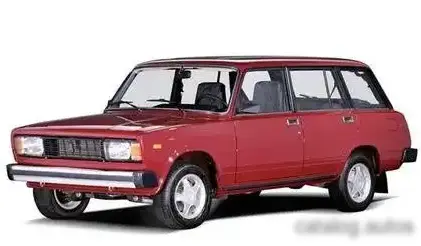
The Lada 21045 1.5 D is a diesel-powered station wagon produced by the Soviet/Russian automaker Lada between 1999 and 2000. It represents a late iteration of the 2104 series, which itself was a significant evolution of the original Lada 1200 introduced in the 1960s, heavily based on the Fiat 124. The 21045 was primarily aimed at the domestic Russian market and other Eastern European countries, offering a practical and affordable vehicle for both personal and commercial use. This particular variant, equipped with the 1.5-liter diesel engine producing 53 horsepower, occupied the lower end of the 2104 range, prioritizing fuel economy and durability over outright performance.
Technical Specifications
| Brand | Lada |
| Model | 2104 |
| Generation | 21045 |
| Type (Engine) | 1.5 D (53 Hp) |
| Start of production | 1999 |
| End of production | 2000 |
| Powertrain Architecture | Internal Combustion engine |
| Body type | Station wagon (estate) |
| Seats | 5 |
| Doors | 5 |
| Fuel consumption (urban) | 5.7 l/100 km (41.3 US mpg, 49.6 UK mpg, 17.5 km/l) |
| Fuel consumption (extra urban) | 3.8 l/100 km (61.9 US mpg, 74.3 UK mpg, 26.3 km/l) |
| Fuel consumption (combined) | 5.6 l/100 km (42 US mpg, 50.4 UK mpg, 17.9 km/l) |
| Fuel Type | Diesel |
| Acceleration 0 – 100 km/h | 23 sec |
| Acceleration 0 – 62 mph | 23 sec |
| Acceleration 0 – 60 mph | 21.9 sec |
| Maximum speed | 125 km/h (77.67 mph) |
| Weight-to-power ratio | 20 kg/Hp, 50 Hp/tonne |
| Weight-to-torque ratio | 11 kg/Nm, 90.6 Nm/tonne |
| Power | 53 Hp @ 4800 rpm |
| Power per litre | 34.8 Hp/l |
| Torque | 96 Nm @ 3000 rpm (70.81 lb.-ft. @ 3000 rpm) |
| Engine layout | Front, Longitudinal |
| Engine Model/Code | VAZ-341 |
| Engine displacement | 1524 cm3 (93 cu. in.) |
| Number of cylinders | 4 |
| Engine configuration | Inline |
| Cylinder Bore | 76 mm (2.99 in.) |
| Piston Stroke | 84 mm (3.31 in.) |
| Compression ratio | 23:1 |
| Number of valves per cylinder | 2 |
| Fuel injection system | Precombustion chamber injection |
| Engine aspiration | Naturally aspirated engine |
| Valvetrain | OHC |
| Kerb Weight | 1060 kg (2336.9 lbs.) |
| Max. weight | 1475 kg (3251.82 lbs.) |
| Max load | 415 kg (914.92 lbs.) |
| Trunk (boot) space – minimum | 345 l (12.18 cu. ft.) |
| Trunk (boot) space – maximum | 1145 l (40.44 cu. ft.) |
| Fuel tank capacity | 42 l (11.1 US gal | 9.24 UK gal) |
| Length | 4115 mm (162.01 in.) |
| Width | 1620 mm (63.78 in.) |
| Height | 1443 mm (56.81 in.) |
| Wheelbase | 2420 mm (95.28 in.) |
| Front track | 1365 mm (53.74 in.) |
| Rear (Back) track | 1321 mm (52.01 in.) |
| Drivetrain Architecture | The Internal combustion engine (ICE) drives the rear wheels of the vehicle. |
| Drive wheel | Rear wheel drive |
| Number of gears and type of gearbox | 5 gears, manual transmission |
| Front suspension | Double wishbone |
| Rear suspension | Rigid axle suspension |
| Front brakes | Disc |
| Rear brakes | Drum |
| Steering type | Worm-reduction unit |
| Tires size | 175/70 SR13 |
Introduction
The Lada 21045 1.5 D, produced from 1999 to 2000, represents a practical and economical offering within the broader Lada 2104 family. The 2104 series, a mainstay of Soviet and later Russian automotive production, was a direct descendant of the Fiat 124, licensed and adapted for local manufacturing. The “5” designation in 21045 indicated the inclusion of the diesel engine. This variant was positioned as the entry-level option for buyers seeking a spacious, durable station wagon with a focus on fuel efficiency, particularly important in regions where gasoline was less readily available or more expensive. It served as a workhorse vehicle for families, farmers, and small businesses.
Powertrain & Engine Architecture
The heart of the 21045 1.5 D is the VAZ-341 diesel engine, a 1.5-liter inline-four cylinder unit. This engine is characterized by its robust construction and relatively simple design, prioritizing reliability over high performance. It utilizes a precombustion chamber injection system, a common diesel technology of the era, where fuel is injected into a small chamber connected to the main cylinder, promoting more complete combustion. The engine produces 53 horsepower at 4800 rpm and 96 Nm (70.81 lb-ft) of torque at 3000 rpm. The engine’s overhead camshaft (OHC) configuration simplifies the valvetrain. The engine is mounted longitudinally in the front of the vehicle, driving the rear wheels. The 21045 was equipped with a five-speed manual transmission, chosen for its durability and cost-effectiveness. The transmission’s gear ratios were optimized for maximizing fuel economy and providing adequate pulling power at lower speeds, rather than sporty acceleration.
Driving Characteristics
The driving experience of the Lada 21045 1.5 D is best described as utilitarian. With only 53 horsepower, acceleration is slow, taking approximately 23 seconds to reach 100 km/h (62 mph). The engine’s torque, however, provides reasonable pulling power for everyday driving and hauling loads. The five-speed manual transmission allows the driver to keep the engine in its optimal power band, but frequent shifting is often necessary, especially when encountering hills or overtaking. Compared to the gasoline-powered versions of the 2104, the diesel offered significantly better fuel economy, but at the expense of refinement and performance. The rear-wheel-drive layout provides a predictable handling balance, but the suspension, while durable, is not particularly sophisticated, resulting in a somewhat bumpy ride on uneven surfaces.
Equipment & Trim Levels
The Lada 21045 1.5 D was typically sparsely equipped, reflecting its position as an affordable, no-frills vehicle. Standard features generally included basic cloth upholstery, a simple dashboard layout with analog gauges, and manual windows and door locks. Heating was standard, but air conditioning was rarely fitted. Optional extras were limited, but could include upgraded seat covers, a radio, and occasionally, more robust suspension components. The interior was designed for practicality and durability, with hard-wearing materials and a focus on ease of cleaning.
Chassis & Braking
The 21045 utilized a body-on-frame construction, contributing to its robustness. The front suspension employed a double wishbone design, while the rear suspension featured a rigid axle. This setup prioritized durability and load-carrying capacity over handling precision. The braking system consisted of disc brakes on the front wheels and drum brakes on the rear. The steering was a worm-reduction type, providing a relatively heavy but direct feel. The tires were typically 175/70 SR13, chosen for their affordability and suitability for a wide range of road conditions.
Market Reception & Comparison
The Lada 21045 1.5 D was well-received in its target markets for its affordability, fuel efficiency, and durability. Critics acknowledged its lack of refinement and performance, but recognized its value as a practical and reliable workhorse. Compared to the gasoline-powered 2104 variants, the diesel offered significantly better fuel economy, making it a popular choice for drivers covering long distances or those operating on a tight budget. However, the diesel engine was also known for being noisier and producing more exhaust emissions. Compared to Western European or Japanese station wagons of the same era, the 21045 1.5 D was significantly less sophisticated, but also considerably more affordable.
Legacy
The Lada 21045 1.5 D, while no longer in production, remains a common sight on the roads of Russia and other former Soviet republics. The VAZ-341 diesel engine, while simple, proved to be remarkably durable and relatively easy to maintain, contributing to the longevity of these vehicles. In the used car market, the 21045 1.5 D is valued for its affordability and simplicity. Parts availability remains relatively good, and the vehicle’s robust construction means that many examples are still in serviceable condition. It represents a significant chapter in the history of Russian automotive manufacturing, embodying a period of practical engineering and affordability.
