
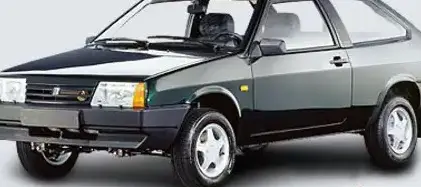
The Lada 2108, introduced in 1984 and remaining in production until 1997, represented a significant step forward for AvtoVAZ, the Soviet automotive manufacturer. This model, internally designated as the 2108, was the first front-wheel-drive Lada and marked a departure from the rear-wheel-drive designs that had characterized the brand for decades. The 1.3-liter (65 hp) variant was a mainstay of the lineup, serving as the entry-level option and appealing to buyers seeking affordable and practical transportation. It was built on the new for the time, B-platform, and was intended to modernize Lada’s offerings and compete with emerging Western European hatchbacks. The 2108 was primarily sold within the Eastern Bloc and select export markets, becoming a common sight on the roads of countries like Bulgaria, Hungary, and East Germany.
Technical Specifications
| Brand | Lada |
| Model | 2108 |
| Generation | 2108 |
| Type (Engine) | 1.3 (65 Hp) |
| Start of production | 1984 |
| End of production | 1997 |
| Powertrain Architecture | Internal Combustion engine |
| Body type | Hatchback |
| Seats | 5 |
| Doors | 3 |
| Fuel consumption (urban) | 8.6 l/100 km (27.4 US mpg, 32.8 UK mpg, 11.6 km/l) |
| Fuel Type | Petrol (Gasoline) |
| Acceleration 0 – 100 km/h | 16 sec |
| Acceleration 0 – 62 mph | 16 sec |
| Acceleration 0 – 60 mph | 15.2 sec |
| Maximum speed | 150 km/h (93.21 mph) |
| Weight-to-power ratio | 13.8 kg/Hp, 72.2 Hp/tonne |
| Weight-to-torque ratio | 9.6 kg/Nm, 104.4 Nm/tonne |
| Power | 65 Hp @ 5600 rpm |
| Power per litre | 50.5 Hp/l |
| Torque | 94 Nm @ 3500 rpm (69.33 lb.-ft. @ 3500 rpm) |
| Engine layout | Front, Transverse |
| Engine displacement | 1288 cm3 (78.6 cu. in.) |
| Number of cylinders | 4 |
| Engine configuration | Inline |
| Cylinder Bore | 76 mm (2.99 in.) |
| Piston Stroke | 71 mm (2.8 in.) |
| Compression ratio | 9.9:1 |
| Number of valves per cylinder | 2 |
| Fuel injection system | Carburettor |
| Engine aspiration | Naturally aspirated engine |
| Valvetrain | OHC |
| Kerb Weight | 900 kg (1984.16 lbs.) |
| Max. weight | 1325 kg (2921.12 lbs.) |
| Max load | 425 kg (936.96 lbs.) |
| Trunk (boot) space – minimum | 270 l (9.53 cu. ft.) |
| Trunk (boot) space – maximum | 1000 l (35.31 cu. ft.) |
| Fuel tank capacity | 43 l (11.36 US gal | 9.46 UK gal) |
| Length | 4006 mm (157.72 in.) |
| Width | 1650 mm (64.96 in.) |
| Height | 1402 mm (55.2 in.) |
| Wheelbase | 2560 mm (100.79 in.) |
| Front track | 1400 mm (55.12 in.) |
| Rear (Back) track | 1370 mm (53.94 in.) |
| Drivetrain Architecture | The Internal combustion engine (ICE) drives the front wheels of the vehicle. |
| Drive wheel | Front wheel drive |
| Number of gears and type of gearbox | 5 gears, manual transmission |
| Front suspension | Spring Strut |
| Rear suspension | Coil spring |
| Front brakes | Disc |
| Rear brakes | Drum |
| Steering type | Steering rack and pinion |
| Tires size | 165/70 SR13 |
Powertrain & Engine Architecture
The heart of the Lada 2108 1.3 was the VAZ-2108 engine, a 1.3-liter inline-four cylinder unit. This engine, while relatively simple in design, was robust and proved to be quite durable. It featured a single overhead camshaft (OHC) operating two valves per cylinder. Crucially, this variant utilized a carburetor for fuel delivery, a cost-saving measure that also reflected the technological standards of the time. The carburetor, while less efficient than fuel injection, was easier to maintain and repair in the often-limited service infrastructure available in the car’s primary markets. The engine produced 65 horsepower at 5600 rpm and 94 Nm (69.33 lb-ft) of torque at 3500 rpm. The engine was transversely mounted, driving the front wheels through a standard five-speed manual transmission. An automatic transmission was not offered with this engine.
Driving Characteristics
The 1.3-liter Lada 2108 was not known for its blistering performance. Acceleration from 0 to 60 mph took around 15.2 seconds, and the top speed was limited to approximately 93 mph. The carburetor contributed to a somewhat sluggish throttle response, and the engine needed to be revved to extract its maximum power. Compared to the later 1.5 and 1.6-liter versions, or the more powerful injection-equipped models, the 1.3 felt noticeably underpowered, especially when fully loaded or tackling inclines. However, the five-speed manual transmission offered a reasonable range of gear ratios, allowing drivers to keep the engine in its optimal power band. The gear ratios were fairly long, prioritizing fuel economy over outright acceleration. The front-wheel-drive layout provided decent handling, although the suspension was tuned for comfort rather than sporty dynamics.
Equipment & Trim Levels
The 1.3-liter Lada 2108 typically represented the base trim level. Standard equipment was fairly basic, reflecting its position as an affordable car. It generally included cloth upholstery, a simple dashboard layout with analog gauges, and manual windows and door locks. Features like a radio, upgraded interior trim, or power steering were typically optional extras. The exterior trim was also minimal, with black plastic bumpers and relatively small steel wheels with hubcaps. The focus was on providing a functional and reliable vehicle at a low price point.
Chassis & Braking
The Lada 2108 featured a relatively simple chassis design. The front suspension utilized MacPherson strut springs, while the rear suspension employed a twist-beam axle with coil springs. The braking system consisted of disc brakes on the front wheels and drum brakes on the rear. The braking performance was adequate for everyday driving, but lacked the stopping power of more modern vehicles. The steering was a rack-and-pinion system, providing reasonable precision, although it lacked power assistance in the base 1.3-liter model.
Market Reception & Comparison
The Lada 2108 1.3 was generally well-received in its target markets as a practical and affordable car. Critics acknowledged its improved design compared to earlier Lada models, but also noted its relatively basic features and modest performance. Compared to the 1.5 and 1.6-liter versions, the 1.3 offered better fuel economy but significantly less power. The 1.5-liter version, while slightly more expensive, provided a noticeable improvement in performance and was often considered a better value. Reliability was generally good, although the carburetor required periodic adjustment and maintenance. The 1.3-liter model was particularly popular with drivers who prioritized fuel efficiency and low running costs.
Legacy
The Lada 2108 1.3, while not a performance icon, played a significant role in modernizing the Lada brand and introducing front-wheel drive to its lineup. The VAZ-2108 engine proved to be a durable and reliable unit, and many examples are still on the road today. In the used car market, the 1.3-liter variant is often the most affordable option, making it a popular choice for budget-conscious buyers or those seeking a classic Soviet-era vehicle. Its simplicity and relatively low maintenance requirements continue to appeal to enthusiasts and those who appreciate a straightforward, no-frills driving experience. The 2108 laid the groundwork for subsequent Lada models and helped establish the brand as a major player in the Eastern European automotive market.
